
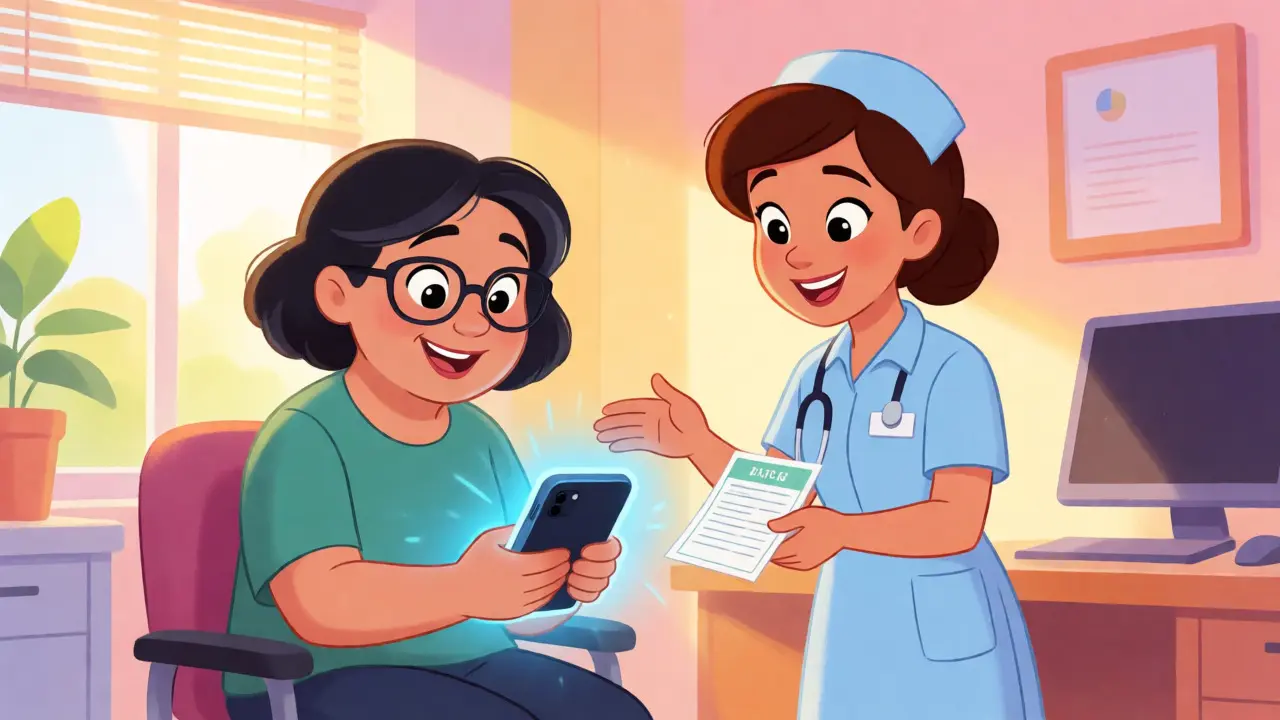
Imagine sitting in a doctor's office, trying to understand your new medication schedule, but the only information provided is a small print pamphlet you can't read. For millions of people with visual impairments, this isn't a hypothetical scenario-it's a daily reality that leads to confusion, anxiety, and sometimes dangerous medical errors. The good news? Technology has caught up. Audio resources are transforming how visually impaired patients access critical health information, turning inaccessible paper trails into clear, spoken instructions. This guide breaks down exactly what tools exist, which ones actually work, and how to make sure you're getting the info you need without fighting through barriers.
Why Audio Matters More Than You Think
It’s not just about convenience; it’s about safety. According to data from the National Eye Institute, approximately 7.6 million Americans aged 16 and older experience vision loss that impacts their daily activities. When these individuals rely solely on visual formats for medical advice, the risk skyrockets. Dr. Anne Spaulding, an associate professor at Emory University School of Medicine, highlighted a stark statistic in JAMA Internal Medicine: visually impaired patients experience 2.3 times more medication errors than sighted counterparts when audio alternatives aren't provided. That’s not a minor inconvenience-that’s a significant health disparity.
The legal framework supports this shift. The Americans with Disabilities Act (ADA) and Section 504 of the Rehabilitation Act mandate that healthcare providers offer auxiliary aids, including audio recordings and screen readers. Yet, compliance doesn’t always equal usability. Many facilities provide audio options, but they’re often clunky, outdated, or incompatible with modern smartphones. Understanding the landscape helps you advocate for better care.
Top Apps and Tools for Independent Access
You don’t have to wait for a nurse to read your chart aloud anymore. Several powerful apps put control back in your hands. Here’s what stands out in 2026:
| Tool Name | Primary Function | Cost | Best For |
|---|---|---|---|
| BARD Mobile | Access to NLS library (books, magazines) | Free (with certification) | General health literacy & long-form reading |
| Voice Dream Reader | Reads text from PDFs, websites, files | $29.99 one-time | Custom documents & lab results |
| KNFBReader | OCR scanning & text-to-speech | $99.00 one-time | Converting printed handouts instantly |
| RightHear | Location-based audio signage | Institutional license | Hospital navigation & wayfinding |
BARD Mobile, developed by the National Library Service for the Blind and Physically Handicapped, remains a gold standard for free content. It offers nearly 50,000 titles, including many health-related books. While it requires a certification process proving visual impairment, the payoff is substantial: no subscription fees and high-quality human narration. However, its interface can feel dated compared to consumer apps like Audible.
For immediate needs, Voice Dream Reader is a powerhouse. Priced at $29.99 as of early 2024, it excels at reading complex PDFs-think insurance forms or discharge summaries. With support for over 100 voices and 30 languages, it allows users to customize speed and pitch, making dense medical jargon easier to digest. Users report it handles scanned images surprisingly well, though lighting conditions still matter.
If you frequently receive paper handouts, KNFBReader is worth the investment. At $99, it uses advanced OCR (Optical Character Recognition) to convert printed text to speech with 98.7% accuracy. In testing, it processes documents in under three seconds on compatible iOS devices. This speed is crucial when you’re standing at a pharmacy counter needing quick verification of dosage instructions.
Navigating Physical Spaces with Audio Tech
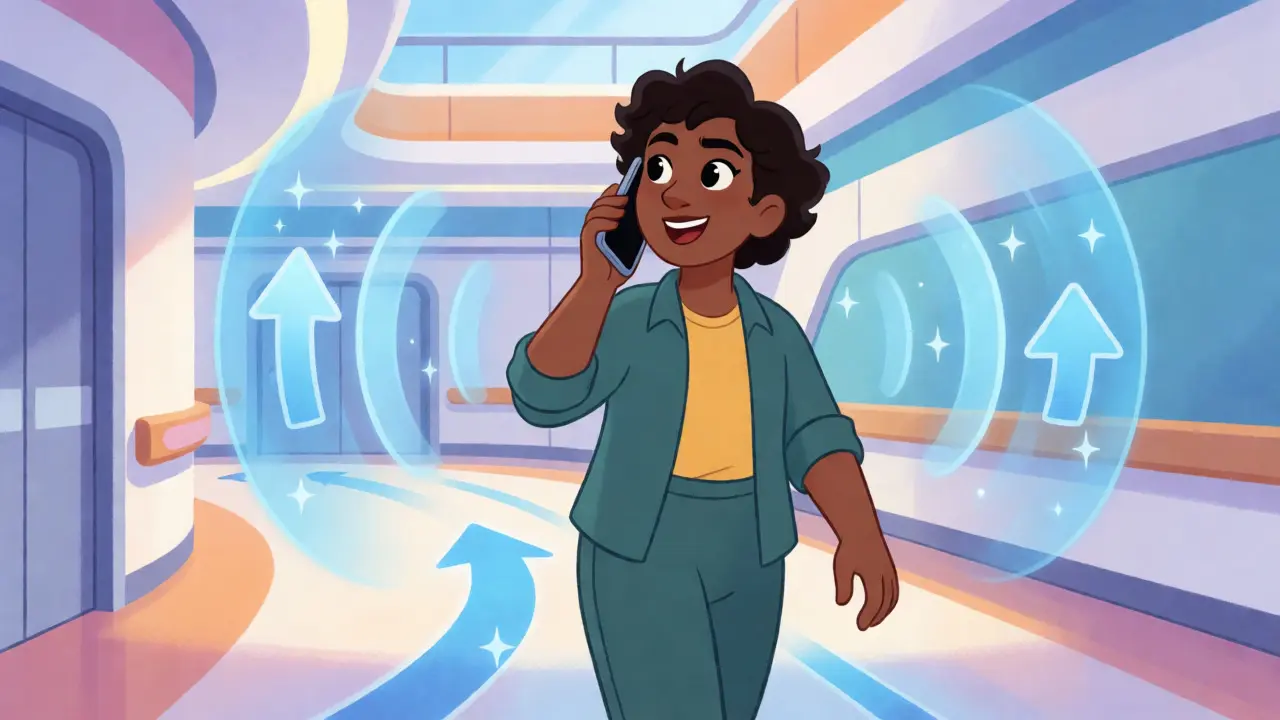
Understanding your diagnosis is half the battle; finding the right room is the other half. Traditional signs are useless if you can’t see them. Enter location-aware audio systems. RightHear launched its U.S. expansion in 2022 and has since become a favorite in large hospitals. By using Bluetooth beacons and smartphone GPS, it delivers specific audio cues based on where you stand. No internet connection required during use.
Hospitals implementing RightHear reported a 47% drop in navigation assistance requests from visually impaired patients. That’s a massive win for both patient independence and staff efficiency. Unlike generic map apps, RightHear understands building layouts. It knows the difference between "Radiology" and "Cardiology" wings, guiding you turn-by-turn with 3-meter accuracy.
While Google Maps introduced an Accessibility Mode in 2021, user testing showed it took 22% longer to navigate complex healthcare environments compared to venue-specific systems. Why? Because general maps lack indoor precision. If you’re dealing with multi-level clinics or sprawling campuses, specialized hospital apps or beacon-based systems are far superior.
The Human Element: Staff Training and Consistency
Tech alone doesn’t solve everything. A major pain point identified in surveys is inconsistent implementation. A February 2024 survey by the National Federation of the Blind found that 63% of visually impaired patients faced inconsistent availability of audio materials across different providers. Worse, 58% reported that healthcare staff were unfamiliar with the available resources.
This gap creates friction. You might arrive prepared with Voice Dream Reader ready to scan your intake form, only to find the receptionist insists on handing you a tiny printed sheet. Effective communication requires training. The CMS Office of Minority Health recommends allocating 8-12 weeks for comprehensive communication access plan development, including staff training. Facilities that follow this protocol see 28% higher patient satisfaction scores among visually impaired patients.
Ask questions. Before your appointment, call ahead and ask: "Do you have electronic copies of my records I can access via email?" or "Is there a screen-reader-friendly portal for test results?" Pushing for digital-first workflows benefits everyone, but especially those relying on audio output.

Overcoming Common Barriers
Despite progress, hurdles remain. One significant issue is digital literacy. Only 43% of older adults with vision loss feel comfortable using smartphone-based audio solutions, according to National Eye Institute data. For these users, simpler interfaces or staff-assisted services are vital.
Another challenge is content quality. A 2023 American Foundation for the Blind study found that 17% of audio files failed basic screen reader compatibility tests. Garbled audio or poorly structured HTML on patient portals can render otherwise useful info useless. If you encounter a website that doesn’t play nice with your screen reader, report it. Feedback drives improvement.
Funding is also a concern. Only 62% of surveyed hospitals have dedicated budgets for audio accessibility beyond minimum ADA compliance. This means some smaller clinics may lag behind. Knowing your rights helps. Under the Affordable Care Act and recent CMS rules effective January 2023, Medicare covers audio description services for beneficiaries with certified visual disabilities. Don’t hesitate to request these services explicitly.
Looking Ahead: AI and Personalization
The future of accessible healthcare info is promising. We’re seeing the rise of AI-powered personalized audio summaries. Mayo Clinic, for instance, piloted a system in late 2024 that generates concise audio briefings of medical records, tailored to the patient’s reading level and preferences. Instead of listening to a full hour-long record dump, you get a five-minute summary highlighting key changes and action items.
Additionally, the 21st Century Cures Act mandated that all electronic health record systems include audio output capabilities by December 2024. This regulatory push ensures that basic audio functionality becomes standard, not an add-on. As we move further into 2026, expect more integration between wearables and hospital systems, allowing real-time audio updates on vitals or appointment reminders directly to your earbuds.
Are audio resources covered by insurance?
Generally, yes, if deemed medically necessary. Since January 2023, CMS Rule 42 CFR §410.152 covers audio description services for Medicare beneficiaries with certified visual disabilities. Private insurers vary, so check your policy for "auxiliary aids" or "communication access" clauses.
What is BARD Mobile and who qualifies?
BARD Mobile is an app from the National Library Service for the Blind and Physically Handicapped offering free audio books and magazines. To qualify, you must certify visual impairment through a professional authority (doctor, optometrist, etc.). The application process typically takes 14-21 business days.
Can I use my own phone for hospital navigation?
Yes, if the facility uses beacon technology like RightHear. These systems work via Bluetooth and GPS on standard smartphones. However, not all hospitals have installed these systems yet. Check with the hospital's accessibility coordinator before your visit to confirm compatibility.
Which app is best for reading lab results?
Voice Dream Reader is highly recommended for this task. It handles PDFs and formatted text well, allowing you to adjust reading speed and highlight key terms. KNFBReader is also excellent if your results come as scanned images rather than native digital files.
What should I do if staff refuses to provide audio info?
Politely cite the ADA requirement for effective communication. Ask to speak with the patient advocate or accessibility officer. Document the interaction. If persistent issues occur, file a complaint with the Office for Civil Rights (OCR), which enforces nondiscrimination laws in healthcare.
Nathan Rock
September 4, 2026 AT 17:04It is profoundly moving to witness the tangible evolution of healthcare accessibility, as this post illuminates not merely a technological shift but a fundamental reimagining of patient autonomy and dignity in an increasingly digital world. The statistic regarding medication errors serves as a stark reminder that convenience is often conflated with safety, yet for those navigating the labyrinthine corridors of modern medicine without visual cues, every misread label represents a potential crisis rather than a minor inconvenience. We must recognize that true inclusivity requires more than just compliance with legal frameworks like the ADA; it demands a holistic integration of empathy into the very architecture of our medical institutions, ensuring that information flows seamlessly to all minds regardless of sensory input. The emphasis on AI-driven personalization suggests a future where healthcare becomes not just accessible but intuitively tailored to individual cognitive preferences, thereby reducing the cognitive load on patients who are already burdened by their conditions. Furthermore, the discussion around staff training highlights a critical human element that technology alone cannot replace, reminding us that systems are only as effective as the people who operate them. It is essential that we continue to advocate for these advancements, pushing beyond minimum standards toward a paradigm where accessibility is considered a primary design principle rather than an afterthought. This journey towards equitable healthcare is ongoing, requiring persistent collaboration between technologists, policymakers, and most importantly, the patients themselves who live these realities daily. Let us embrace these tools not just as gadgets, but as bridges connecting isolated individuals to the broader community of care they deserve.
Sophia Calimbahin
September 4, 2026 AT 20:20This is exactly what I've been screaming about for years!! Hospitals treat blind people like an inconvenience instead of customers paying good American tax dollars or insurance premiums. If a doctor can't take five seconds to read a label out loud because they're too busy looking at their iPad, they shouldn't be practicing medicine. Stop hiding behind "compliance" when your actual service sucks. Fix the damn system.
Ankur Saini
September 6, 2026 AT 00:42the part about inconsistent staff training really hit home for me
i had a similar experience last month where the receptionist tried to hand me a paper form and looked confused when i asked for a digital copy
it feels so isolating when you have the tech ready but the human side fails you
Elizabeth Lucero
September 6, 2026 AT 18:38While the article praises Voice Dream Reader, anyone with basic technical literacy knows it's bloated software compared to native iOS/Android TTS engines which are free and integrated directly into the OS. Paying $29.99 for a feature that costs $0 is poor financial planning. Also, KNFBReader is overpriced garbage; ABBYY FineReader has been doing OCR better for a decade. The author clearly hasn't tested these apps rigorously against modern competitors.
Will Ryan
September 7, 2026 AT 23:45The ontology of health is fractured by sight.
We construct reality through visual data, excluding the auditory truth.
Access is not a tool, it is existential validation.
To hear is to exist in the clinical gaze.
Ste Gomez
September 8, 2026 AT 07:55The assertion that RightHear reduces navigation requests by 47% is impressive, but one must consider the selection bias inherent in such institutional reports. Facilities that implement beacon technology likely already possess higher baseline resources and staff competency. Without a control group from non-implemented facilities with similar socioeconomic demographics, this statistic remains anecdotal evidence rather than empirical proof of universal efficacy.
Aliyu Summaiyya
September 9, 2026 AT 05:34honestly this whole thing is a waste of time if the hospitals dont actually maintain the servers
ive seen righthear go down for weeks cause no one paid the license fee
tech doesnt work without admin support its just broken promises
James Clarke
September 9, 2026 AT 18:17I think everyone here is making valid points!!!
It’s wonderful to see such passion for improving healthcare!!!
We should all try to be more understanding of the different perspectives!!!
Maybe if we listen to each other, we can find a middle ground!!!
Let’s keep the conversation positive and constructive!!!
Katie Evans
September 9, 2026 AT 21:16We are trapped in a visual hegemony that dictates value.
To ignore the audio path is to deny the soul of the patient.
Information is power, and silence is oppression.
Michelle Wright
September 10, 2026 AT 07:54stop blaming the users for lack of access
its lazy management
fix it now
Daniel Beckett
September 10, 2026 AT 23:07I truly believe that every single person deserves to feel confident and safe when they are receiving medical care, and seeing these resources highlighted gives me great hope for the future of our healthcare system. It is heartwarming to know that there are dedicated professionals working hard to bridge the gap between complex medical information and those who need it most, ensuring that no one feels left behind or overwhelmed by paperwork they cannot read. When we provide clear, audible instructions, we empower patients to take charge of their own health journeys, fostering a sense of independence that is crucial for overall well-being and mental peace during stressful times. I encourage everyone reading this to share these tips with friends or family members who might benefit from them, as spreading awareness is the first step toward creating a more inclusive environment for all. Let us remain optimistic and supportive of these necessary changes, knowing that small improvements in communication can lead to significant enhancements in quality of life for many individuals. Together, we can build a healthcare landscape that welcomes everyone with open arms and clear voices.
Deepak Sharma
September 11, 2026 AT 13:41Love this energy!
KNFBReader is a game changer for sure.
Keep pushing for better access!
Paige! :) Bremer
September 11, 2026 AT 14:20It makes me so happy to see that there are so many options available now for people who struggle with reading printed materials because it really does make such a huge difference in how comfortable and informed you feel when you are visiting the doctor or picking up prescriptions. I remember feeling so anxious before my last appointment because I wasn't sure if I would understand the discharge papers, but having an app that reads everything out loud helped me calm down so much. It is wonderful that technology is advancing in ways that help real people in their everyday lives, and I hope that more hospitals start using these kinds of systems soon so that everyone can have a stress-free experience. Thank you for sharing this guide, it is very helpful for anyone who might be new to these tools or looking for recommendations.