
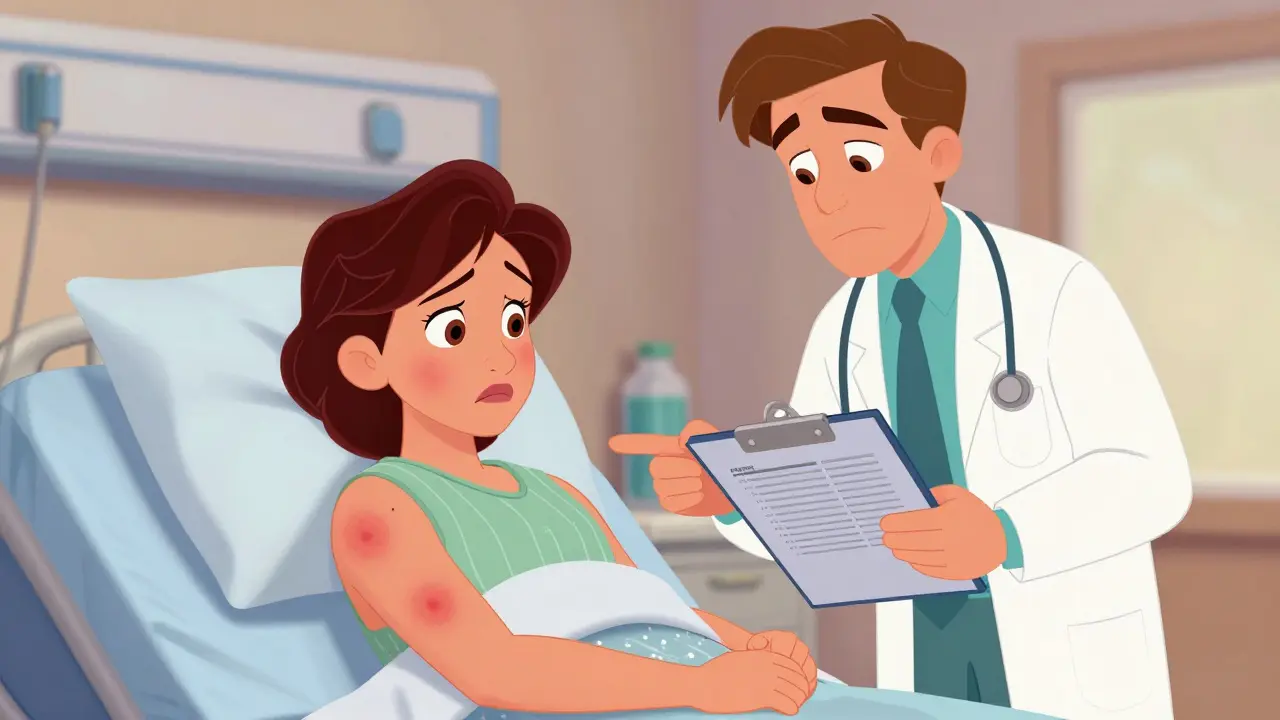
Imagine starting a new medication for gout or seizures. Two weeks later, you feel fine. But by week six, your skin breaks out in a rash, you run a high fever, and your liver enzymes spike dangerously high. This isn't just an allergy; it is DRESS syndrome, or Drug Reaction with Eosinophilia and Systemic Symptoms. It is a rare but life-threatening condition that turns a routine prescription into a medical emergency.
DRESS is classified as a Severe Cutaneous Adverse Reaction (SCAR). Unlike common rashes that fade after stopping the drug, DRESS involves multiple organs. The mortality rate sits at approximately 10%, primarily due to liver failure. Recognizing the signs early-specifically the combination of fever, rash, and blood abnormalities-can be the difference between full recovery and long-term organ damage.
What Exactly Is DRESS Syndrome?
DRESS stands for Drug Reaction with Eosinophilia and Systemic Symptoms. You might also see it referred to as Drug Rash with Eosinophilia and Systemic Symptoms or Drug-Induced Hypersensitivity Syndrome (DIHS). It was first recognized in the 1930s, but the term became formalized in the 1980s as doctors realized it was a distinct entity from other drug reactions.
The core of the problem is an immune system overreaction. Your body treats a harmless medication as a dangerous invader. This triggers a cascade involving CD4+ T cells and eosinophils (a type of white blood cell). These cells release inflammatory chemicals like Interleukin-5 and Interleukin-13, which attack not just your skin, but your liver, kidneys, lungs, and heart.
It is crucial to understand that DRESS is idiosyncratic. This means it cannot be predicted by standard dose-response relationships. A person can take a drug safely for years, or only once, and still develop DRESS. Genetic factors play a significant role, particularly with specific HLA alleles like HLA-B*58:01 in Asian populations taking allopurinol.
The Classic Triad: Signs You Cannot Ignore
Diagnosing DRESS relies on identifying a specific cluster of symptoms. Doctors look for a "triad" of issues that appear together. If you are taking a high-risk medication and notice these signs, seek immediate medical attention.
- Fever: Most patients experience a temperature above 38°C (100.4°F). This often starts before the rash appears, mimicking the flu.
- Skin Rash: In 75-90% of cases, the rash is morbilliform, meaning it looks like measles. It spreads across the body, often starting on the face and neck. It can become swollen, red, and painful.
- Hematologic Abnormalities: Blood tests reveal elevated eosinophils (>700 cells/μL) in 95% of cases. Atypical lymphocytes are also present in 85% of patients.
Beyond this triad, systemic involvement is common. Liver damage occurs in 70-90% of cases, with ALT levels sometimes exceeding 1,000 U/L. Kidney involvement affects 10-30% of patients, leading to rising creatinine levels. Less commonly, lungs and the heart may be affected.
Latency Period: Why Timing Matters
One of the biggest challenges in diagnosing DRESS is the delay. Common allergic reactions happen within minutes or hours. DRESS takes time to build up.
The latency period-the time between starting the drug and the onset of symptoms-is typically 2 to 8 weeks. Some cases appear as early as one week, while others don't show up until 16 weeks later. This long window often leads doctors to blame viral infections instead of the medication. For example, if you start carbamazepine for epilepsy and get a fever three weeks later, it is easy to assume you caught a cold. In reality, it could be the beginning of DRESS.
Allopurinol, a common drug for gout, has a particularly long median incubation time of 36 days compared to 22 days for other drugs. This extended timeline makes early detection even harder.

Culprit Drugs: Who Is Responsible?
Not all medications carry the same risk. Certain drugs are responsible for the majority of DRESS cases. Knowing these helps in maintaining vigilance.
| Drug Class | Specific Medications | Percentage of Cases | Risk Factors |
|---|---|---|---|
| Xanthine Oxidase Inhibitors | Allopurinol | 40-50% | Renal impairment, HLA-B*58:01 allele |
| Antiepileptics | Carbamazepine, Phenytoin, Lamotrigine | 20-30% | Rapid dose escalation |
| Antibiotics | Sulfonamides (e.g., Trimethoprim-sulfamethoxazole) | 10-15% | Prior sulfa allergy |
| Others | Minocycline, Vancomycin, Alendronate | <5% | Varying by individual |
Allopurinol is the single biggest contributor. Patients with chronic kidney disease (stage 3+) are at significantly higher risk. The incidence rises to 1 in 200 among allopurinol users with an eGFR below 60 mL/min/1.73m². Regulatory bodies now recommend genetic screening for HLA-B*58:01 before starting allopurinol in high-risk populations, a move that reduced DRESS incidence by 75% in Taiwan.
DRESS vs. SJS/TEN: Spotting the Difference
DRESS is often confused with Stevens-Johnson Syndrome (SJS) and Toxic Epidermal Necrolysis (TEN). All three are SCARs, but they behave differently. Misdiagnosis can lead to inappropriate treatment.
SJS and TEN are characterized by blistering and peeling of the skin. They have a shorter latency period (1-4 weeks) and involve mucous membranes (mouth, eyes, genitals) in over 90% of cases. The mortality rate for TEN is much higher, at 30-40%, due to massive skin loss and fluid imbalance.
DRESS, on the other hand, rarely causes significant skin detachment. Mucosal involvement occurs in only 30-50% of cases. Instead, DRESS attacks internal organs more aggressively than SJS. The immunological mechanism differs too: SJS/TEN involve cytotoxic CD8+ T cells killing skin cells directly, while DRESS involves CD4+ T cells and eosinophils causing systemic inflammation.
If you see blisters and peeling skin, think SJS/TEN. If you see a widespread red rash, swelling, fever, and lab evidence of liver or kidney stress, think DRESS.

Diagnosis Criteria: RegiSCAR Guidelines
To ensure consistent diagnosis, experts use the RegiSCAR criteria. This validation study, published in the Journal of Investigative Dermatology, provides a scoring system. A patient must be hospitalized and meet at least three of the following:
- Acute skin rash
- Fever greater than 38°C
- Lymphadenopathy (swollen lymph nodes)
- Hospitalization for 15 or more days
- Eosinophilia >1,500/μL or >10% of total WBC
- Atypical lymphocytes in blood smear
- Involvement of three or more internal organs
Doctors also check for HHV-6 reactivation. Human herpesvirus 6 becomes active in 60-70% of DRESS cases between 2-4 weeks after symptom onset. While it is unclear if HHV-6 causes DRESS or is just triggered by the immune chaos, its presence supports the diagnosis and may contribute to severity.
Treatment Protocol: Stop, Steroids, Support
Time is tissue. The most critical step in managing DRESS is stopping the offending drug immediately. Discontinuation within 24 hours of recognition reduces mortality from 15% to 5%. Delayed withdrawal worsens outcomes significantly.
Once the drug is stopped, hospitalization is almost always required. Patients stay in intensive care or specialized dermatology units for an average of 14-21 days. The cornerstone of treatment is systemic corticosteroids. Prednisone (0.5-1 mg/kg/day) or methylprednisolone is used for 4-8 weeks, followed by a very slow taper. Stopping steroids too quickly can cause the symptoms to rebound.
Supportive care is vital. Because the immune system is suppressed and skin barrier is compromised, infection risk is high. Bacteremia and fungemia occur in 10% of cases. Strict hygiene and monitoring for pathogens like Escherichia coli and Candida albicans are essential.
Newer treatments are emerging. Anakinra, an IL-1 receptor antagonist, combined with steroids, has been shown to reduce hospital stays from 18.5 to 11.2 days in severe cases. Tocilizumab is currently being studied for steroid-refractory cases. However, steroids remain the standard of care.
Long-Term Outlook and Prevention
Surviving the acute phase is only half the battle. About 20-30% of patients suffer persistent organ damage, particularly renal impairment. One survey found that 27% of survivors required ongoing nephrology follow-up. Autoimmune sequelae, such as Graves' disease or thyroiditis, can develop months after the initial reaction.
Prevention focuses on risk assessment. For allopurinol, checking kidney function and performing HLA-B*58:01 testing in high-risk groups is key. The American College of Rheumatology now recommends febuxostat as a first-line alternative for patients with reduced kidney function to avoid allopurinol entirely.
Patients who have had DRESS must never take the culprit drug again. Cross-reactivity is possible, so avoiding related chemical structures is wise. Carrying a medical alert card specifying the DRESS trigger is a simple but life-saving habit.
How long does it take for DRESS syndrome to go away?
The acute phase typically lasts 2-4 weeks after stopping the drug, but full resolution can take months. Hospitalization averages 14-21 days. Skin lesions may persist for weeks, and internal organ inflammation requires careful monitoring. Complete recovery depends on early intervention and the extent of organ damage.
Can DRESS syndrome be fatal?
Yes, DRESS has a mortality rate of approximately 10%. Death usually results from fulminant hepatitis (liver failure), myocarditis (heart inflammation), or severe secondary infections. Early diagnosis and immediate drug discontinuation significantly improve survival rates.
What is the difference between DRESS and SJS?
DRESS has a longer latency period (2-8 weeks vs 1-4 weeks for SJS), less mucosal involvement, and no significant skin detachment. SJS/TEN involve blistering and peeling skin, while DRESS causes widespread red rash and systemic organ inflammation driven by eosinophils and T-cells.
Which drugs are most likely to cause DRESS?
Allopurinol is the most common cause, accounting for 40-50% of cases. Antiepileptic drugs like carbamazepine, phenytoin, and lamotrigine cause 20-30% of cases. Sulfonamide antibiotics account for another 10-15%. Other culprits include minocycline and vancomycin.
Is there a genetic test for DRESS susceptibility?
For allopurinol-induced DRESS, yes. Testing for the HLA-B*58:01 allele is recommended for individuals of Asian descent before starting treatment. This test has high sensitivity (80-90%) for predicting risk. No equivalent widespread genetic tests exist yet for antiepileptic-induced DRESS.
What are the long-term effects of DRESS syndrome?
About 20-30% of survivors experience long-term complications. These include chronic kidney disease, persistent liver enzyme elevations, and autoimmune disorders like thyroiditis or Graves' disease. Regular follow-up with specialists is crucial for monitoring these potential sequelae.