
HIV Medication & Antibiotic Interaction Checker
Risk Level
LowMechanism of Action
Imagine taking your daily HIV medication is a routine part of your life, keeping the virus suppressed and your health stable. Then you catch a cold or a urinary tract infection, and your doctor prescribes an antibiotic. It seems like a simple fix, but for many people living with HIV, this new prescription can quietly disrupt the delicate balance of their treatment. The issue isn't just about side effects; it's about how these two types of drugs fight over the same metabolic pathways in your liver, potentially rendering one or both ineffective.
The core problem lies in the complexity of modern combination antiretroviral therapy (ART) which uses multiple drugs to suppress the HIV virus. While ART has revolutionized HIV care, it also creates a minefield of potential drug-drug interactions (DDIs). Recent data indicates that nearly 68% of HIV patients receive at least one antibiotic annually, making this a frequent clinical reality rather than a rare exception. Understanding these antibiotic interactions is not optional-it’s essential for maintaining viral suppression and preventing resistance.
Why These Interactions Happen: The Role of Liver Enzymes
To understand why an antibiotic might mess with your HIV meds, you have to look at how your body processes drugs. Most antiretrovirals are not water-soluble. They rely on a specific group of liver enzymes called the cytochrome P450 system, particularly the CYP3A4 isoenzyme, to break down and clear from your body. This is where the trouble starts. Many antibiotics also use this same system, or they actively interfere with it.
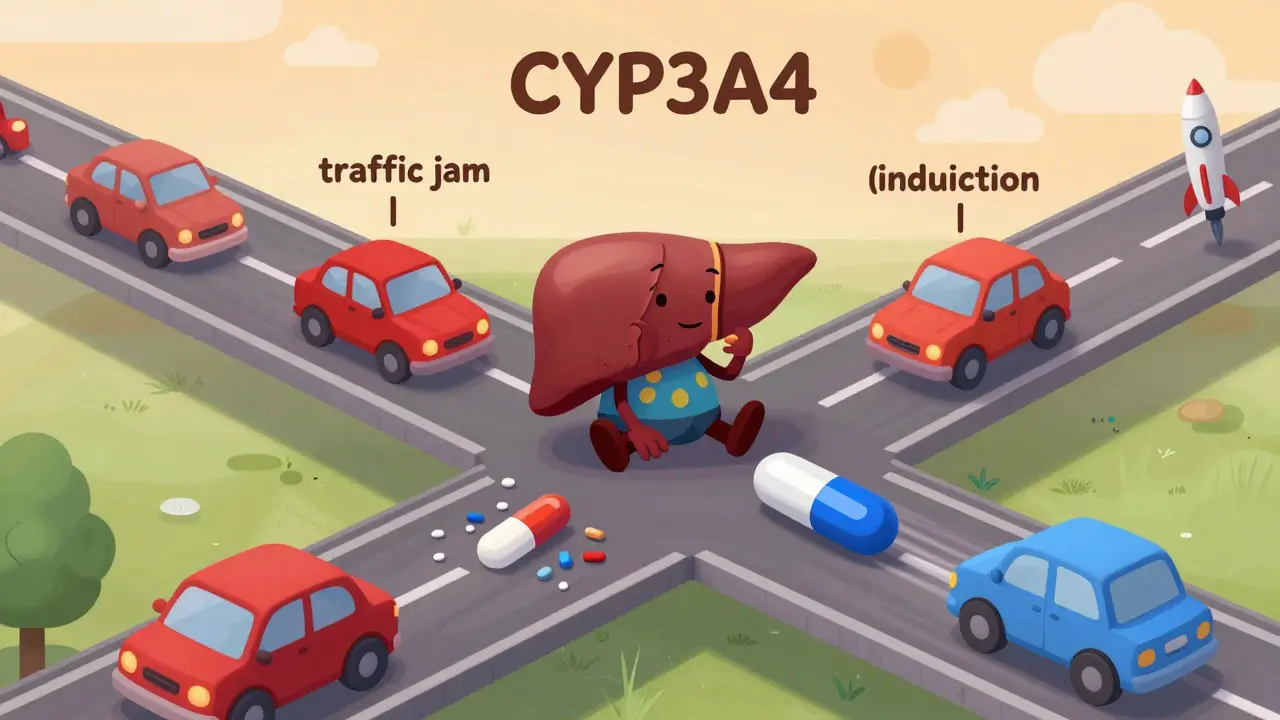
Think of CYP3A4 as a busy highway. If an antibiotic acts as a "traffic jam" (an inhibitor), it slows down the processing of your HIV medication, causing levels in your blood to spike too high. This can lead to increased toxicity. Conversely, if an antibiotic acts as a "turbocharger" (an inducer), it speeds up the processing, causing HIV drug levels to drop too low. When levels drop, the virus can start replicating again, leading to resistance. This bidirectional nature means the interaction can go either way, depending on the specific drugs involved.
| Antiretroviral Class | Metabolism Pathway | Interaction Risk with Antibiotics | Key Examples |
|---|---|---|---|
| Nucleoside Reverse Transcriptase Inhibitors (NRTIs) | Minimal CYP450 involvement | Low | Tenofovir, Emtricitabine |
| Integrase Strand Transfer Inhibitors (INSTIs) | Variable (some minimal, some moderate) | Moderate to Low | Dolutegravir, Bictegravir |
| Protease Inhibitors (PIs) | Extensive CYP3A4 metabolism | High | Darunavir, Atazanavir |
| Non-Nucleoside Reverse Transcriptase Inhibitors (NNRTIs) | Extensive CYP3A4 metabolism | High | Efavirenz, Rilpivirine |
High-Risk Combinations to Watch Out For
Not all combinations are created equal. Some pairings are considered "major" or even "contraindicated" because the risk of harm outweighs the benefit. The most notorious culprits involve potent CYP3A4 inhibitors and inducers.
- Rifampin and Protease Inhibitors: Rifampin, commonly used for tuberculosis, is a powerful enzyme inducer. It can reduce the plasma concentration of boosted protease inhibitors by up to 80%. This dramatic drop often leads to virologic failure. In such cases, doctors usually switch to rifabutin, a less potent inducer, though dose adjustments are still necessary.
- Clarithromycin and Boosted Darunavir: Clarithromycin is metabolized by CYP3A4. When taken with boosted darunavir (which inhibits CYP3A4), clarithromycin levels can increase by 82%. This significantly raises the risk of hearing loss, muscle pain, and other toxicities. Azithromycin is often preferred in these scenarios because it bypasses the CYP450 system entirely.
- Fluoroquinolones and Tenofovir Disoproxil Fumarate (TDF): Research published in Clinical Infectious Diseases showed that combining fluoroquinolone antibiotics with TDF increases the risk of acute kidney injury by 3.2-fold. This additive nephrotoxic effect requires careful monitoring of kidney function, especially in older adults or those with pre-existing renal issues.
It’s worth noting that newer integrase inhibitors like dolutegravir and bictegravir generally have fewer interactions. However, they aren’t immune. For instance, certain cation-containing supplements or antacids can chelate with dolutegravir, reducing its absorption. While not strictly an antibiotic interaction, this highlights the broader principle that timing and compatibility matter.

Practical Strategies for Safe Co-Administration
So, what should you do if you’re prescribed an antibiotic? The first step is communication. Your healthcare provider needs a complete list of everything you take, including over-the-counter meds and herbal supplements. A 2023 guideline from the University of Washington emphasizes that providers should conduct a thorough medication history at every visit to preemptively identify risks.
- Use Reliable Interaction Checkers: Tools like the University of Liverpool’s HIV Drug Interactions database are gold standards. As of late 2023, it catalogs over 400 specific interactions. A validation study found 98% concordance with published pharmacokinetic studies, making it highly reliable for quick checks.
- Consider Timing Separation: For drugs that affect absorption rather than metabolism, separating doses by 2-4 hours can sometimes mitigate the issue. This is common with multivitamins containing zinc or iron and INSTIs.
- Monitor Blood Levels: In complex cases, therapeutic drug monitoring (TDM) may be recommended. This involves measuring the actual concentration of the drug in your blood to ensure it stays within the therapeutic window.
- Watch for Symptoms: Be alert for signs of toxicity (nausea, rash, fatigue) or treatment failure (return of symptoms, rising viral load). Report these to your doctor immediately.
For example, if you are on a cobicistat-boosted regimen and need treatment for a fungal infection, posaconazole is often preferred over voriconazole. Voriconazole requires a significant dose reduction when combined with cobicistat, whereas posaconazole has fewer conflicts. This level of detail underscores why generic advice doesn't always apply-your specific regimen dictates the safe path.

The Impact of Long-Acting Injectables
A newer development in HIV care is the rise of long-acting injectable medications, such as cabotegravir and rilpivirine. These offer the convenience of monthly or bimonthly injections instead of daily pills. However, they introduce a unique challenge: extended half-lives. Cabotegravir, for instance, has a half-life of up to 56 days. This means that even after you stop the injection, the drug remains in your system for months.
This prolonged presence creates a window of vulnerability. If you start an interacting antibiotic shortly after an injection, the interaction may persist long after the antibiotic course is finished. Healthcare providers must account for this tail end of drug exposure when prescribing. Similarly, subcutaneous lenacapavir, approved in late 2022, has minimal CYP450 interactions, offering a safer profile for patients who frequently need antimicrobial therapy. But until the drug is fully cleared, caution remains paramount.
Future Directions and Standardization Efforts
The landscape is evolving. The FDA now requires detailed drug-drug interaction studies for all new antiretroviral approvals, a shift that has resulted in 78% of new ARV approvals between 2019 and 2023 including comprehensive antibiotic interaction data in their labeling. This is a significant improvement over the 42% seen in the previous five years.
Furthermore, the University of Liverpool recently launched version 10.0 of their interaction checker, incorporating machine learning to predict novel interactions based on chemical structure analysis. This technology aims to flag potential issues before they become clinical problems. Meanwhile, the NIH has allocated $15.7 million for a project aimed at creating personalized dosing algorithms using pharmacogenomic data. This could mean that in the near future, your genetic makeup will help determine the safest antibiotic choice, moving beyond one-size-fits-all guidelines.
Despite these advancements, vigilance is key. With 23.7% of hospital admissions for HIV patients involving potentially harmful drug interactions, the stakes are high. By staying informed and working closely with your healthcare team, you can navigate these complexities safely.
Can I take any antibiotic while on HIV medication?
Not necessarily. While many antibiotics are safe, some have significant interactions with specific antiretrovirals. Always consult your doctor or pharmacist before starting a new antibiotic to check for potential conflicts with your current regimen.
What is the safest antibiotic for someone on a protease inhibitor?
Azithromycin is often considered a safer alternative to clarithromycin for respiratory infections in patients on boosted protease inhibitors because it does not rely heavily on CYP3A4 metabolism. However, individual factors vary, so professional guidance is essential.
How do long-acting HIV injections affect antibiotic choices?
Long-acting injections like cabotegravir remain in the body for weeks or months. This means interactions with antibiotics can persist long after the antibiotic course ends. Doctors must consider the residual drug levels when prescribing concurrent therapies.
Where can I check for specific drug interactions?
The University of Liverpool’s HIV Drug Interactions website is a widely respected resource. It provides real-time assessments and is regularly updated with the latest research. Your pharmacist can also access specialized databases to verify compatibility.
Do newer HIV medications have fewer interactions?
Generally, yes. Newer integrase inhibitors like dolutegravir and bictegravir tend to have fewer CYP450-mediated interactions compared to older protease inhibitors and NNRTIs. However, they still require attention to absorption-affecting substances.