

There is a persistent myth in healthcare circles that generic drugs can contain anywhere from 80% to 125% of the active ingredient found in their brand-name counterparts. If you have ever heard someone say, "I don't take generics because they might be 25% weaker or stronger," you are hearing this exact misconception. It sounds plausible on the surface, but it is scientifically inaccurate. The reality of generic drug absorption rates is far more precise, rigorous, and reassuring than this headline-grabbing statistic suggests.
The 80-125% range is not a tolerance for manufacturing error or dosage variance. It is a statistical boundary used to prove that two drugs are bioequivalent. Understanding what this number actually represents requires looking under the hood of pharmacokinetics-the study of how the body absorbs, distributes, metabolizes, and excretes drugs. When we break down the math and the regulatory science behind this rule, the picture becomes clear: approved generics are virtually identical to brand-name drugs in terms of performance.
Defining Bioequivalence: More Than Just Ingredients
To understand why the 80-125% rule exists, we first need to define bioequivalence. In simple terms, bioequivalence means that two different pharmaceutical products (a generic and its reference listed drug) perform the same way in the human body. They do not just contain the same chemical; they deliver that chemical into your bloodstream at the same rate and to the same extent.
The U.S. Food and Drug Administration (FDA) defines bioequivalence as "the absence of a significant difference in the rate and extent to which the active ingredient... becomes available at the site of drug action." This definition, codified in federal regulations (21 CFR § 320.1), focuses on availability, not just content. A pill could contain exactly 100% of the correct ingredient, but if it dissolves too slowly or too quickly, it fails the test. The goal is therapeutic equivalence-ensuring that patient outcomes remain consistent regardless of whether they take the brand or the generic version.
This concept was formalized following the Hatch-Waxman Act of 1984, which streamlined the approval process for generics while maintaining high safety standards. By 1992, the FDA had standardized the 80-125% statistical range through specific guidance documents. This standardization allowed manufacturers to bring affordable alternatives to market without compromising efficacy, creating the robust generic drug ecosystem we rely on today.
The Math Behind the Myth: Why 80-125%?
If you look at the numbers 80 and 125, they seem asymmetrical. You might expect a symmetric range like 90-110% or 80-120%. The reason for the 80-125% spread lies in statistics, specifically in how drug concentration data behaves. Pharmacokinetic data is not normally distributed; it follows a log-normal distribution. To analyze this data accurately, scientists must use logarithmic transformations.
Here is how the math works:
- Log Transformation: Scientists take the natural logarithm of the drug exposure ratios. The natural log of 1.0 (which represents 100% equivalence) is 0.
- Symmetric Bounds: On the log scale, the acceptable deviation is ±0.223. This value corresponds to a 20% difference.
- Back-Conversion: When you convert these log values back to percentages, -0.223 becomes 0.80 (80%), and +0.223 becomes 1.25 (125%).
This creates the asymmetric 80-125% window. It ensures that the comparison is statistically valid for the type of biological data being measured. As explained by Certara scientists in 2018, this method accounts for the variability inherent in human biology. Without this transformation, the statistical tests would be flawed, potentially approving unsafe drugs or rejecting safe ones.
| Concept | Technical Detail | Practical Implication |
|---|---|---|
| Data Distribution | Log-normal | Drug levels in blood vary exponentially, not linearly. |
| Statistical Range | 80-125% | Represents ±20% on a logarithmic scale, ensuring symmetry. |
| Confidence Interval | 90% CI | We must be 90% sure the true mean falls within the range. |
| Active Ingredient | Identical | Generics must contain the exact same dose as the brand. |
How the Test Is Conducted: AUC and Cmax
Bioequivalence is not determined by weighing pills. It is determined through rigorous clinical studies involving healthy volunteers. These studies typically enroll 24 to 36 participants who receive both the generic and the brand-name drug in a randomized crossover design. Blood samples are taken at multiple time points-often 12 to 18 times over 72 hours-to plot a concentration-time curve.
Two primary pharmacokinetic (PK) parameters are evaluated:
- AUC (Area Under the Curve): This measures the total systemic exposure to the drug. It tells us how much of the drug entered the bloodstream overall. If the AUC of the generic is significantly lower than the brand, the patient might not get enough medication to treat their condition.
- Cmax (Maximum Concentration): This measures the peak level of the drug in the blood. It reflects the rate of absorption. If Cmax is too high, there is a risk of side effects due to a sudden spike in drug levels. If it is too low, the drug might not work effectively.
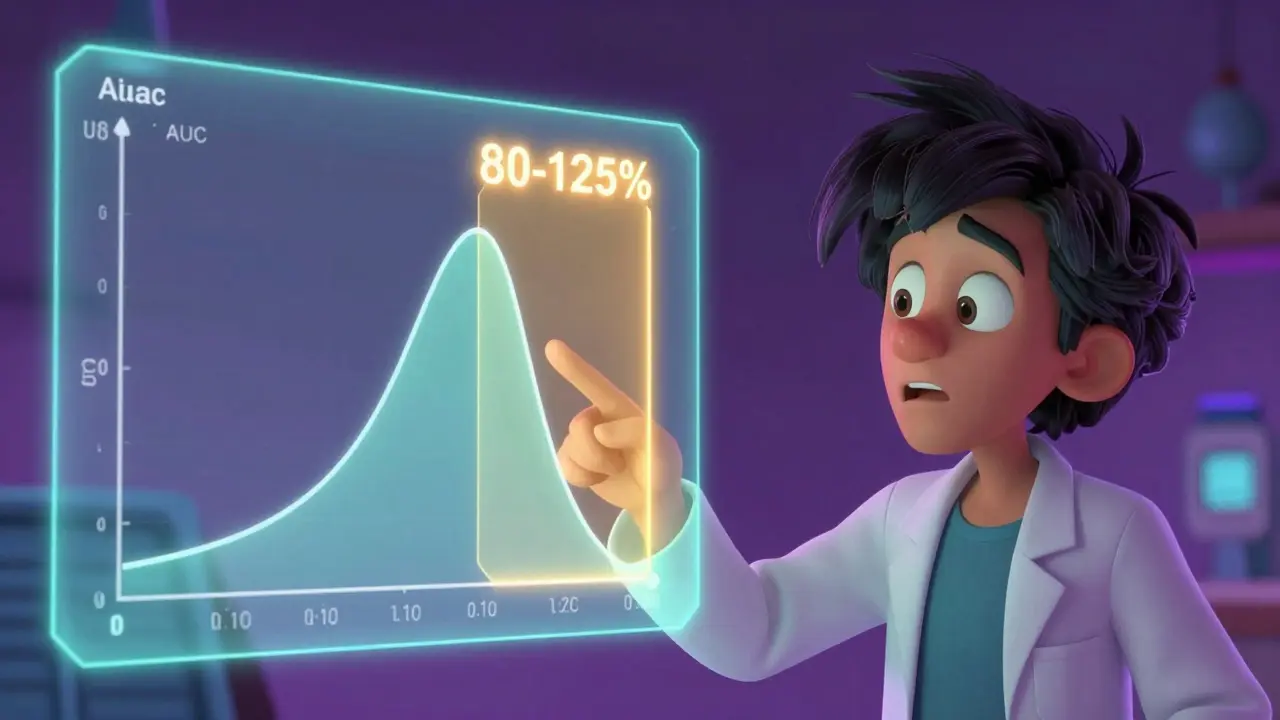
For a generic drug to be approved, the 90% confidence interval (CI) of the ratio between the generic and the reference product for both AUC and Cmax must fall entirely within the 80-125% range. Note the emphasis on the *confidence interval*. It is not enough for the average result to be in the middle; the statistical certainty must exclude any possibility of significant difference outside that window.
Consider an example: If the reference drug has a mean AUC of 100 units, a generic with a mean AUC of 90 units and a standard deviation of 10 might have a 90% CI of 83-97. This passes because the entire interval is inside 80-125. However, if the mean were 85 units with the same variability, the CI might drop to 78-92. This fails because part of the interval dips below 80, indicating uncertainty about whether the drug is strong enough.
Real-World Precision: Generics Are Closer Than You Think
Because the requirement applies to the 90% confidence interval rather than just the point estimate, the actual performance of approved generics is much tighter than the 80-125% window suggests. An analysis by the FDA of 2,070 bioequivalence studies conducted between 2008 and 2012 revealed that 98% of generic drugs had point estimates within 95-105% of the reference product. In many cases, the true mean bioavailability differs by less than 5%.
Dr. Shiew Mei Huang, Deputy Director of the Office of Clinical Pharmacology at the FDA, has explicitly stated that the 80-125% range is frequently misunderstood. She clarifies that it does not mean generics can have 20-25% more or less drug. Instead, the statistical rigor ensures that the true difference is highly likely to be negligible. Dr. Jerry Avorn of Harvard Medical School noted in a 2019 perspective that bioequivalence standards are actually more stringent than many clinicians realize, citing average differences of only 3.5% between brands and generics.
This precision translates directly to patient health. A large-scale study published in JAMA Internal Medicine in 2016 analyzed 2 million patient records and found equivalent clinical outcomes for cardiovascular drugs whether patients received brand or generic versions. Similarly, the FDA’s Sentinel Initiative, which monitors safety across 200 million patient records, showed no significant difference in adverse event rates between brand and generic drugs for 94% of evaluated products between 2015 and 2020.
Exceptions and Complexities: Narrow Therapeutic Index Drugs
While the 80-125% rule works well for the vast majority of medications, regulators recognize that some drugs require stricter controls. These are known as Narrow Therapeutic Index Drugs (NTIDs). NTIDs have a very small margin between the effective dose and the toxic dose. Examples include warfarin (a blood thinner), levothyroxine (for thyroid conditions), and certain anti-seizure medications.
For these critical medications, the FDA has implemented tighter bioequivalence criteria. Instead of the standard 80-125% range, NTIDs often must demonstrate equivalence within a 90-111% range. This narrower window reduces the risk of slight variations affecting patient stability. The 2019 FDA guidance for Warfarin Sodium Oral Dosage Forms outlines these enhanced requirements, reflecting a nuanced approach to regulation that prioritizes safety for high-risk therapies.
Furthermore, complex generic products-such as topical creams, inhalers, or extended-release formulations-pose unique challenges. For these, traditional pharmacokinetic measures (AUC and Cmax) may not fully capture therapeutic equivalence. Experts like Dr. Kenneth Letzig have cautioned that while the 80-125% rule is robust for immediate-release oral solids, more sophisticated approaches are needed for complex delivery systems. The FDA is currently developing model-informed drug development approaches to address these complexities, aiming to refine bioequivalence testing for these specialized products by 2025.

Addressing Patient Concerns and Provider Confusion
Despite the scientific clarity, confusion persists among healthcare providers and patients. Surveys indicate that many pharmacy students and even practicing pharmacists initially misunderstand the 80-125% rule. A 2020 survey by the National Community Pharmacists Association found that 78% of pharmacists explain the bioequivalence rule to patients weekly. Crucially, 63% reported that once properly explained, patient concerns about generic efficacy are alleviated.
The barrier is often communication, not science. Patients hear "80-125%" and assume variability in potency. Providers need to reframe this conversation. Instead of focusing on the statistical bounds, emphasize the outcome: "The generic performs identically to the brand in clinical trials and real-world use." The FDA’s #GenericsWork campaign, which reached over 1.2 million people on social media, successfully highlighted this message, reinforcing that generics save the U.S. healthcare system billions annually without sacrificing quality.
In 2022, the Supreme Court upheld the FDA’s bioequivalence standards in Smith v. Mylan, with Justice Kavanaugh noting that the agency’s scientifically grounded approach has withstood three decades of real-world testing. This legal affirmation underscores the robustness of the current regulatory framework.
Conclusion: Trusting the Science
The 80-125% rule is a statistical tool, not a permission slip for inconsistency. It is a rigorous mathematical boundary designed to account for biological variability while ensuring therapeutic equivalence. When you take a generic drug, you are taking a product that has been proven to deliver the same amount of medicine to your body at the same rate as the brand-name original. The slight asymmetry in the numbers reflects advanced statistical methodology, not a lack of precision. With generics accounting for 90% of U.S. prescriptions and saving hundreds of billions of dollars, understanding this rule helps demystify one of the most cost-effective pillars of modern healthcare.
Does the 80-125% rule mean generic drugs have less active ingredient?
No. Generic drugs must contain the exact same amount of active ingredient as the brand-name drug. The 80-125% rule refers to the rate and extent of absorption into the bloodstream, not the quantity of powder in the pill. Regulatory agencies verify the dosage strength separately to ensure it matches the reference product exactly.
Why is the range 80-125% instead of 90-110%?
The range appears asymmetric because drug absorption data follows a log-normal distribution. Statisticians use logarithmic transformations to analyze this data accurately. On a log scale, the range is symmetric around 100%, representing a ±20% deviation. When converted back to standard percentages, this results in the 80-125% window. This method ensures the statistical test is valid for biological data.
Are generic drugs as effective as brand-name drugs?
Yes. Large-scale studies, including one analyzing 2 million patient records in JAMA Internal Medicine, show equivalent clinical outcomes for brand and generic drugs. The FDA’s analysis indicates that the actual difference in bioavailability between approved generics and brands averages only 3.5%, which is clinically insignificant for most medications.
What are Narrow Therapeutic Index (NTI) drugs?
NTI drugs are medications where a small change in dose can lead to treatment failure or toxicity. Examples include warfarin and levothyroxine. Because the margin for error is so small, the FDA requires tighter bioequivalence standards for these drugs, typically within a 90-111% range, rather than the standard 80-125%.
How is bioequivalence tested?
Bioequivalence is tested using randomized crossover studies with healthy volunteers. Participants take both the generic and brand-name drug, and blood samples are collected over time to measure AUC (total exposure) and Cmax (peak concentration). The 90% confidence interval of the ratio between the two must fall entirely within the 80-125% range for approval.
Do international agencies use the same standard?
Yes. The European Medicines Agency (EMA) and Health Canada use identical 80-125% criteria with 90% confidence intervals for most drugs. This global harmonization ensures that generic drugs approved in one major jurisdiction meet similar safety and efficacy standards worldwide.