

When you swallow a pill, you think about the active ingredient-the part that lowers your blood pressure or clears up an infection. But that active pharmaceutical ingredient (API) is usually just a tiny fraction of what’s inside. The rest? It’s a cocktail of fillers, binders, and colorants known as excipients, which are inactive ingredients used to stabilize, deliver, and shape medications. For decades, regulators and doctors treated these components as truly inert-biologically silent background noise. That assumption is cracking.
New research suggests that many excipients are not as passive as we thought. Some interact with biological targets in ways that could influence how a drug works-or even cause unexpected side effects. If you’ve ever wondered why two identical-looking pills from different manufacturers feel different, or why a generic didn’t work quite like the brand name, the answer might lie in those “inactive” ingredients.
What Are Excipients and Why Do We Use Them?
Excipients make up 60% to 99% of the total mass of most oral solid dosage forms. They aren’t there by accident. Without them, many drugs would be impossible to manufacture, store, or take. Think about it: pure active ingredients can be powders that don’t stick together, liquids that degrade instantly, or substances so bitter they’re undrinkable. Excipients solve these problems.
They serve several critical functions:
- Stability: Preventing the API from breaking down before it reaches your body.
- Delivery: Controlling how fast or slow the drug releases into your system.
- Taste masking: Making unpleasant medicines palatable, especially for children.
- Manufacturing aid: Helping tablets hold their shape during compression and packaging.
The U.S. Food and Drug Administration (FDA) defines excipients as components other than the API that are not intended to exert therapeutic effects at the intended dosage. According to the FDA’s Inactive Ingredient Database (IID), there are approximately 1,500 approved excipients across 20 routes of administration. Each drug product typically contains 5 to 15 different excipients. Common examples include lactose (a filler), microcrystalline cellulose (a binder), croscarmellose sodium (a disintegrant), magnesium stearate (a lubricant), and tartrazine (a coloring agent).
The Myth of Inertness: New Science Challenges Old Assumptions
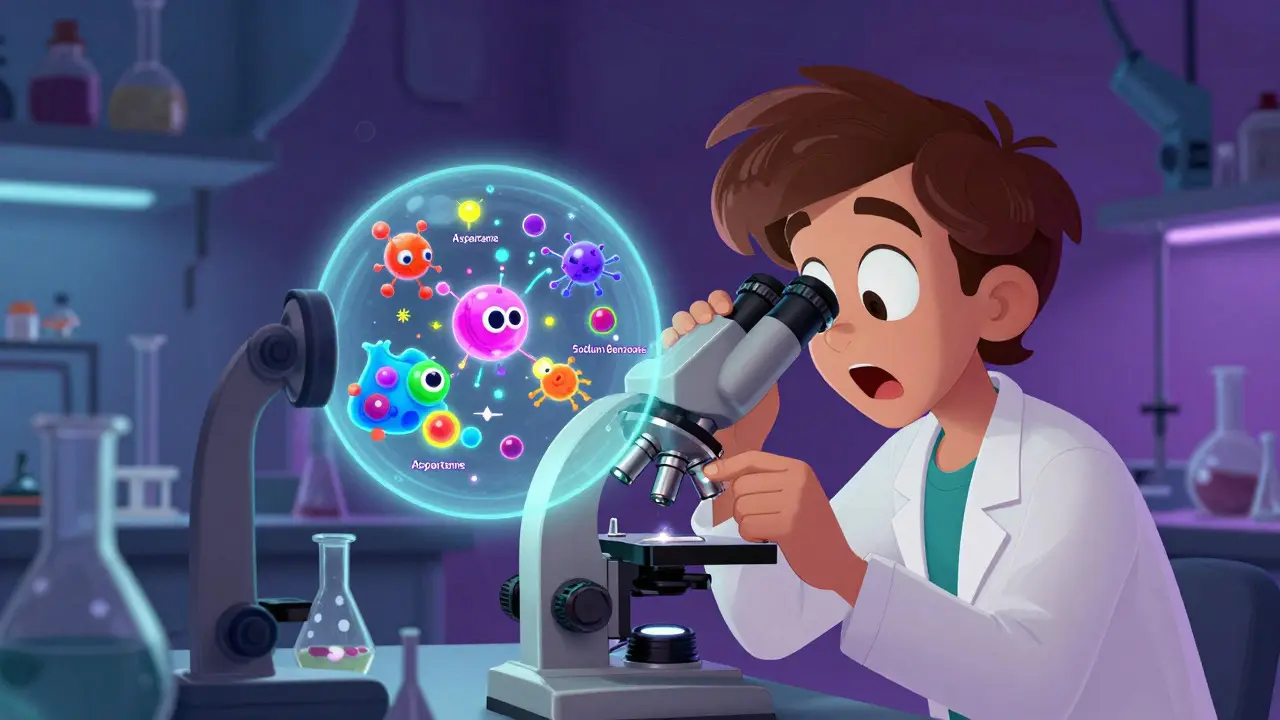
For years, the pharmaceutical industry operated on a simple premise: if it’s not the active ingredient, it doesn’t matter biologically. But a landmark 2020 study published in Science turned that idea on its head. Researchers tested 314 commonly used excipients against 44 human biological targets. The result? 38 excipients showed measurable activity against at least one target.
This isn’t theoretical. Consider these findings:
- Aspartame inhibited the glucagon receptor with an IC50 of 8.5 μM.
- Sodium benzoate blocked monoamine oxidase B (MAO-B) with an IC50 of 320 nM.
- Propylene glycol affected monoamine oxidase A (MAO-A) with an IC50 of 210 nM.
Here’s the kicker: some of these excipients reach concentrations in the body during normal use that overlap with their in vitro activity levels. In other words, they’re present in amounts high enough to potentially trigger biological responses.
Dr. Giovanni Traverso, lead author of the study, put it bluntly: “Our findings suggest that the blanket classification of excipients as ‘inactive’ is scientifically inaccurate for a meaningful subset of these compounds.” This challenges the foundational logic behind generic drug approval, which often assumes that as long as the API is bioequivalent, the rest doesn’t matter.
How Regulators Handle Excipient Differences
Not all drug products are created equal when it comes to excipient rules. The FDA applies stricter standards depending on how the drug enters the body.
| Drug Product Type | Excipient Requirement vs. Reference Listed Drug (RLD) | Rationale |
|---|---|---|
| Parenteral (injectable) | Identical excipients at identical concentrations (Q1 & Q2 sameness) | Direct entry into bloodstream; higher risk of adverse reactions |
| Ophthalmic (eye drops) | Identical excipients at identical concentrations (Q1 & Q2 sameness) | Sensitive tissue; minimal absorption buffer |
| Otic (ear drops) | Identical excipients at identical concentrations (Q1 & Q2 sameness) | Localized effect; potential for systemic absorption |
| Oral solids (tablets, capsules) | Different excipients allowed if safety/efficacy maintained | Gastrointestinal tract provides metabolic barrier; more flexibility |
For oral medications, generic manufacturers can use different excipients as long as they prove the final product is bioequivalent to the brand-name version. Bioequivalence means the drug reaches the bloodstream at similar rates and amounts. The FDA measures this using pharmacokinetic parameters like Cmax (peak concentration) and AUC (total exposure over time).
But here’s where it gets tricky. Bioequivalence tests focus on the API. They don’t always account for how excipients might alter local irritation, immune response, or long-term tolerability. That gap has led to real-world issues.
Real-World Consequences: When Excipients Go Wrong
We’ve seen cases where excipient choices directly impacted patient safety and drug availability. One of the most famous was the 2018 recall of 14 generic valsartan products due to NDMA contamination. NDMA is a probable carcinogen that formed because manufacturers switched to a new solvent system during production-a change tied to excipient and process adjustments.
Another example involves Teva’s 2021 approval of a generic version of Jardiance (empagliflozin). To improve manufacturing efficiency, Teva replaced sodium starch glycolate with croscarmellose sodium as a disintegrant. They backed this switch with robust bioequivalence data showing nearly identical Cmax (374 vs. 368 ng/mL) and AUC (4,215 vs. 4,187 ng·h/mL) values. The FDA approved it because the scientific evidence supported safety and efficacy.
Contrast that with Aurobindo’s 2020 application for a generic Entresto (sacubitril/valsartan). They proposed replacing magnesium stearate with sodium stearyl fumarate. The FDA rejected the application after in vitro testing showed a 15% difference in dissolution rate at pH 6.8. Even though both are lubricants, their physical properties altered how quickly the drug broke down in simulated intestinal fluid. That small change raised concerns about inconsistent dosing.
These cases highlight a key point: excipients aren’t just placeholders. Their chemical and physical properties actively shape how a drug behaves in the body.
Cost, Complexity, and the Future of Excipient Regulation
Demonstrating excipient safety isn’t cheap or easy. Generic drug applicants spend an average of $1.2 million and 18 months developing safety justifications for novel excipients or concentration changes. Most rely on three strategies:
- Prior safe use via the IID: Used in 68% of successful ANDAs (Abbreviated New Drug Applications).
- Toxicological studies: Required for 22% of novel excipients.
- Excipient bridging arguments: Successful in 63% of cases when supported by pharmacokinetic data.
The stakes are rising. The global pharmaceutical excipients market was valued at $7.8 billion in 2022 and is projected to reach $11.3 billion by 2028. Meanwhile, regulatory complexity has surged. Between 2018 and 2023, the FDA issued 14 guidance documents specifically addressing excipient considerations-compared to just 3 in the previous decade.
Why the shift? Because modern drug delivery systems are getting more sophisticated. Extended-release formulations, orally disintegrating tablets, and fixed-dose combinations often require novel excipients to function properly. In fact, 87% of new molecular entities now incorporate at least one novel excipient for enhanced delivery.
Looking ahead, the FDA proposed updating the IID to include predicted tissue concentrations for each excipient. This would help address concerns raised by the Science study, particularly around diethyl phthalate and propylene glycol, which reach biologically active levels in certain tissues. Additionally, a proposed amendment to 21 CFR 314.94 would require in vitro screening for all novel excipients against a panel of 50 high-risk targets-an addition that could increase development costs by $500,000 to $1 million per new excipient.
What Should Patients and Clinicians Know?
If you’re a patient, here’s the bottom line: switching between brands and generics is generally safe, but not always seamless. Most people experience no difference. But if you notice increased side effects, reduced effectiveness, or allergic reactions after switching, talk to your doctor. Keep a log of symptoms and note which manufacturer produced the pill. Pharmacists can often identify specific excipients that may be causing issues-for example, lactose intolerance affecting tablet tolerance, or dyes triggering sensitivities.
Clinicians should stay informed about excipient profiles, especially for patients with multiple comorbidities or sensitivities. While only 0.03% of adverse events reported to the FDA’s Adverse Event Reporting System (FAERS) are definitively linked to excipients, underreporting likely skews this number. Individual variability matters. What’s inert for one person may not be for another.
Pharmaceutical companies face a balancing act. Flexibility in excipient selection speeds up generic development and reduces costs-but it demands rigorous justification. As Dr. Jane Axelrad, former FDA Deputy Director for Generic Drugs, noted in her 2023 JAMA commentary: “The current system works well for most excipients but needs modernization for novel delivery systems.” With complex generic applications up 23% since 2019, that modernization is no longer optional.
Are excipients really inactive?
Not always. Recent studies show that some excipients interact with biological targets at concentrations reached during normal use. While many remain effectively inert, the label “inactive” is a regulatory term, not a biological guarantee.
Can changing excipients affect how well a generic drug works?
Yes, indirectly. Excipients influence dissolution rates, stability, and absorption. If a generic uses different excipients without proper bioequivalence testing, it may release the active ingredient too fast or too slow, altering efficacy.
Why do injectable drugs have stricter excipient rules than pills?
Injectables enter the bloodstream directly, bypassing the digestive system’s filtering mechanisms. This increases the risk of immediate reactions, so regulators require identical excipients to minimize unknown variables.
Should I worry about excipients in my medication?
For most people, no. Approved excipients undergo safety reviews. However, if you have known allergies (e.g., to lactose, dyes, or preservatives) or experience unusual side effects after switching brands, consult your healthcare provider.
How does the FDA ensure excipient safety?
The FDA maintains the Inactive Ingredient Database (IID) with approved excipients and maximum safe concentrations by route. Manufacturers must justify any novel excipients through prior use data, toxicology studies, or bridging arguments supported by pharmacokinetic evidence.