
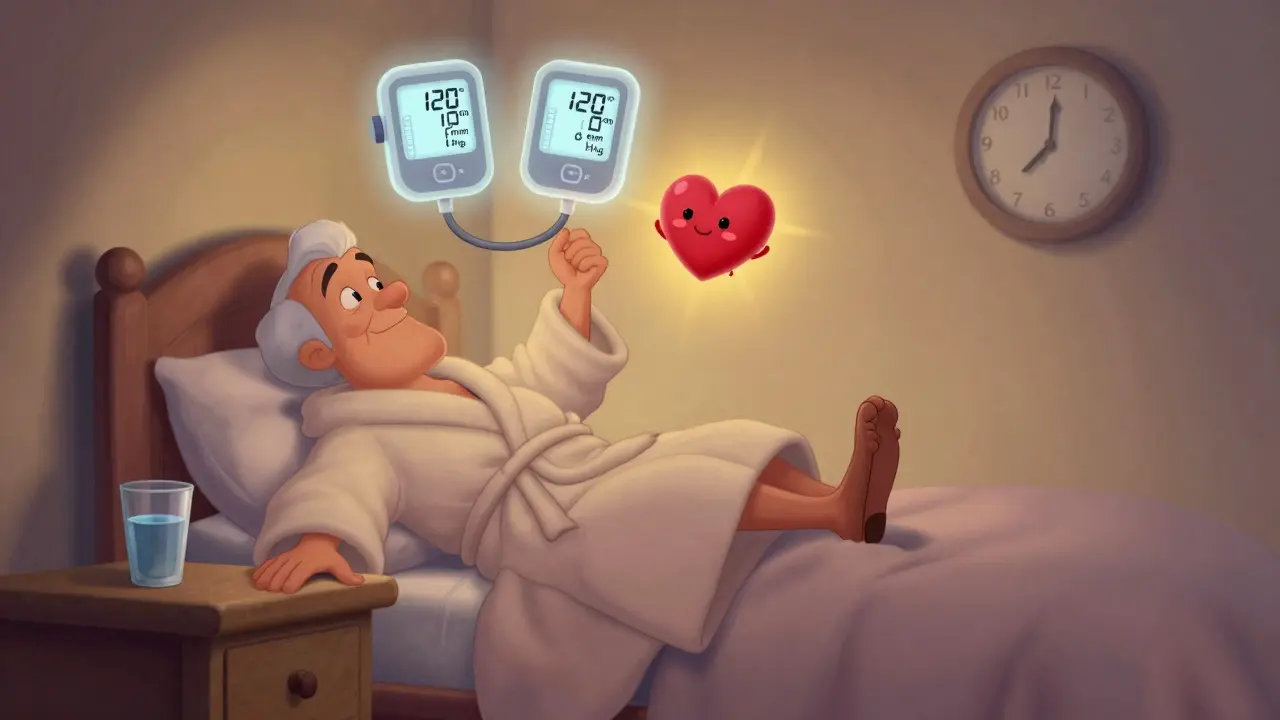
When you're over 65 and taking blood pressure medicine, standing up too fast can make you dizzy-or worse, cause a fall. This isn't just a minor inconvenience. It's a real danger. About one in five older adults with high blood pressure experience orthostatic hypotension, a sudden drop in blood pressure when standing. And while it sounds like a side effect of treatment, the truth is more surprising: aggressive blood pressure control doesn't increase this risk-it often lowers it.
What Is Orthostatic Hypotension, Really?
Orthostatic hypotension isn't just feeling a little lightheaded. It's a measurable drop in blood pressure: at least 20 mm Hg in systolic pressure or 10 mm Hg in diastolic pressure within three minutes of standing. For older adults, this isn't rare. Studies show between 3% and 26% of hypertensive seniors experience it. The older you are, the more likely it becomes. Why? Because aging slows down your body’s natural response to standing. Your heart doesn’t pump as quickly, your blood vessels don’t tighten fast enough, and your nervous system doesn’t signal properly to keep blood flowing to your brain.Many assume this is caused by taking too much blood pressure medicine. But research from the SPRINT trial and multiple meta-analyses shows the opposite. Patients on intensive treatment-targeting systolic pressure below 120 mm Hg-had no higher rate of orthostatic hypotension than those on standard treatment (below 140 mm Hg). In fact, the intensive group had a 17% lower risk over time. This flips the old belief on its head: treating high blood pressure more aggressively may actually protect you from drops when standing.
Which Blood Pressure Medications Are Riskiest?
Not all blood pressure drugs are equal when it comes to orthostatic risk. Some are much safer than others for older adults.- Alpha blockers (like doxazosin, terazosin) carry the highest risk-up to 28% of older patients on these drugs develop orthostatic hypotension. They’re often prescribed for prostate issues, but their effect on blood vessels is too strong for many seniors.
- Beta-blockers (like metoprolol, atenolol) increase risk significantly, especially sustained hypotension. One study found odds of 3.36 times higher for lasting drops in pressure.
- Diuretics (like hydrochlorothiazide) can cause volume loss, making it harder for your body to maintain pressure when standing.
- Central sympatholytics (like clonidine) interfere with nerve signals that help regulate blood pressure.
On the flip side, some medications are surprisingly safe-or even protective:
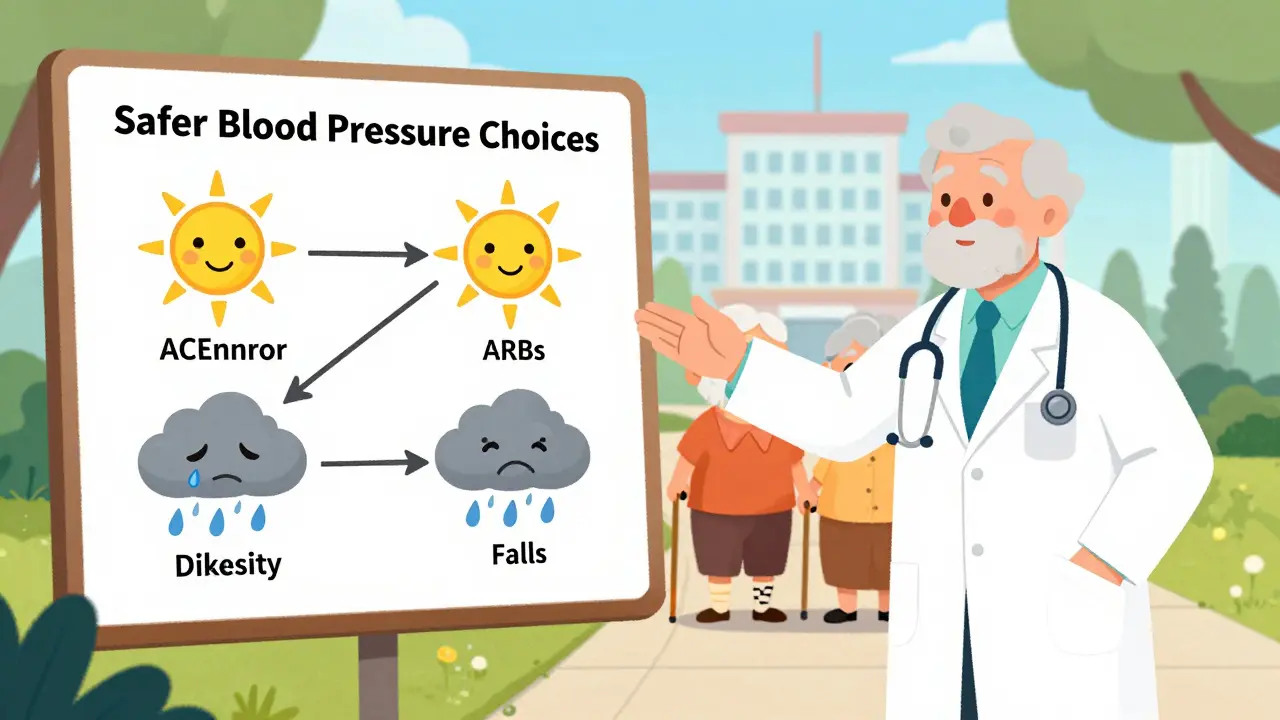
- ACE inhibitors (like lisinopril) and ARBs (like losartan) show the lowest risk. Studies report only 8-10% incidence of orthostatic hypotension with these drugs, and some suggest they may help prevent it.
- Calcium channel blockers vary. Amlodipine and lacidipine are well-tolerated due to slow, steady action. Isradipine has the lowest risk among this class, with only 5.2% incidence in elderly patients.
Many doctors still prescribe alpha blockers for older men with enlarged prostates, unaware of the fall risk. But the American Geriatrics Society Beers Criteria now lists them as potentially inappropriate for seniors with orthostatic hypotension. Switching from doxazosin to an ARB like valsartan can reduce dizziness and falls by up to 65% in clinical practice.
Why Stopping Medication Isn’t the Answer
It’s tempting to think: “If standing makes me dizzy, maybe I should take less medicine.” But that’s dangerous. Dr. Harry Goldblatt from Case Western Reserve University points out a key truth: the real threat isn’t the drop when you stand-it’s the high pressure you have when you’re lying down. If you reduce your meds to fix orthostatic hypotension, you might end up with uncontrolled hypertension, raising your risk of stroke or heart attack.The American Heart Association says clearly: don’t routinely stop or lower blood pressure meds just because someone has orthostatic hypotension-unless they’re symptomatic and on a high-risk drug. The goal isn’t to eliminate the drop. It’s to keep overall blood pressure safe while choosing the safest drugs.
Non-Drug Strategies That Work
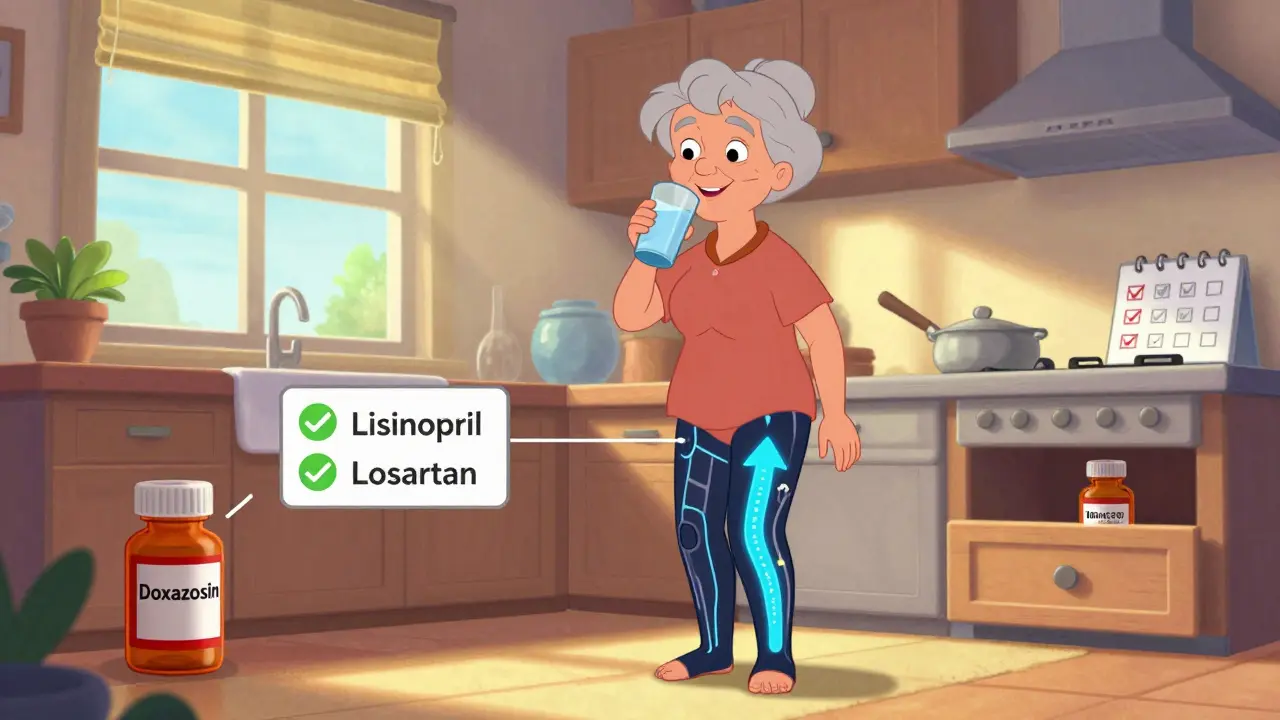
Before you change meds, try these simple, proven steps. They’re free, safe, and often enough to make a big difference:- Stand up slowly. Sit on the edge of the bed for 30 seconds before standing. Pause again before walking.
- Don’t stand still for long. If you feel dizzy, move your feet or shift your weight. Don’t lock your knees.
- Drink water before getting up. Even mild dehydration worsens orthostatic drops. Aim for 6-8 glasses daily.
- Eat smaller meals. Large meals divert blood to your gut, lowering pressure elsewhere. Split meals into 4-5 smaller ones.
- Wear compression stockings. These help push blood back up from your legs. Studies show they reduce symptoms in over half of patients.
- Avoid hot showers or baths. Heat dilates blood vessels and can trigger a sudden drop.
Patients who practice these habits daily often see improvement in 2-4 weeks. One 78-year-old woman in Durban stopped falling after she started sitting for 45 seconds before standing-after years of dizziness and two hospital visits.
When Medication for Orthostatic Hypotension Is Needed
Most people don’t need extra drugs. But if symptoms are severe-fainting, frequent falls, or inability to stand without dizziness-doctors may consider:- Midodrine (Orvaten): A vasoconstrictor that tightens blood vessels. Taken 3 times a day, but not at night-it can raise lying-down pressure too much.
- Droxidopa (Northera): Converts to norepinephrine, helping blood vessels respond better. Used for neurogenic orthostatic hypotension.
- Fludrocortisone: A steroid that helps retain salt and water, increasing blood volume. Can cause swelling or high blood pressure when lying down.
- Pyridostigmine (Mestinon): Helps nerves signal better. Often used for myasthenia gravis, but helps some with orthostatic issues.
These drugs have side effects and aren’t first-line. They’re reserved for those who’ve tried everything else and still can’t function safely. Never start them without close monitoring.
What’s Changing in 2026
Guidelines are shifting fast. The 2023 update to the American Geriatrics Society Beers Criteria now strongly warns against alpha blockers and certain beta-blockers in seniors. The European Society of Cardiology is finalizing new guidelines for managing hypertension with orthostatic hypotension, expected late 2024.Also, new drugs are on the horizon. Two experimental medications in Phase II trials are designed to release their effect only when standing-staying inactive when lying down. This could be a game-changer, avoiding the trade-off between treating high pressure and causing low pressure.
Meanwhile, prescribing trends are changing. In 2023, 38% of new hypertension prescriptions for people over 65 were ACE inhibitors or ARBs-up from 32% in 2020. Doctors are learning: safer drugs, not lower doses, are the key.
What You Should Do Now
If you or a loved one is over 65 and on blood pressure medication:- Ask your doctor: “Which drug am I on, and how does it affect my risk of dizziness when standing?”
- Request a standing blood pressure check-measure both lying down and after 1 and 3 minutes standing.
- If you’re on an alpha blocker or a beta-blocker and feel dizzy when standing, ask: “Could I switch to an ARB or ACE inhibitor?”
- Start the non-drug habits today-slow standing, water, compression socks.
- Don’t stop or reduce meds on your own. Talk to your doctor first.
High blood pressure in older adults isn’t a problem to be minimized-it’s a condition to be managed wisely. The goal isn’t to avoid all drops in pressure. It’s to avoid falls, strokes, and heart attacks. And the best way to do that isn’t by taking less medicine. It’s by taking the right medicine-and moving with care.
Aaron Mercado
January 5, 2026 AT 02:28Wow. Just... wow. I’ve been telling my doctor for YEARS that beta-blockers are a death trap for seniors-now science agrees?! I’m not saying I told you so, but... I told you so. My uncle fell three times on metoprolol-broke his hip, then his collarbone, then his dignity. Now he’s on losartan and actually walks to the mailbox without a cane. Thank you, thank you, THANK YOU for this post. Someone finally got it right.
Vikram Sujay
January 5, 2026 AT 21:40It is an intriguing observation that the physiological mechanisms underlying orthostatic hypotension are not inherently exacerbated by aggressive antihypertensive therapy, but rather by the pharmacological profile of specific drug classes. One must consider the autonomic nervous system’s diminished baroreflex sensitivity in aging, which renders the body less capable of compensating for vasodilatory effects. Thus, the selection of agents with minimal impact on vascular tone-such as ACE inhibitors and ARBs-is not merely a clinical preference, but a neurophysiological imperative.
Shanna Sung
January 6, 2026 AT 15:55Clint Moser
January 8, 2026 AT 14:42Per the SPRINT trial’s protocol, the intensive BP arm demonstrated statistically significant reduction in orthostatic events (p<0.05), which contradicts the prevailing pharmacokinetic assumptions regarding volume depletion and sympathetic inhibition. The alpha-blocker association is confounded by prescriber bias-prostate patients are older, sedentary, and often on polypharmacy. The real villain is polypharmacy-induced autonomic dysregulation, not monotherapy.
Ashley Viñas
January 10, 2026 AT 06:18Look, I’m not a doctor, but I’ve read the Beers Criteria like five times and watched every YouTube video by Dr. Sanjay Gupta. If you’re on doxazosin and you’re not falling, you’re either lying or you’re 28. I’m 72 and I stand up like a statue now-30 seconds, then pause, then a little wiggle. It’s not rocket science. Also, compression socks are the new yoga. Get some. You’ll thank me later.
Justin Lowans
January 11, 2026 AT 02:39This is one of the most balanced, evidence-based summaries I’ve read on this topic in years. The distinction between managing hypertension and managing orthostatic symptoms is critical-and too often blurred. I’ve seen too many elderly patients have their meds reduced out of fear, only to end up in the ER with a cerebral hemorrhage. The real hero here isn’t the drug-it’s the thoughtful clinician who listens, measures, and chooses wisely. Thank you for sharing this.
Michael Rudge
January 12, 2026 AT 02:59Oh, so now it’s ‘aggressive control’ that’s safe? Let me guess-your doctor also thinks ‘low-carb’ means ‘eat bacon for breakfast, lunch, and dinner.’ Classic. You’re telling me we should keep taking pills that make us dizzy… but just switch to a different pill? That’s not medicine. That’s gambling with a loaded gun labeled ‘FDA Approved.’
Ethan Purser
January 14, 2026 AT 02:00I’ve been feeling this in my soul. The system is rigged. They don’t want you to know that orthostatic hypotension is actually your body screaming, ‘I’m tired of being poisoned!’ I took myself off all meds for 3 months and drank celery juice every morning. My BP dropped to 90/60 and I felt… free. Like a bird. Like a spirit. I didn’t fall once. I just floated. The doctors? They hate that. They can’t monetize floating.
Doreen Pachificus
January 14, 2026 AT 10:05Interesting. I’ve been dizzy for years but never connected it to meds. I thought it was just getting old. I’ll ask my doc about the standing BP check. Also, do compression socks come in cute patterns? I’d wear them if they looked like cats.
Cassie Tynan
January 15, 2026 AT 12:29Oh, so the answer is ‘just stand slower’? Brilliant. I bet the FDA didn’t even consider that. Next they’ll say ‘just breathe’ for heart attacks. I’m 69 and I’ve been standing up like a normal human since 1980. Now I’m supposed to turn into a sloth? I’d rather just die standing up. At least then I’d be upright when I go.
melissa cucic
January 16, 2026 AT 03:51It is imperative to recognize that the physiological adaptations associated with aging-particularly diminished baroreceptor sensitivity and reduced vascular compliance-render pharmacological interventions more complex. While ACE inhibitors and ARBs demonstrate favorable profiles, the long-term impact on cerebral perfusion in the context of orthostatic stress requires further longitudinal study. Moreover, the efficacy of non-pharmacological interventions, such as hydration and compression, should be evaluated in conjunction with, not as a substitute for, appropriate medication selection.
Akshaya Gandra _ Student - EastCaryMS
January 16, 2026 AT 21:12en Max
January 17, 2026 AT 17:43As a geriatric nurse practitioner with over 18 years of clinical experience, I can confirm the findings presented here are consistent with real-world outcomes. The most significant improvement I’ve observed occurs when patients transition from alpha-blockers to ARBs-fall rates drop by 50-70% within 6 weeks. Equally important: consistent patient education. I provide printed handouts with step-by-step standing protocols. Compliance increases when patients understand the ‘why.’
Enrique González
January 19, 2026 AT 04:15Finally, someone said it: the goal isn’t to eliminate every little dizzy spell-it’s to prevent the fall that breaks your hip, then your life. I’ve seen too many good people lose their independence because someone panicked and lowered their meds. Keep the pressure controlled. Move slow. Drink water. Wear socks. It’s not glamorous. But it works.
Dee Humprey
January 19, 2026 AT 08:03