
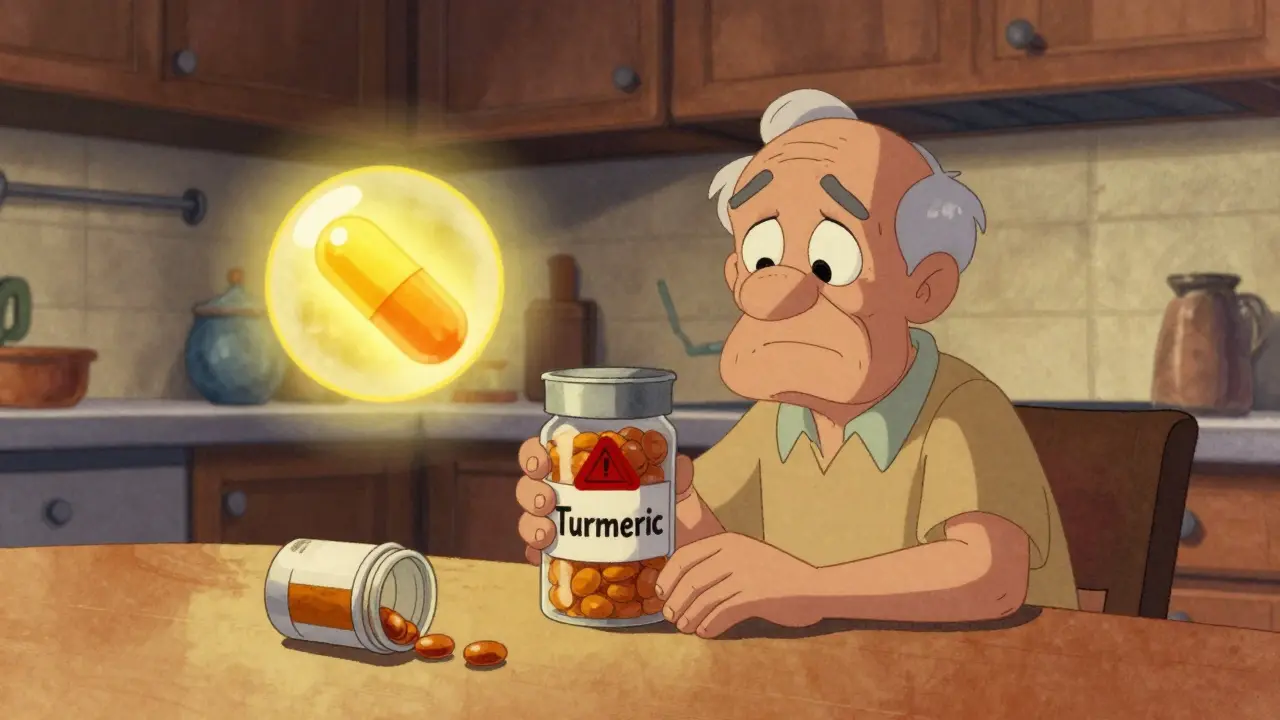
If you take a blood thinner like warfarin, rivaroxaban, or aspirin, and you’ve started sprinkling turmeric on your eggs or popping curcumin capsules for "inflammation," you need to hear this: turmeric isn’t just a spice anymore-it’s a potent biological agent that can turn your medication into a danger zone.
How Turmeric Acts Like a Blood Thinner
Turmeric gets its bright yellow color from curcumin, a compound that does way more than flavor curry. Research shows curcumin directly interferes with your blood’s ability to clot. It doesn’t just thin blood like aspirin does-it attacks clotting at multiple points. A 2012 study published in PubMed found curcumin slows down two key clotting proteins: thrombin and factor Xa. These are the same targets of powerful prescription drugs like rivaroxaban and apixaban. But unlike those drugs, which are dosed precisely and monitored with blood tests, curcumin’s strength varies wildly. A teaspoon of ground turmeric might contain 20-40 mg of curcumin. A supplement? That could be 500 mg or more-sometimes over 95% pure curcumin. That’s not a pinch of spice. That’s a pharmacological dose. Curcumin also stops platelets from clumping together. Platelets are the first responders to a cut. If they can’t stick, bleeding lasts longer. So now you’ve got a double whammy: slower clot formation + reduced platelet activity. This isn’t theoretical. Real patients have bled out because of it.Real Cases, Real Danger
In April 2018, New Zealand’s Medsafe issued a public warning after a patient on stable warfarin therapy saw their INR-your blood’s clotting timer-spike to over 10. Normal range? 2 to 3.5. Anything above 4.5 is dangerous. Above 10? That’s a 50% chance of spontaneous bleeding inside the brain or gut. The only new variable? The patient had started taking a turmeric supplement. Another case involved a kidney transplant patient taking tacrolimus, a drug that prevents organ rejection. He took 15 spoonfuls of turmeric powder daily for ten days. His tacrolimus levels jumped to 29 ng/mL-far above the safe limit. His kidneys started failing. Why? Turmeric blocked the liver enzyme (CYP3A4) that normally breaks down tacrolimus. The drug built up to toxic levels. These aren’t outliers. They’re red flags. The Welsh Medicines Information Centre (WMIC) confirmed in 2024 that curcumin can reduce how fast warfarin leaves the body. That means warfarin sticks around longer, increasing its effect. And since warfarin’s safe window is razor-thin, even a small change can be deadly.Which Blood Thinners Are Riskiest with Turmeric?
Not all blood thinners are equal. Some are more sensitive to turmeric’s interference than others.- Warfarin (Coumadin): Highest risk. Its effect is measured by INR, and turmeric can push it into the danger zone fast. WMIC and Medsafe both call this a "serious risk."
- DOACs (rivaroxaban, apixaban, dabigatran): Less studied, but still risky. Curcumin inhibits factor Xa-the same target as rivaroxaban. Combining them could overload the effect. The British Heart Foundation warns against mixing them.
- Aspirin, clopidogrel (Plavix): These are antiplatelet drugs. Turmeric also blocks platelets. Together, they’re a recipe for bruising, nosebleeds, or worse.
- NSAIDs (ibuprofen, naproxen): These already raise bleeding risk. Add turmeric, and you’re stacking the deck.
- Heparin, enoxaparin (Lovenox): Injected anticoagulants. Turmeric doesn’t interact with them the same way, but no one has proven it’s safe. Don’t assume.

Why "Natural" Doesn’t Mean Safe
People think "natural" equals harmless. That’s a dangerous myth. You wouldn’t take a handful of digitalis leaves because they’re "natural" and good for the heart. You’d die. Turmeric is the same. It’s a plant with powerful chemistry. Just because it’s in your kitchen doesn’t mean your body can handle it in supplement form. Supplements aren’t regulated like drugs. One bottle of turmeric capsules might have 5% curcumin. Another might have 95%. No label tells you how much you’re actually getting. There’s no standard. No safety testing. No monitoring. And here’s the kicker: many people don’t even realize they’re taking it. Turmeric is in golden milk lattes, smoothies, teas, and even some protein powders. If you’re on warfarin and drinking one of those daily, you’re already in the danger zone.What Doctors Say Now
The medical community isn’t divided. They’re united. - Medsafe (New Zealand): "Concurrent use... should be avoided." - WMIC (UK): "Monitor closely if taken together." - Mayo Clinic: "Turmeric in large doses can act like a blood thinner, causing bleeding or dangerously enhancing the effects." - Healthline: "Talk to your doctor before taking turmeric if you’re on anticoagulants." - British Heart Foundation: Includes turmeric in their list of supplements that interact with blood thinners. Dr. Oracle’s summary in 2023 says it plainly: "The evidence clearly indicates that the anticoagulant properties of turmeric/curcumin create a significant risk when combined with warfarin." The message isn’t "maybe." It’s "don’t."
What You Should Do
If you’re on a blood thinner:- Stop taking turmeric supplements immediately. No exceptions. Not even "low dose."
- Check your food and drinks. Are you drinking golden milk every morning? Eating curry daily? That’s fine-small amounts in food are unlikely to cause harm. But supplements? Not even close.
- Don’t assume your doctor knows. Most doctors don’t ask about supplements unless you bring it up. Tell them. Write it down. Say: "I’m on warfarin. I take turmeric in tea and capsules."
- Get your INR checked. If you’ve been taking turmeric, even for a few weeks, ask for an INR test. Don’t wait for symptoms.
- Stop turmeric two weeks before any surgery. Even dental work. Bleeding during a tooth extraction can be life-threatening if your blood won’t clot.
What About Turmeric in Cooking?
Good news: eating turmeric as a spice in food is generally safe. A typical curry dish uses about 1-2 teaspoons of ground turmeric. That’s roughly 20-80 mg of curcumin. Studies show that at this level, anticoagulant effects are minimal-especially if you’re not on warfarin. The real problem is concentrated forms: capsules, powders, extracts, tinctures. Those deliver 10 to 100 times more curcumin than food. That’s where the danger lives. If you love turmeric in your food, keep using it. Just don’t turn it into medicine.The Bigger Picture
This isn’t just about turmeric. It’s about how we think about supplements. We live in a world where "natural" is marketed as safe, gentle, and harmless. But nature doesn’t care about your prescriptions. It doesn’t know your INR. It doesn’t care if you’re 70 and on blood thinners because of a mechanical heart valve. The science is clear. The cases are documented. The warnings are out there. Yet millions of people keep taking turmeric supplements without knowing the risk. If you’re on a blood thinner, you’re already in a high-risk group. Adding turmeric isn’t a wellness boost-it’s a gamble with your life. Your body doesn’t distinguish between a pill and a spice when the chemistry is the same. And when that chemistry clashes with your medication? The result isn’t a mild side effect. It’s internal bleeding. Stroke. Death. Don’t wait for a warning label. Don’t wait for your doctor to ask. If you’re on a blood thinner, leave the turmeric capsules on the shelf. Keep the spice in the cabinet. That’s all you need.Can I take turmeric if I’m on warfarin?
No. Turmeric, especially in supplement form, can dangerously increase the blood-thinning effect of warfarin. Cases have been documented where INR levels spiked above 10 after starting turmeric, leading to life-threatening bleeding. Even small doses in supplements can interfere. Avoid turmeric supplements entirely if you’re on warfarin.
Is it safe to eat turmeric in food if I’m on blood thinners?
Yes, eating turmeric as a spice in meals is generally safe. A teaspoon of ground turmeric in curry or soup contains only 20-80 mg of curcumin-far below the levels found in supplements. The risk comes from concentrated forms: capsules, powders, extracts. Stick to culinary use and avoid daily supplements.
How long should I stop turmeric before surgery?
Stop all turmeric supplements at least two weeks before any surgery, including dental procedures. Turmeric can prevent normal blood clotting, increasing bleeding risk during and after surgery. Even if you’ve only taken it for a few days, the effect can linger. Always tell your surgeon and anesthesiologist about any supplements you’ve taken.
What are the signs turmeric is interacting with my blood thinner?
Watch for unexplained bruising, nosebleeds, bleeding gums, blood in urine or stool, unusually heavy periods, or headaches that won’t go away. These could signal internal bleeding. If you’ve started turmeric and notice any of these, get your INR checked immediately. Don’t wait for symptoms to worsen.
Are there any safe turmeric alternatives for inflammation?
Yes. Omega-3 fatty acids from fish oil (in low doses) and ginger (in culinary amounts) have anti-inflammatory effects with less interaction risk. But even these need to be discussed with your doctor. Never replace prescribed medication with supplements without medical advice. Your doctor can help you find safe, evidence-based options that won’t interfere with your blood thinner.
Maggie Noe
January 9, 2026 AT 07:39Aron Veldhuizen
January 10, 2026 AT 00:25Meghan Hammack
January 10, 2026 AT 18:07Johanna Baxter
January 10, 2026 AT 20:35Jerian Lewis
January 11, 2026 AT 19:10tali murah
January 13, 2026 AT 13:03Jenci Spradlin
January 15, 2026 AT 02:01Micheal Murdoch
January 15, 2026 AT 17:41Drew Pearlman
January 16, 2026 AT 02:02Chris Kauwe
January 17, 2026 AT 10:50RAJAT KD
January 19, 2026 AT 06:29Lindsey Wellmann
January 19, 2026 AT 15:21Ian Long
January 20, 2026 AT 17:23Pooja Kumari
January 21, 2026 AT 10:05