
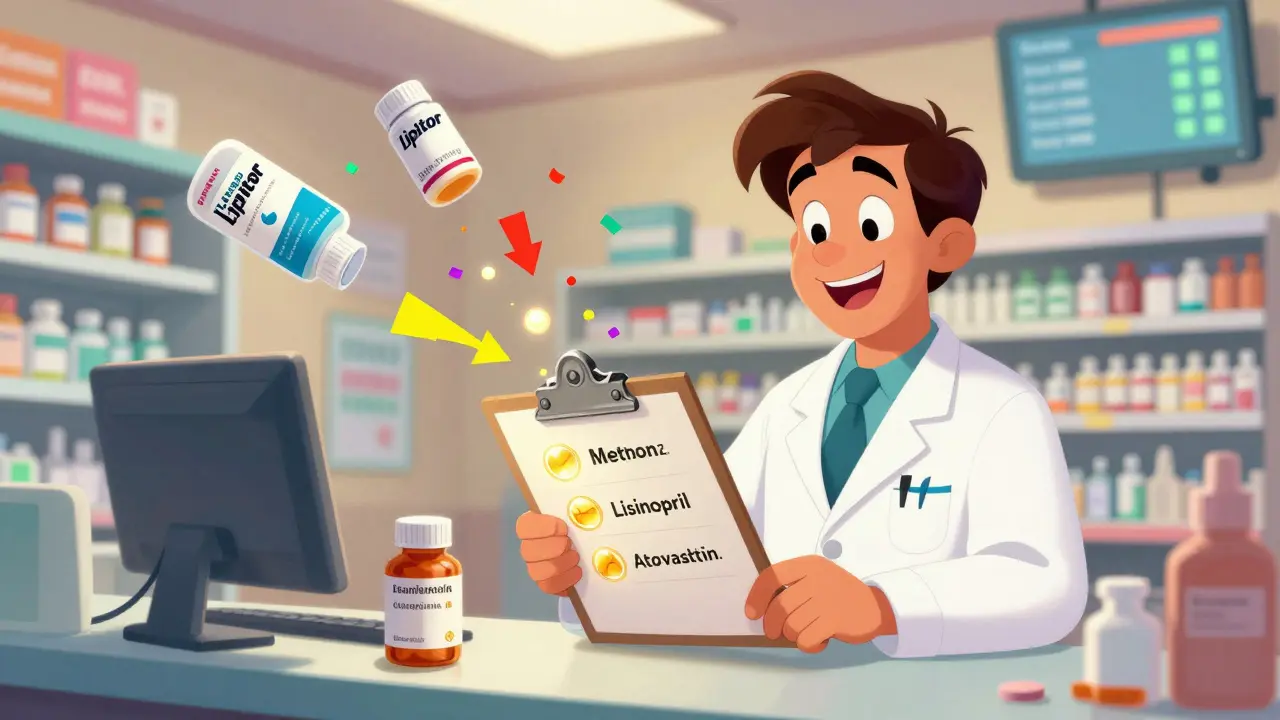
Most pharmacies carry hundreds of medications, but generic drugs are the real backbone of daily operations. They make up 90% of prescriptions filled, yet only account for 20% of total drug spending. That’s not a coincidence-it’s an opportunity. The problem? Many pharmacies still manage their generic inventory like it’s 2010: ordering by guesswork, overstocking slow movers, and running out of fast-sellers. If your pharmacy is losing money on expired stock or missing sales because metformin or lisinopril is out of stock, you’re not alone. But you can fix it.
Why Generic Stocking Is Different from Brand-Name Inventory
Generic drugs aren’t just cheaper versions of brand-name pills. They behave differently in the system. When a new generic hits the market, demand for the brand-name version can drop overnight. One month, you’re ordering 100 bottles of Lipitor. The next, you’re clearing out the last 20 because patients and prescribers switched to atorvastatin. If your inventory system doesn’t adjust automatically, you’re stuck with $3,000 in expired inventory. Generic medications also have shorter shelf lives. Why? Because manufacturers compete on price, not brand loyalty. To offer lower costs, they often produce smaller batches, which means newer expiration dates. A bottle of generic omeprazole might expire in 18 months instead of 24. That’s not a problem if you’re moving it fast. But if you’re holding onto it because you ordered too much, you’re losing money. Brand-name drugs? You can stock them conservatively. Their prices are high, so you don’t need much on hand. Generics? You need volume. But volume without control equals waste.The 80/20 Rule in Pharmacy Inventory
Here’s a hard truth: 80% of your drug costs come from just 20% of the items you carry. And guess what? That 20% is mostly generics. Not the obscure ones. The common ones: metformin, atorvastatin, levothyroxine, amlodipine, lisinopril, omeprazole, sertraline. These are your high-volume, low-cost drivers. They’re the ones patients refill every month. They’re the ones you need to keep on the shelf, every day. But here’s the trap: pharmacists often treat all generics the same. They assume if one generic sells well, all of them will. That’s wrong. Some generics move like wildfire. Others sit for months. You need to know which is which. Track your turnover rate. Not monthly. Weekly. Look at your dispensing logs. Which generics are being pulled off the shelf three times a week? Which ones haven’t moved in 45 days? That’s your data. That’s your playbook.How to Set Your Reorder Points and Quantities
Forget fixed monthly orders. That’s how you end up with expired stock or empty shelves. Use the formula pharmacies with smart systems actually use: Reorder Point (ROP) = (Average Daily Usage × Lead Time) + Safety Stock Let’s say you sell 5 bottles of metformin 500mg per day. Your supplier takes 3 days to deliver. You want to keep 2 extra bottles as a buffer in case of delay. Your ROP is: (5 × 3) + 2 = 17 bottles. When your stock hits 17, you order. Not when you’re down to 5. Not when you’re out. At 17. That’s the sweet spot. For Reorder Quantity (ROQ), use the Economic Order Quantity (EOQ) model. It balances ordering cost and holding cost. You don’t need a PhD to do it. Most pharmacy software does it for you if you plug in the numbers:- Annual demand for the drug
- Cost to place an order
- Cost to store one unit for a year
The Minimum-Maximum Method That Works
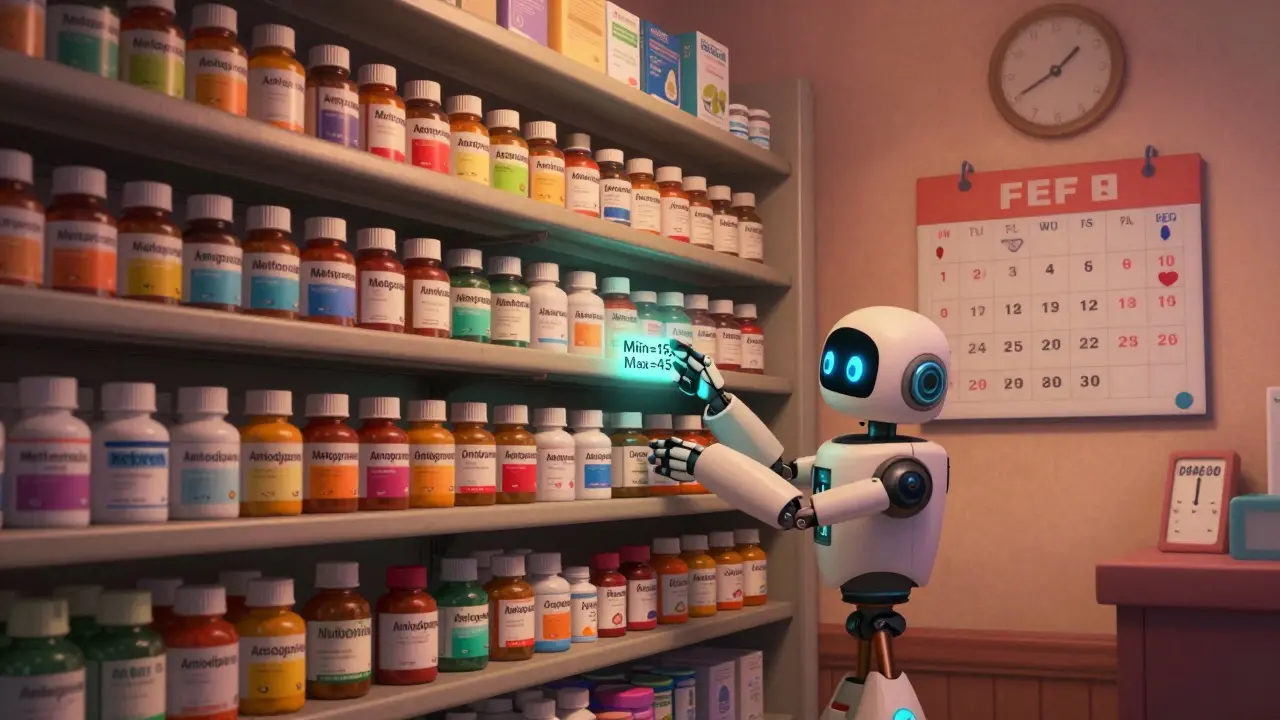
The best strategy for most independent pharmacies is the minimum-maximum method. Set two numbers for every generic:- Minimum: The lowest stock level before you reorder
- Maximum: The highest you’ll let it go before stopping new orders
How to Handle New Generic Entries
When a new generic hits the market, your old inventory becomes a liability. Here’s how to handle it:- Immediately reduce your order size for the brand-name version by 50%.
- Start small with the generic-order just enough for 10 days of sales.
- Track daily sales. If it’s moving fast, increase your order. If it’s not, pause.
- After 30 days, if the generic is filling 70%+ of prescriptions, stop ordering the brand-name version entirely.
Technology Is Your Ally (Even If You’re Small)
You don’t need a $50,000 system to manage generics well. But you do need software that can:- Track expiration dates by batch
- Calculate ROP and EOQ automatically
- Flag slow-moving items
- Adjust reorder points based on seasonal trends
Staff Training and SOPs Are Non-Negotiable
No software fixes bad habits. If your techs are entering stock manually without checking expiration dates, or if your pharmacist isn’t returning unclaimed prescriptions to stock within 24 hours, your numbers are wrong. And wrong numbers = bad decisions. Create simple SOPs for:- Receiving generic shipments-check lot numbers and expiration dates
- Returning expired or unclaimed meds to the vendor
- Flagging generics that haven’t moved in 60 days
- Communicating with prescribers about therapeutic interchange

What Happens When You Get It Right
Pharmacies that nail generic stocking see real results:- 10-15% lower inventory holding costs
- 15% fewer stockouts
- 12-18% higher inventory turnover
- Up to 20% higher profit margins by 2027
Common Mistakes (And How to Avoid Them)
Don’t make these errors:- Stocking too much of a new generic → Start with a 7-day supply. Scale up slowly.
- Ignoring expiration dates → Use first-expiry, first-out (FEFO). Don’t just rotate stock.
- Not adjusting for seasonality → Flu season? Stock more antivirals and cough meds. Winter? More blood pressure meds.
- Using one-size-fits-all reorder rules → Metformin needs daily checks. Rare generics? Monthly is fine.
- Not communicating with prescribers → If your system allows therapeutic interchange, use it. Patients stay on meds longer when they don’t have to switch.
Final Thought: Generics Are Your Competitive Edge
Large chains use AI to predict demand. You can’t compete with their budgets. But you can compete with their efficiency. By mastering generic stocking, you reduce waste, increase cash flow, and build trust with patients who know they’ll always get the medication they need-without paying more. This isn’t about being the biggest pharmacy. It’s about being the smartest one.How many generics should a pharmacy keep in stock?
Focus on your top 20-30 generic medications that make up 80% of your volume. For fast-moving ones like metformin or lisinopril, keep about a week’s supply-enough to cover 7-10 days of sales. For slower movers, 2-4 weeks is fine. Never stock more than your maximum reorder level, and always track expiration dates.
How often should I reorder generic medications?
Reorder based on your Reorder Point (ROP), not on a fixed schedule. For high-turnover generics, that could mean daily or every few days. For slower ones, weekly or biweekly. Use your pharmacy software to trigger alerts when stock hits your ROP. Manual weekly checks are outdated and risky.
What software is best for managing generic inventory?
Look for systems that support automatic ROP and EOQ calculations, expiration tracking, and generic transition alerts. Clotouch, Relex Solutions, and PBA Health’s platforms have features tailored for generic management. Even mid-tier systems like Rx30 or WinPharm now include these tools. Avoid basic inventory modules that treat all drugs the same.
How do I handle a new generic entering the market?
Immediately reduce orders for the brand-name version by 50%. Start with a small order of the new generic-just enough for 7-10 days. Track daily sales. If demand rises, increase your order. If it doesn’t, pause. After 30 days, if the generic fills 70% or more of prescriptions, stop ordering the brand-name drug entirely. Use software alerts to stay ahead of FDA approvals.
Why do generics expire faster than brand-name drugs?
Generic manufacturers often produce smaller batches to keep costs low, which leads to shorter production cycles and newer expiration dates. They also compete on price, so they may use packaging with shorter shelf lives to reduce costs. Always check expiration dates on incoming shipments and use FEFO (first-expiry, first-out) to dispense stock.
Can I rely on historical data for generic stocking?
Historical data is useful, but not enough. Generics change fast-new approvals, price drops, formulary shifts. Pharmacies that update their inventory algorithms quarterly avoid 15-20% overstock during transitions. Always combine historical trends with real-time sales data and FDA alerts.
MARILYN ONEILL
January 22, 2026 AT 03:46Also, why is everyone ignoring that 70% of generics come from India now? Expiration dates? LOL. Some of that stuff expires before it leaves the port.
Coral Bosley
January 23, 2026 AT 06:59Alex Carletti Gouvea
January 23, 2026 AT 14:49Ben McKibbin
January 24, 2026 AT 02:55Systems don’t fix culture. People do. Training isn’t a checkbox. It’s a ritual. Show them the moldy pills. Let them smell it. Make it visceral. Then they’ll care.
Also-FEFO isn’t optional. It’s ethical.
Stephen Rock
January 25, 2026 AT 06:57Also, FDA alerts? Who has time for that? I just check the CVS app. If they're stocking it, I stock it. Simpler. Faster. Less math. More profit.
Andrew Rinaldi
January 26, 2026 AT 16:33So yes, track the numbers. But don't forget why they matter.
Gerard Jordan
January 26, 2026 AT 23:33Just started using Rx30 last month and the generic transition alerts saved me $3k in expired Lipitor. Also, my techs love the FEFO stickers. We made them rainbow colors. Now they compete to see who catches the oldest bottle first 😆
Also-returning unclaimed meds? Game changer. My inventory accuracy jumped from 78% to 96%. No magic. Just consistency.
Roisin Kelly
January 28, 2026 AT 12:34lokesh prasanth
January 28, 2026 AT 20:36Glenda Marínez Granados
January 29, 2026 AT 15:42Yuri Hyuga
January 31, 2026 AT 15:26One thing I’d add: don’t underestimate the power of weekly huddles. Even 10 minutes with your team to review top movers and slowpokes can prevent disasters. Leadership isn’t about software-it’s about showing up.
MAHENDRA MEGHWAL
February 2, 2026 AT 00:58Kevin Narvaes
February 2, 2026 AT 12:29Dee Monroe
February 3, 2026 AT 04:37But this? This is the roadmap. The 80/20 rule. The min-max system. The FEFO. The real talk about new generics.
It’s not just about money. It’s about dignity. About showing up for your patients every day, knowing their meds are there, fresh, and ready. That’s what we’re really doing here. Not math. Service.
Thank you for writing this. I’m printing it out. And I’m putting it on the wall.