

When you’re breastfeeding, every pill you take feels like it might reach your baby. It’s a real concern - and it’s one that stops many mothers from taking needed medications. But here’s the truth: medications in breast milk are far more common - and far less dangerous - than most people think. The vast majority of drugs pass into milk in tiny, harmless amounts. The real question isn’t whether drugs get in - it’s how much, how fast, and whether it matters for your baby.
How Do Medications Even Get Into Breast Milk?
Breast milk isn’t just filtered blood. It’s made by special cells in the breast that pull substances from your bloodstream. Most drugs cross into milk the same way water does: through passive diffusion. About 75% of medication transfer happens this way. The drug moves from where it’s more concentrated (your blood) to where it’s less concentrated (your milk), following a natural balance. But not all drugs move the same way. Some use special transporters in the breast cells - like a taxi service for molecules. Drugs like nitrofurantoin and acyclovir ride these carriers. Others are actively pushed into milk, though that’s rare. What matters most isn’t just the drug itself, but its physical properties. Small molecules (under 300 daltons) slip through easily. Lithium, at just 74 daltons, gets into milk in noticeable amounts. Big molecules like heparin (15,000 daltons) barely make it through - less than 0.1% of the dose ends up in milk. Lipid solubility is another big factor. Drugs that dissolve in fat - like diazepam - move into milk more readily than water-soluble ones like gentamicin. That’s why diazepam can reach milk levels twice as high as in your blood, while gentamicin stays below 10%. Protein binding is the silent gatekeeper. If a drug is tightly glued to proteins in your blood (like warfarin, which is 99% bound), it can’t float freely to cross into milk. Even sertraline, which is 98.5% bound, still gets through - but only a small fraction. And then there’s pH. Milk is slightly more acidic than blood. Weak bases - drugs like amitriptyline - get trapped in milk because they become charged and can’t slip back out. That’s why their milk levels can be 2 to 5 times higher than in your blood.Timing Matters: When You Take the Pill Changes Everything
It’s not just what you take - it’s when. Taking your medication right after breastfeeding gives your body time to clear most of it before the next feeding. Studies show this simple trick can cut infant exposure by 30 to 50%. If you take a pill right before nursing, your baby gets the peak dose. This is especially important for drugs with long half-lives. Diazepam, for example, sticks around in a newborn’s body for up to 100 hours - that’s nearly four days. If you’re taking it regularly, it can build up. That’s why doctors recommend keeping doses under 10 mg/day and watching for signs like excessive sleepiness, poor feeding, or limpness. For most drugs, though, timing alone is enough to keep levels safe.What Do Experts Say About Safety?
There are two main systems used to rate drug safety in breastfeeding: the AAP’s L categories and Dr. Thomas Hale’s 1-5 scale. Both agree on one thing: most drugs are safe. The AAP says 87% of commonly used medications are “usually compatible” with breastfeeding (L1-L2). That includes insulin, penicillin, ibuprofen, sertraline, and many others. These drugs either don’t transfer at all, or the amount that does is too small to matter. On the other end, only about 1-2% of drugs are truly contraindicated - radioactive iodine, certain chemotherapy drugs, or high-dose estrogen pills. Hale’s system is even more detailed. Level 1 drugs like heparin and insulin show no detectable transfer. Level 2 drugs like sertraline and amoxicillin have minimal exposure - often less than 1-2% of the mother’s dose. Level 3 drugs (like fluoxetine) need caution. Levels 4 and 5 are rare and usually involve drugs that can cause serious harm, like lithium in high doses or radioactive tracers. The CDC adds another layer: if an infant receives less than 10% of the mother’s weight-adjusted dose, it’s generally considered safe. For antidepressants, infant blood levels should stay under 10% of the therapeutic range. For antibiotics, levels should be undetectable. Most drugs easily meet these thresholds.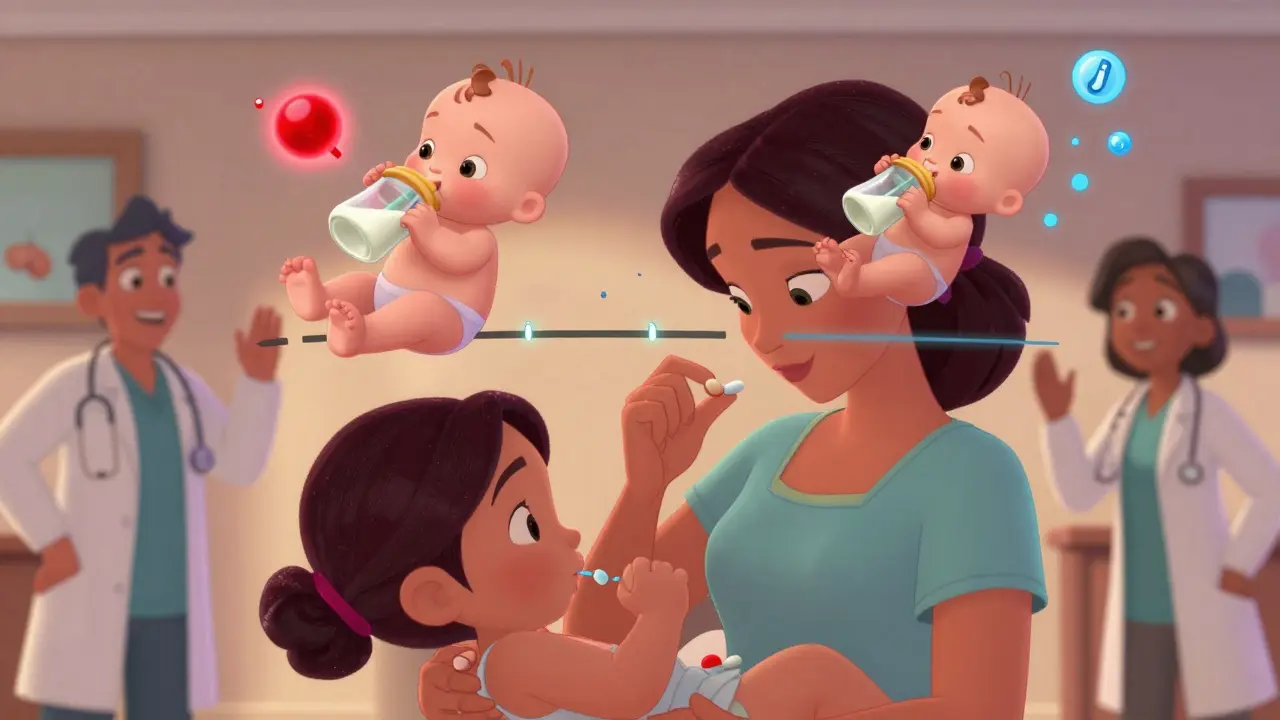
What About Antidepressants and Psychiatric Drugs?
This is where the most fear lives. Many mothers worry that taking an antidepressant will harm their baby’s brain or cause serotonin syndrome. The data tells a different story. Sertraline (Zoloft) is the most prescribed antidepressant during breastfeeding - used by over 3 out of every 100 nursing mothers each month. Studies show infants absorb only 1-2% of the maternal dose. Infant blood levels are typically below 10% of the therapeutic range. Side effects like irritability or poor feeding occur in less than 10% of cases - and often resolve on their own. Fluoxetine (Prozac) is different. It has a very long half-life and builds up in infants. It’s still considered compatible, but sertraline is preferred. Paroxetine is also low-risk. For anxiety, lorazepam is safer than diazepam because it clears faster. The European Medicines Agency has raised concerns about serotonin syndrome, but those are based on rare case reports - not population data. In real-world use, the risk is extremely low. Stopping an antidepressant often causes more harm than the drug itself: postpartum depression worsens, bonding suffers, and breastfeeding rates drop.Drugs That Can Hurt Milk Supply
Not all drugs affect the baby - some hurt the milk. High-dose estrogen birth control pills (over 50 mcg ethinyl estradiol) are the biggest offender. They can slash milk production by 40-60% within just three days. That’s why progestin-only pills, IUDs, or non-hormonal methods are recommended. Bromocriptine and cabergoline - used to stop lactation - work by suppressing prolactin. They’re effective, but they’re not for mothers who want to keep breastfeeding. If you’re taking these, you’re choosing to dry up, not to nurse. Some decongestants like pseudoephedrine can reduce supply slightly, especially in the early weeks. But occasional use is usually fine. Always check with your provider before starting any new medication.What About Nuclear Medicine and Imaging?
If you need a scan - like a bone scan, thyroid test, or PET scan - you might be told to stop breastfeeding for days. But that’s often outdated advice. For Tc-99m MAA (used in lung scans), a 12- to 24-hour pause is still recommended. But for FDG-PET scans (used in cancer detection), you can breastfeed right away. Less than 0.002% of the tracer ends up in milk. For most radioisotopes, pumping and dumping for a few hours is enough. Always ask for the specific half-life and guidance - many hospitals now have lactation specialists who can help you plan.
Real Numbers: How Many Moms Actually Stop Breastfeeding Because of Medications?
Here’s the sad part: 22.4% of mothers stop breastfeeding early because they’re worried about medications. But studies show that in 15-30% of those cases, the drug was actually safe. Many women are told to stop without proper evidence. Antibiotics are the most common - 28.5% of breastfeeding moms take them. Analgesics like ibuprofen and acetaminophen are next. Antidepressants come third. Yet, for all these, the infant exposure is minimal. The real danger isn’t the drug - it’s the fear. A 2022 study found that when mothers got accurate, personalized advice, breastfeeding continuation rates jumped. The key? Talking to someone who knows the data - not just guessing.What Should You Do?
1. Don’t stop your meds without checking. Most are safe. Stopping can hurt you more than the drug hurts your baby. 2. Use trusted resources. The InfantRisk Center’s LactMed app (version 3.2, 2023) is free and updated daily. It uses 12 pharmacokinetic factors to give real-time risk scores. 3. Talk to your provider. Ask: “Is this drug safe for breastfeeding?” and “What’s the infant exposure?” Don’t accept vague answers. 4. Time your doses. Take pills right after a feeding. Wait 3-4 hours before the next one. 5. Watch your baby. Look for excessive sleepiness, poor feeding, fussiness, or rash. Most issues are mild and temporary. 6. Know the exceptions. Avoid high-dose estrogen pills, radioactive iodine, and certain chemotherapy drugs. Everything else? Usually fine.Final Thought: You Can Be Healthy and Breastfeed
You don’t have to choose between taking care of yourself and caring for your baby. The science is clear: 98-99% of medications are compatible with breastfeeding. The goal isn’t zero exposure - it’s smart exposure. With the right info, you can keep nursing, stay healthy, and give your baby the best start - without fear.Do all medications pass into breast milk?
Almost all medications pass into breast milk to some degree, but the amount is usually tiny - often less than 1-2% of the mother’s dose. Large molecules like heparin or insulin barely transfer at all. What matters is whether that small amount could affect the baby - and for most drugs, it doesn’t.
Is it safe to take antidepressants while breastfeeding?
Yes, most are safe. Sertraline is the most studied and preferred option, with infant exposure around 1-2% of the maternal dose. Infant blood levels are typically below 10% of the therapeutic range. Side effects like irritability are rare and mild. Stopping antidepressants often causes more harm than the drug itself, including worsening postpartum depression and reduced bonding.
Can I take ibuprofen or acetaminophen while breastfeeding?
Absolutely. Both ibuprofen and acetaminophen are considered safe for breastfeeding. They transfer in very low amounts - less than 1% of the mother’s dose - and have been used safely for decades. They’re often recommended as first-line pain relievers for nursing mothers.
What if my baby seems sleepy or fussy after I take medication?
Mild fussiness or sleepiness can happen, especially with drugs like benzodiazepines or SSRIs. Watch for signs like excessive sleepiness (hard to wake for feeds), poor feeding, or limpness. If these occur, contact your pediatrician. Often, adjusting timing or switching medications helps. Most symptoms resolve on their own within days.
Do I need to pump and dump after taking medication?
Rarely. Pumping and dumping doesn’t speed up drug clearance from your body - only time does. For most medications, timing your dose after a feeding is enough. Exceptions include radioactive tracers (like Tc-99m), where a short pause (12-24 hours) is advised. Always check with a lactation expert before pumping and dumping - it’s often unnecessary.
Can birth control pills affect my milk supply?
Yes - but only certain kinds. Birth control pills with high-dose estrogen (over 50 mcg ethinyl estradiol) can reduce milk supply by 40-60% within 72 hours. Progestin-only pills, IUDs, and non-hormonal methods don’t affect supply and are recommended for breastfeeding mothers.
What should I do if I’m told a medication is unsafe for breastfeeding?
Ask for the source. Many outdated guidelines still say “avoid” for drugs now known to be safe. Use the InfantRisk Center’s LactMed app or consult a lactation consultant with access to current databases. Most medications once thought to be unsafe are now considered compatible. Don’t stop breastfeeding without getting up-to-date, evidence-based advice.
Madhav Malhotra
January 10, 2026 AT 19:54Just came back from India where my sister-in-law was told to stop breastfeeding because she took ibuprofen for a headache. 😅 I showed her the LactMed app and she’s now nursing like a champ. So glad we have real data now - not just old wives’ tales.
Priya Patel
January 11, 2026 AT 10:07OMG YES. I took sertraline for 8 months postpartum and my baby was literally perfect - slept like a angel, fed like a champ. People act like antidepressants are poison, but my mental health was the real MVP for our bond. 🙌❤️
Christian Basel
January 12, 2026 AT 09:27Passive diffusion? Protein binding kinetics? You’re talking like you’re writing a pharmacokinetics thesis. Can we just say ‘most drugs are fine’ and move on? I don’t need a 10-page breakdown to know I can take Tylenol.
Vincent Clarizio
January 14, 2026 AT 07:59Let me just say this - if you’re worried about your baby getting trace amounts of medication, you’re probably also worried about the water they drink, the air they breathe, the plastic bottles they chew on, and the fact that their daycare is probably full of kids who haven’t had a single vaccine. We live in a toxic world. The real question isn’t whether a drug gets into milk - it’s whether you’re willing to sacrifice your mental and physical health for a myth. I took diazepam at 5mg/day while nursing. My kid is now 7 and plays soccer. He’s not a zombie. He’s not damaged. He’s just… a kid. And I’m a mom who didn’t let fear make me a martyr.
Let me go further: if you’re pumping and dumping for every little pill, you’re not protecting your baby - you’re punishing yourself. Your milk supply will tank, your stress levels will spike, and your baby will feel your anxiety more than any drug ever could. The science says 98% of meds are fine. The fear says otherwise. Choose science.
I’ve seen mothers quit breastfeeding because they were told not to take Zoloft. Then they spiraled into depression. Then they stopped bonding. Then they stopped smiling. That’s the real tragedy. Not the 0.0001% of sertraline in milk. The loss of joy. The loss of self. The loss of connection. That’s what you’re risking when you listen to the noise.
And for the love of god, stop asking random strangers on Facebook. Use LactMed. Talk to a lactation consultant who actually knows what they’re talking about. Not your cousin’s friend’s doula who read one blog post in 2012. We have databases updated daily. Use them.
I’m not saying don’t be cautious. I’m saying be cautious with facts, not fear. Your baby doesn’t need a perfect mom. They need a present, healthy, alive mom. And sometimes, that means swallowing a pill and nursing anyway.
Michael Patterson
January 14, 2026 AT 08:40Ugh I just read this whole thing and I’m so tired of these ‘it’s fine’ posts. What about the babies who DO have reactions? You think it’s rare? I know a kid who got serotonin syndrome from his mom’s SSRI. It wasn’t a ‘mild fussiness’ - he was in the NICU for 3 days. So yeah, maybe 98% are fine - but what about the 2%? Are their parents just supposed to say ‘oh well, science says it’s fine’? No. We need more nuance.
Matthew Miller
January 14, 2026 AT 23:59Wow. So you’re telling me I should just keep taking my meds while breastfeeding because ‘science says so’? That’s it? No accountability? No liability? No ‘what if something goes wrong’? You’re just handing out permission slips like it’s a free pass to poison your kid. Pathetic.
Alfred Schmidt
January 16, 2026 AT 09:56NOOOOOO!!!! You can’t just say ‘it’s fine’ and walk away!!! What about the long-term neurodevelopmental effects??? Have you even READ the animal studies??? What if your child turns out autistic because you took sertraline??? You’re just a reckless parent who doesn’t care!!!
And don’t even get me started on the fact that you’re trusting some app written by some ‘expert’ who probably got paid by Big Pharma!!!
MY BABY ISN’T A LAB RAT!!!
Sam Davies
January 17, 2026 AT 08:44How delightfully quaint. A 2,000-word essay on breast milk pharmacokinetics in the age of TikTok. I suppose next you’ll be explaining why breastfeeding is the only way to achieve cosmic harmony. Still, I’ll give you points for effort - if only because I’ve seen far worse. The real tragedy? The mothers who still believe they must ‘pump and dump’ after a glass of wine. The world is absurd.
Roshan Joy
January 18, 2026 AT 04:51Love this breakdown! 🙌 I’m a dad in India and I’ve been sharing this with my wife’s family - they were freaking out over her taking amoxicillin. Now they’re chill. Also, the timing tip? Game changer. We started doing it and she’s way less stressed. Thanks for the clarity!
PS: LactMed app is now on my phone too. 📲❤️
Priscilla Kraft
January 20, 2026 AT 04:11Thank you for writing this with such care. I was one of those moms who stopped breastfeeding because I was told ‘better safe than sorry’ about my anxiety med. I regret it every day. My baby was fine - but I wasn’t. This post is the kind of thing I wish I’d found sooner. You’re helping so many.
Alex Smith
January 20, 2026 AT 05:34So… let me get this straight. You’re telling me I can take ibuprofen, but not estrogen pills? And that’s the big danger? Wow. I thought the real villain was the pharmaceutical industry pushing meds on moms. Turns out it’s just… birth control. That’s the plot twist I didn’t see coming.
Jennifer Littler
January 21, 2026 AT 00:48As a clinical pharmacist who specializes in perinatal care, I can confirm: the data overwhelmingly supports safety for >95% of medications. The real issue? Inconsistent counseling. Many OBs and pediatricians still default to ‘avoid’ without checking current guidelines. This post is a necessary correction. For those seeking reassurance: LactMed, Hale’s ratings, and AAP guidelines are your best friends. And yes - timing doses post-feed is low-hanging fruit for reducing exposure. Do it.