
Want to lose weight but feel like every diet promises the same thing-eat less, move more-and still leaves you hungry and frustrated? You’re not alone. The low-GI diet has been around for decades, and while it doesn’t promise rapid weight loss, it offers something more lasting: stable energy, fewer cravings, and better control over your appetite. But here’s the catch-it’s not magic. It’s science. And it doesn’t work the same for everyone.
What Is the Glycemic Index, Really?
The glycemic index (GI) is a number that tells you how fast a food turns into sugar in your blood after you eat it. Pure glucose? That’s 100. White bread? Around 75. A pear? About 38. The lower the number, the slower the sugar spike. This isn’t just about sugar. It’s about insulin. When blood sugar jumps fast, your body releases a big burst of insulin to mop it up. That spike and crash cycle leaves you tired, hungry again within hours, and more likely to reach for snacks. Low-GI foods-like beans, oats, apples, and most vegetables-release sugar slowly. That means your insulin stays steady. Your hunger stays steady. And your energy? It lasts. The system was created in 1981 by Dr. David Jenkins at the University of Toronto. Back then, it was meant to help people with diabetes. But over time, people noticed something: those who ate more low-GI foods tended to weigh less. Not because they ate less-but because they didn’t crave as much.Low-GI vs. High-GI: The Food List That Matters
Not all carbs are equal. Here’s what actually belongs on your plate:- Low-GI (55 or less): Lentils (GI 32), chickpeas (28), barley (25), oats (55), apples (36), pears (38), non-starchy veggies like broccoli (15), sweet potatoes (54), plain yogurt (33), and most nuts.
- Medium-GI (56-69): Brown rice (68), whole wheat bread (69), banana (51), and pineapple (66).
- High-GI (70+): White bread (75), white rice (73), corn flakes (81), instant oatmeal (83), and potatoes (85).
Does Low-GI Help You Lose Weight? The Evidence
Let’s cut through the noise. If you’re hoping the low-GI diet will make you drop pounds faster than keto or intermittent fasting, you might be disappointed. A 2021 Cochrane Review looked at 17 studies involving over 2,000 people. When calories were kept the same, low-GI diets didn’t lead to more weight loss than high-GI diets. Another big study, the DIETFITS trial in 2018, found no difference in weight loss between low-GI and high-GI groups after a year-both lost about 6.5 kg on average. So why do people say it works? Because it helps you eat less without trying. When your blood sugar doesn’t crash, you don’t get the 3 p.m. snack attack. You’re not starving by dinner. You’re not reaching for cookies because you feel shaky. That’s not a diet trick-that’s biology. A 2019 review in Nutrients found that low-GI diets improved blood sugar control in people with type 2 diabetes, lowering HbA1c by 0.5%. That’s meaningful. And in the same study, participants often lost weight-not because they counted GI points, but because they naturally ate fewer calories by choosing whole foods.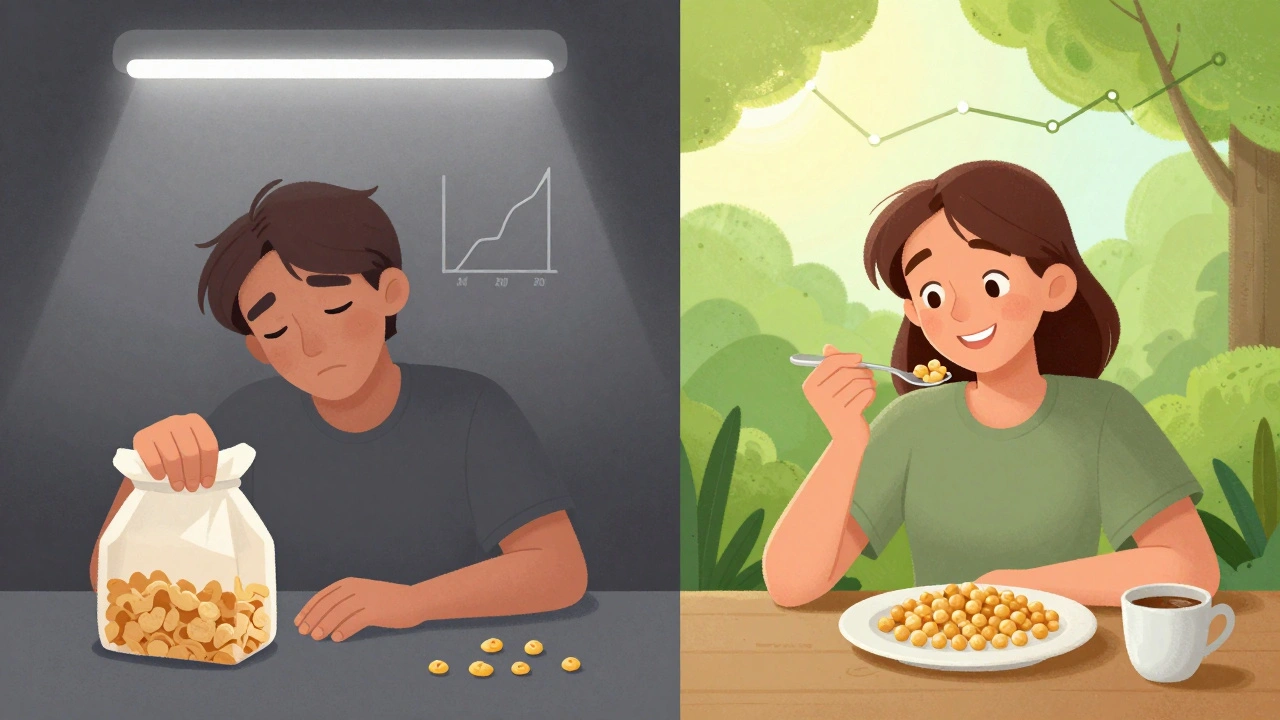
Why It Works Better for Some People
Not everyone reacts the same way to the same food. A 2015 study from the Weizmann Institute in Israel found that two people eating the same banana could have blood sugar spikes that differed by up to 20 points. That’s huge. That’s why some people thrive on low-GI eating-and others don’t notice a difference. If you’re someone who gets shaky or foggy after eating rice or pasta, your body might be extra sensitive to sugar spikes. That’s when low-GI eating makes sense. Dr. David Ludwig from Harvard argues that low-GI diets help your body burn more calories at rest. He says reducing insulin spikes might boost metabolism by 50-100 calories a day. That’s not much, but over a year? It adds up to 5-10 pounds of fat you don’t gain. On the other side, Karen Collins from the American Institute for Cancer Research says: “When calories are controlled, GI doesn’t move the needle on weight loss.” She’s right. But she’s missing the bigger picture. Most people don’t control calories. They control hunger. And low-GI foods help with that.How to Actually Start a Low-GI Diet (No Charts Needed)
You don’t need to memorize GI numbers. You don’t need an app. Here’s how to do it the simple way:- Swap refined carbs for whole ones. White rice → brown rice or barley. White bread → sourdough or rye. Instant oats → steel-cut oats.
- Always add protein or fat. Eat fruit with nuts. Have yogurt with seeds. Add beans to your salad. Fat and protein slow down sugar absorption-even if the food is medium-GI.
- Choose fiber-rich foods. Vegetables, legumes, whole grains, and seeds are naturally low-GI and keep you full longer.
- Watch how you cook. Al dente pasta has a lower GI than mushy pasta. A slightly green banana has less sugar than a yellow one.
- Don’t avoid fruit. Apples, berries, and pears are low-GI and packed with nutrients. Avoid fruit juices-they spike blood sugar fast.
The Real Advantage: Better Health Beyond the Scale
Even if you don’t lose weight, a low-GI diet improves your health in ways that matter:- Lower LDL (“bad”) cholesterol by 4-10%.
- Reduced risk of type 2 diabetes-studies show a 15-20% drop in incidence.
- Improved energy levels and mental clarity.
- Less inflammation, which links to heart disease, arthritis, and even depression.
What Doesn’t Work (And Why People Quit)
People fail at the low-GI diet for the same reasons they fail at every diet:- They think it’s a magic number game. You can’t eat cake because it’s GI 38 and call it healthy.
- They get overwhelmed by lists and apps. You don’t need to know the GI of every food.
- They don’t eat enough protein or fat. Low-GI doesn’t mean low-calorie or low-fat.
- They give up because they don’t see quick results. This isn’t a 30-day challenge. It’s a lifelong shift.
Bottom Line: Is It Worth It?
If you’re looking for a diet that helps you lose weight fast, look elsewhere. If you want a way to eat that keeps your energy steady, your cravings quiet, and your health strong over time-yes, it’s worth it. The low-GI diet isn’t about restriction. It’s about choosing foods that work with your body, not against it. It’s about eating real food that fills you up without crashing you down. It’s about feeling good, not just looking good. And if you’ve tried everything else and still feel tired, hungry, and stuck? Start here. Swap one high-GI food for a low-GI one this week. See how you feel. Then do it again next week. You don’t need to change everything at once. Just change one thing. Then another. Your body will thank you-even if the scale doesn’t move right away.Can I lose weight on a low-GI diet?
Yes, but not because of the glycemic index alone. People lose weight on low-GI diets because they naturally eat fewer calories-thanks to better hunger control. When calories are tightly controlled in studies, low-GI diets don’t cause more weight loss than high-GI diets. The real benefit is sustainability: you’re less likely to binge or snack between meals.
Are all low-GI foods healthy?
No. Chocolate cake can have a GI of 38, and ice cream can be 37. Just because a food has a low GI doesn’t mean it’s nutritious. Focus on whole, unprocessed foods like vegetables, legumes, whole grains, nuts, and fruits. Avoid packaged low-GI snacks-they’re often loaded with sugar, fat, and artificial ingredients.
Do I need to count GI numbers?
No. You don’t need to memorize numbers or use an app. Just make simple swaps: choose oats over cornflakes, barley over white rice, apples over juice. Add protein or fat to meals to slow digestion. Focus on whole foods, and you’ll naturally eat a low-GI diet.
Why do some people say low-GI diets don’t work for weight loss?
Because when scientists control calories, low-GI diets don’t lead to more weight loss than high-GI diets. The confusion comes from real-world results: people on low-GI diets often eat less without trying. The diet works by reducing cravings and hunger-not by burning more calories. It’s about behavior, not biology alone.
Is the low-GI diet good for diabetes?
Yes, strongly. Studies show low-GI diets improve blood sugar control, lower HbA1c by about 0.5%, and reduce insulin spikes. The European Association for the Study of Diabetes recommends it as a top strategy for managing type 2 diabetes. It’s one of the most evidence-backed diets for this condition.
What’s the best low-GI breakfast?
Try steel-cut oats with chia seeds and berries, or scrambled eggs with sautéed spinach and a slice of rye toast. Avoid sugary cereals, white toast, or fruit juice. These cause quick spikes and crashes. A balanced low-GI breakfast keeps you full until lunch without the mid-morning hunger pangs.
Can I still eat potatoes on a low-GI diet?
Yes-but not often, and not as a main carb. Potatoes have a high GI (85), but they’re still nutritious. Cool them after cooking to lower their GI slightly, and always pair them with protein or healthy fats-like grilled chicken or olive oil. Use them as a side, not the star of the meal.
Francine Phillips
December 3, 2025 AT 13:59Low-GI diet? Sounds like a fancy way to say eat more beans and less toast.
Makenzie Keely
December 4, 2025 AT 12:49Finally, someone who gets it! The glycemic index isn’t about restriction-it’s about rhythm. Your body doesn’t need fireworks; it needs a steady flame. Swap white rice for barley, add nuts to your fruit, and watch how your 3 p.m. energy crash disappears. No apps needed. No counting. Just real food that doesn’t trick your metabolism. And yes, chocolate cake might have a low GI-but that doesn’t make it a health food. Stop confusing numbers with nutrition. You’re not a spreadsheet. You’re a human being who deserves to feel steady, not stuffed.
Albert Essel
December 5, 2025 AT 17:44I’ve tried keto, intermittent fasting, paleo-all worked for a while, then I crashed. Low-GI was the first thing that didn’t feel like a punishment. I didn’t lose weight fast, but I stopped craving sugar. My anxiety dropped. My sleep improved. It’s not magic, but it’s science with soul. I’m not a diabetic, but my dad is-and his HbA1c dropped 0.7% after switching to whole grains and legumes. That’s not a fluke. It’s biology working the way it’s supposed to.
Charles Moore
December 5, 2025 AT 23:24For anyone new to this: don’t overthink it. If you’re eating mostly plants, legumes, whole grains, and lean proteins, you’re already on the right track. The GI numbers? Useful, but not mandatory. I used to stress over whether my banana was 51 or 54-then I just ate it with peanut butter and moved on. The real win? Less hunger between meals. Less guilt. More energy. That’s the goal. Not perfection. Not labels. Just feeling better, one meal at a time.
Gavin Boyne
December 7, 2025 AT 04:53Oh wow, another article pretending low-GI is some secret weapon. Let me guess-next you’ll tell us that ‘calories don’t matter’? The Cochrane Review says it doesn’t outperform high-GI diets when calories are controlled. So why are we still selling this like it’s the Holy Grail? Because people want magic. Not science. Not nuance. Just a number to chase so they can feel like they’re doing something right. Spoiler: you’re not. You’re just swapping one processed food for another labeled ‘low-GI.’ Enjoy your sugar-free, fiber-fortified, artificially sweetened ‘health’ bar. I’ll be over here eating an apple.
Rashmin Patel
December 8, 2025 AT 17:22OMG YES!!! 🙌 I switched from white rice to brown barley and my bloating? GONE. My mood? So much calmer. I used to get this insane sugar crash after lunch-like I needed a nap and a candy bar just to stay awake. Now? I’m working out at 4 p.m. without caffeine! I didn’t even know I was that sensitive to spikes until I tried this. Also-please stop eating ‘low-GI’ snacks! They’re just candy with a fancy label. Real food = real results. My mom in India has been eating dal and roti her whole life and she’s 72 and still hikes mountains. No supplements. No gimmicks. Just whole food. We forgot how simple this was.
sagar bhute
December 10, 2025 AT 12:28This is just another diet cult. People think they’re smart because they know GI numbers. But you’re still eating. You’re still gaining weight if you’re in surplus. Stop pretending this is some breakthrough. It’s not. It’s just carb-shaming with a scientific veneer. If you’re fat, eat less. Move more. End of story. Stop overcomplicating it with graphs and studies. You’re not a lab rat. You’re a human who needs discipline-not a spreadsheet.
Cindy Lopez
December 12, 2025 AT 01:52Chocolate cake has a GI of 38? That’s misleading. The glycemic index doesn’t account for portion size, fat content, or overall caloric density. It’s a flawed metric that’s been weaponized by marketers. Don’t fall for it. If you’re eating cake, you’re eating cake. Whether it’s labeled ‘low-GI’ or not, it’s still sugar, fat, and refined flour. Real nutrition doesn’t need a number. It needs honesty.
James Kerr
December 13, 2025 AT 21:02My grandma ate like this her whole life-beans, veggies, whole wheat bread, no processed junk. She never counted anything. Never weighed food. Never dieted. She’s 91 and still gardens. Just saying-maybe we’re overthinking this. Swap one thing. Eat slower. Add protein. That’s it. No apps. No stress. Just food that doesn’t make you feel like crap after.
vinoth kumar
December 15, 2025 AT 15:41As someone from India, I can say this: our traditional meals are naturally low-GI. Dal-rice, roti-sabzi, curd with veggies-no one here had to learn about glycemic index. We just ate. The problem now is we’re replacing those with white bread, Maggi, and sugary chai. The solution isn’t complicated. Go back to what our grandparents ate. Simple. Real. Filling. And yes, it works.
bobby chandra
December 16, 2025 AT 07:17Let’s be real-this isn’t a diet. It’s a rebellion against the junk food industrial complex. White bread? A sugar bomb wrapped in a lie. Instant oatmeal? A chemical trap. The low-GI lifestyle? It’s choosing to eat like your body actually evolved to eat-not like some food scientist in a lab decided you should. I used to feel like a zombie after lunch. Now? I’m sharp, calm, and I don’t need a nap. This isn’t about losing weight. It’s about reclaiming your energy. Your focus. Your damn life.
Archie singh
December 16, 2025 AT 20:55Low-GI? Please. You’re just replacing one form of self-deception with another. You think eating lentils makes you virtuous? You’re still consuming calories. You’re still human. Stop pretending you’ve cracked some ancient code. The only thing that matters is energy balance. Everything else is noise engineered by wellness influencers to sell you books and supplements. Your body doesn’t care about GI. It cares about surplus. End of discussion.
Kidar Saleh
December 18, 2025 AT 10:40What fascinates me is how this mirrors traditional diets across cultures. Mediterranean, Okinawan, Indian rural diets-all low-GI by default. They didn’t need a term for it. They just ate food that grew nearby, in season, minimally processed. The modern obsession with numbers is a luxury problem. The real lesson? Eat like your ancestors. Not because it’s trendy. Because it works. And it’s sustainable. Not because you’re trying to lose 10 pounds-but because you want to live to 90 without insulin.
Chloe Madison
December 19, 2025 AT 09:53As a registered dietitian with 18 years in clinical nutrition, I can confirm: the evidence is clear. When patients adopt a low-GI pattern-not as a diet, but as a lifestyle-they experience improved satiety, reduced triglycerides, and better glycemic control. The weight loss is often modest, but the metabolic improvements are profound. This isn’t about aesthetics. It’s about preventing chronic disease. I’ve seen patients reverse prediabetes-not with pills, but with steel-cut oats, lentils, and apples. That’s not hype. That’s medicine.