

When a doctor gives you a biosimilar instead of the original biologic drug, the billing process isn’t as simple as swapping one pill for another. Unlike generic pills, biosimilars are complex biological products made from living cells. Their reimbursement under Medicare Part B follows a unique, highly technical system that affects what providers get paid, how claims are coded, and even whether patients get access to lower-cost options. Understanding how this works isn’t just for billers-it impacts treatment choices, out-of-pocket costs, and the future of affordable biologic therapies.
How Biosimilars Are Different from Generics
Many people assume biosimilars work like generic drugs. They don’t. Generic versions of small-molecule drugs like metformin or lisinopril are chemically identical to their brand-name counterparts. Biosimilars, on the other hand, are highly similar to- but not identical to-their reference biologics, like Humira or Enbrel. Because they’re made from living organisms, tiny differences in manufacturing can affect how they behave in the body. That’s why the FDA doesn’t approve them as "interchangeable" unless they meet extra standards. And that difference is why Medicare treats them differently in billing.
Before 2018, all biosimilars for a single reference product shared the same HCPCS code. For example, if two biosimilars were approved for infliximab (the active ingredient in Remicade), they both used code Q5101. The payment was a blended rate based on the average price of all versions. This created a problem: if one biosimilar came in cheaper, the others got a free ride. They were paid the same as the more expensive one, even if they cost less to buy. That gave manufacturers little reason to lower prices.
The 2018 Shift: Product-Specific Codes
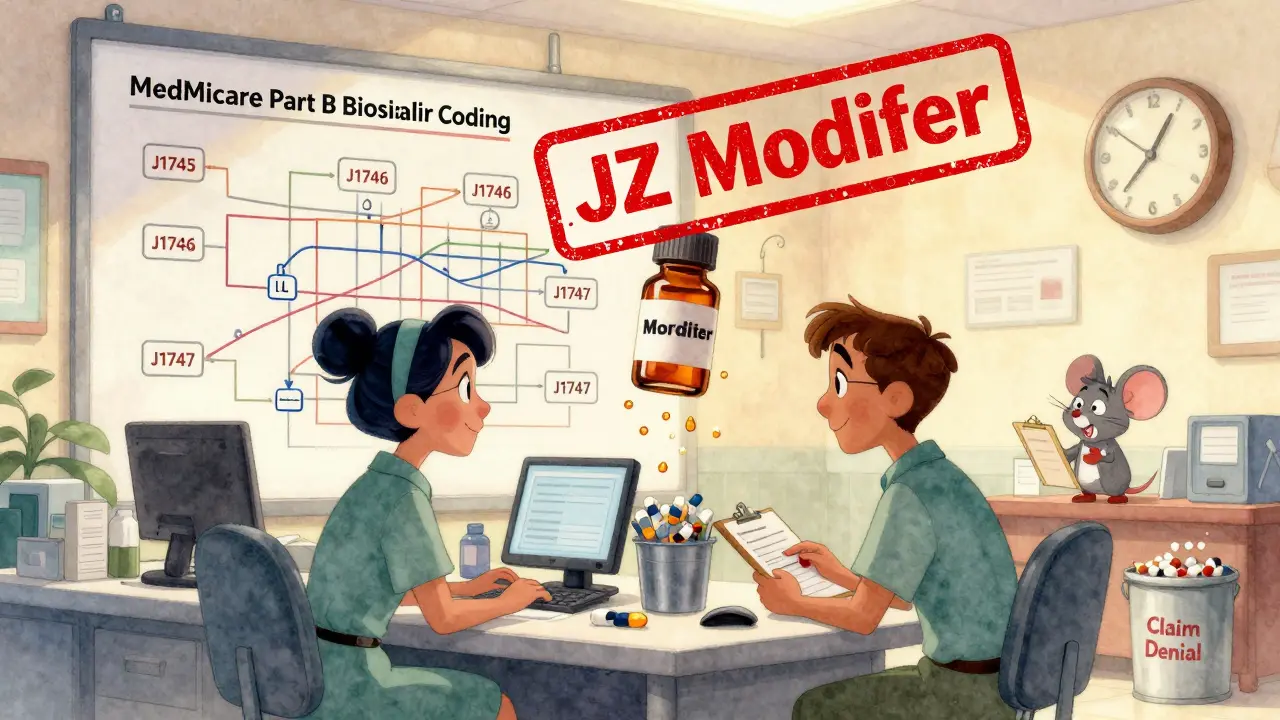
In January 2018, Medicare changed the rules. Each biosimilar now gets its own unique HCPCS code. Inflectra for infliximab got J1745. Renflexis got J1746. Hadlima got J1747. This wasn’t just a paperwork change-it rewired the financial incentives.
Now, reimbursement is calculated as 100% of the biosimilar’s own Average Selling Price (ASP) plus 6% of the reference product’s ASP. So if Remicade sells for $2,500 per dose and Inflectra sells for $2,000, the provider gets paid $2,000 + 6% of $2,500 = $2,150. That’s $150 more than the cost of the drug. But here’s the catch: if the provider gave Remicade instead, they’d get $2,500 + 6% of $2,500 = $2,650. That’s a $500 difference in revenue per dose.
This structure means providers earn more by using the original biologic-even when a biosimilar is cheaper. Critics call this a perverse incentive. It’s not that providers are choosing the more expensive option out of greed. It’s that the payment system rewards them for doing so.
The JZ Modifier: A New Layer of Complexity
On July 1, 2023, Medicare added another layer: the JZ modifier. This applies to all infliximab and its biosimilars. The JZ modifier tells Medicare that no drug was discarded during administration. If a vial contains 100 mg and you only use 50 mg, you’re supposed to report the unused portion. But if you use every last drop, you attach JZ to the claim.
Why does this matter? Because Medicare uses discarded amounts to adjust payments. If you don’t report the JZ modifier correctly, your claim gets denied. A 2022 survey of gastroenterology practices found that after the JZ rule went live, billing staff spent 30% more time verifying discarded amounts. One clinic reported a 20% spike in claim rejections in the first three months.
Providers now need to track every vial, document every drop, and make sure the modifier matches the actual usage. It’s a compliance burden that adds time, training, and risk-especially in high-volume clinics.
How Payment Rates Are Calculated
Medicare doesn’t just guess at prices. CMS collects ASP data quarterly from manufacturers. The ASP is the average price paid by wholesalers after discounts. For the first six months after a biosimilar launches, CMS uses the Wholesale Acquisition Cost (WAC) instead because there’s not enough real-world sales data yet. After that, the payment switches to the actual ASP.
Here’s how it works step-by-step:
- A biosimilar gets FDA approval.
- CMS assigns it a unique J-code (or Q-code if temporary).
- For the first six months, payment = 106% of WAC.
- After six months, payment = 100% of the biosimilar’s ASP + 6% of the reference product’s ASP.
- Payment rates are updated every quarter and published on the CMS website.
Providers must check these updates. Using an old code or outdated price leads to denials. A 2023 survey by Fresenius Kabi found that 22% of initial claim rejections were due to using outdated HCPCS codes.
Why Biosimilar Adoption Is Still Low in the U.S.
Despite being 20-30% cheaper than the reference biologic, biosimilars make up only about 35% of the infliximab market in the U.S. five years after entry. In Europe, that number is 75-80%.
Why the gap? It’s not just about price. It’s about payment. In Europe, many countries use reference pricing: if you choose a biosimilar, you get paid the same as if you chose the brand. In the U.S., you get paid more if you choose the brand. That changes behavior.
One study from Avalere Health estimated that if Medicare removed the 6% add-on based on the reference product’s price and paid biosimilars 106% of their own ASP, utilization would jump by 15-20 percentage points. That’s a massive shift.
Providers aren’t ignoring cost savings-they’re responding to financial signals. If the system rewards them for using the expensive drug, they’ll use the expensive drug.
What Providers Need to Do Right Now
If you’re a clinic, pharmacy, or infusion center, here’s what you need to get right:
- Use the correct HCPCS code for each biosimilar. Check CMS’s quarterly updates.
- Apply the JZ modifier only when no drug is discarded-especially for infliximab products.
- Train staff to verify the product administered matches the code billed. Mismatches cause denials.
- Implement a dual-check system: pharmacy confirms the drug given, billing confirms the code used.
- Don’t assume all payers follow Medicare rules. Medicare Advantage and commercial insurers often have their own rules.
Practices that use dual verification reduce billing errors from 12-15% down to under 3%, according to the Community Oncology Alliance. That’s not just about getting paid-it’s about avoiding audits and penalties.
What’s Coming Next
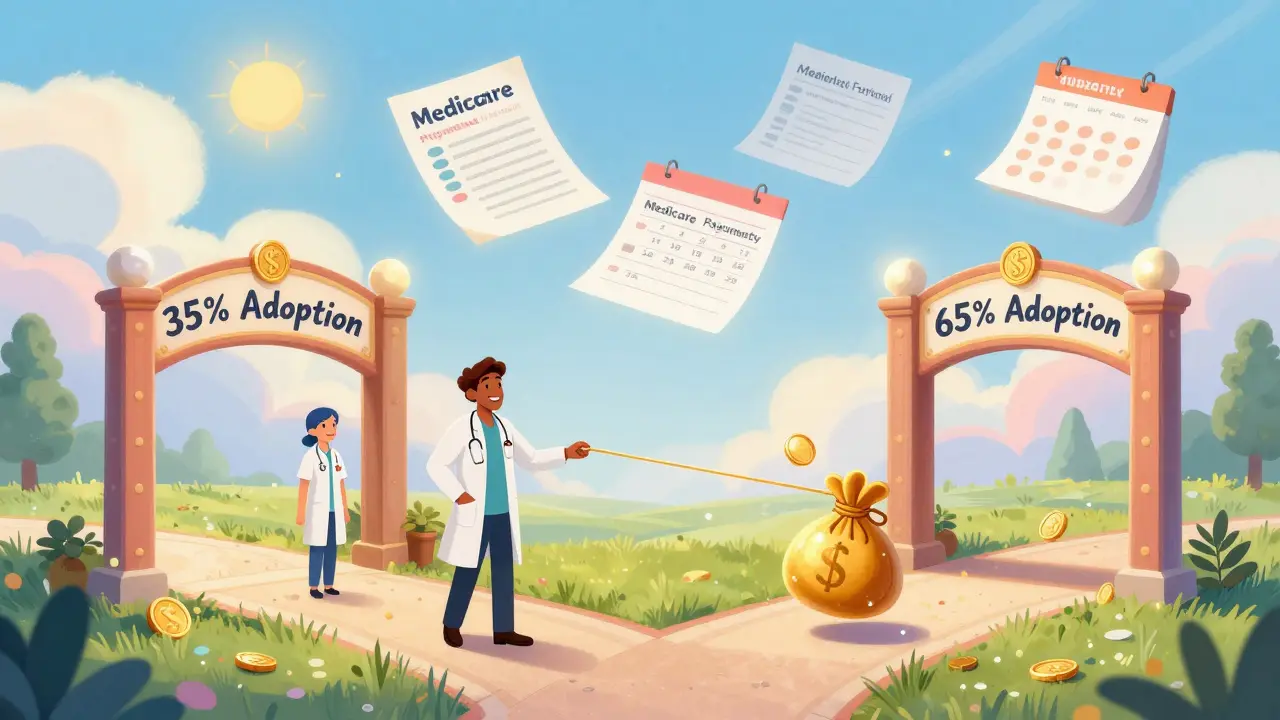
CMS is considering major changes. In early 2023, they asked for public feedback on whether to eliminate the 6% reference product add-on for biosimilars. They’re also looking at a "least costly alternative" model, where if three or more biosimilars exist for one drug, Medicare would pay 106% of the average price across all of them. That would level the playing field.
MedPAC, the Medicare advisory panel, recommended this change in June 2023. If adopted, it could push U.S. biosimilar adoption from 35% to 65% in five years. But manufacturers are worried: if reimbursement drops, they may delay launches or cut R&D budgets.
For now, the system remains a mix of good intentions and unintended consequences. It encourages competition by giving each biosimilar its own code. But it also protects the profits of the original biologic. Until the payment structure changes, the cheapest option won’t always win.
Where to Find Current Codes and Rates
There’s no single dashboard for this. You need to check multiple sources:
- CMS Physician Fee Schedule - Updated quarterly, lists all J-codes and payment rates.
- Medicare Learning Network (MLN) - Provides billing guides and updates.
- Manufacturer websites - Companies like Fresenius Kabi, Sandoz, and Amgen publish free coding guides.
- Medicare Administrative Contractors (MACs) - Local contractors may have additional instructions.
Bookmark these. Change happens fast. One outdated code can cost you hundreds of dollars per claim.
Bottom Line
Biosimilar billing under Medicare Part B is complex, but it’s not impossible. The system was designed to support competition, and it has. More biosimilars are approved than ever before. But the payment structure still favors the original biologic. Until the 6% add-on is restructured, providers will keep choosing the more expensive drug-not because they want to, but because the system tells them to.
For patients, this means access to lower-cost alternatives isn’t guaranteed. For providers, it means staying updated isn’t optional-it’s essential. For policymakers, the question remains: should reimbursement reflect the cost of the drug, or the cost of the brand?”
Do biosimilars use the same HCPCS code as the reference biologic?
No. Since January 2018, each FDA-approved biosimilar has its own unique HCPCS code (J-code or Q-code). For example, Remicade uses J1745, while Inflectra uses J1745 and Renflexis uses J1746. The reference product keeps its original code, and biosimilars get individual codes to ensure accurate payment tracking.
How is reimbursement calculated for biosimilars under Medicare Part B?
Medicare pays 100% of the biosimilar’s own Average Selling Price (ASP) plus 6% of the reference product’s ASP. For example, if a biosimilar costs $2,000 per dose and the reference product costs $2,500, the provider is paid $2,000 + (6% of $2,500) = $2,150. This differs from the original biologic, which gets 100% of its ASP plus 6% of its own ASP.
What is the JZ modifier and when do I need to use it?
The JZ modifier indicates that no drug was discarded during administration. It’s required for all infliximab and its biosimilars as of July 1, 2023. If you use every milligram from a vial, you must add JZ to the claim. If you discard any amount, you do not use JZ. Failure to use it correctly leads to claim denials.
Why are biosimilars used less in the U.S. than in Europe?
In Europe, many countries use reference pricing-providers get paid the same regardless of whether they choose the biosimilar or the brand. In the U.S., providers earn more per dose when they use the original biologic because Medicare’s payment includes 6% of the higher-priced reference product’s ASP. This creates a financial incentive to choose the more expensive option, slowing adoption.
Can Medicare Advantage plans pay differently than traditional Medicare for biosimilars?
Yes. Medicare Advantage plans are private insurers and can set their own reimbursement rates. Some pay 100-103% of ASP, while others may use fixed fees or negotiate lower rates. Providers must verify each plan’s policy before administering biosimilars, as payment can vary significantly from traditional Medicare’s 106% ASP model.
How often do Medicare biosimilar payment rates change?
Payment rates are updated quarterly, typically in January, April, July, and October. CMS releases new ASP data and revised payment amounts through the Physician Fee Schedule. Providers must check these updates regularly to avoid billing errors.
Is there a way to reduce billing errors with biosimilars?
Yes. Successful practices use a dual-verification system: pharmacy staff confirm the biosimilar administered, and billing staff confirm the correct HCPCS code is used before submitting claims. This reduces error rates from 12-15% to under 3%. Also, always use the latest CMS coding guides and manufacturer resources.
Aysha Siera
January 17, 2026 AT 21:38The government is letting Big Pharma rig the system so they can keep charging $2500 for a drug that costs $2000 to make
They don't want you to know this but the JZ modifier? It's a trap
They're tracking your vials like you're a criminal
And the 6% add-on? That's not a bonus-it's a bribe
They want you to pick the expensive one
And if you don't? Your clinic gets audited
They're not trying to save money-they're trying to control you
Tyler Myers
January 18, 2026 AT 15:20Look, I've been coding Medicare claims since 2008 and this is pure nonsense. The system isn't broken-it's designed exactly how it should be. Biosimilars aren't generics. They're not interchangeable. The 6% add-on exists because the reference product carries the R&D burden. If you want to pay less, use the biosimilar-but don't pretend the payer should subsidize your cost-cutting while the manufacturer eats the cost of innovation. This isn't capitalism-it's entitlement wrapped in a J-code.
Zoe Brooks
January 19, 2026 AT 10:07Just reading this made me want to hug my pharmacist 😭
It's wild how something so life-changing-like access to affordable meds-gets tangled in billing codes and modifiers.
Providers aren't greedy-they're just following the money trail.
Imagine if we paid doctors for keeping people healthy instead of for giving expensive shots.
We could fix this. We just need to want to.
Let's push for change. Not just for clinics, but for the people who need these drugs to live.
Kristin Dailey
January 20, 2026 AT 10:39America pays more because we don't let the government negotiate. Europe? They crush prices. We let pharma laugh all the way to the bank. Fix the system or stop pretending we care about affordability.
Wendy Claughton
January 20, 2026 AT 21:16I keep thinking… what if we stopped measuring value by profit and started measuring it by access?
What if the goal wasn’t to maximize provider revenue-but to maximize patient health?
There’s something deeply sad about a system that rewards the most expensive option-even when a cheaper, equally safe alternative exists.
It’s not about greed. It’s about inertia.
And inertia… is just fear dressed up as policy.
Maybe we need to stop asking how the system works… and start asking why it works this way.
And then… maybe we dare to change it.
Robert Davis
January 22, 2026 AT 12:39Let me tell you something no one else will: the JZ modifier was never about reducing waste. It was about control. CMS knew that if you made providers track every drop, they’d stop using biosimilars altogether. Why? Because the paperwork became unbearable. It’s not a compliance tool-it’s a sabotage tool disguised as efficiency. And don’t get me started on how the 6% add-on is just a backdoor subsidy for the original biologic manufacturers. This isn’t healthcare policy. It’s corporate engineering.
Nishant Sonuley
January 23, 2026 AT 22:53As someone who’s worked in infusion centers in both India and the US, I can tell you this: the difference isn’t just in the codes-it’s in the culture. Here, we treat billing like a legal minefield. In India, we treat it like a shared responsibility. No one’s auditing vial waste. No one’s fighting over modifiers. We just give the drug, document it, and move on. And guess what? Patients get treated faster, cheaper, and without a 20-page compliance checklist. Maybe the problem isn’t the biosimilars-it’s that we turned healthcare into a spreadsheet. And spreadsheets don’t heal people. People do.
Chuck Dickson
January 24, 2026 AT 22:05Hey everyone-this is actually really hopeful.
Yes, the system is messed up.
But here’s the good news: we know exactly what fixes it.
Remove the 6% add-on. Pay biosimilars 106% of their own ASP.
Boom. Adoption jumps 15-20%.
Providers still make a fair profit.
Patients pay less.
Manufacturers still get paid.
It’s not complicated.
What’s complicated is why we haven’t done it yet.
Let’s make some noise. Let’s call our reps. Let’s demand change.
This isn’t politics-it’s justice.
Robert Cassidy
January 25, 2026 AT 07:53You think this is bad? Wait till you see what’s coming next.
They’re already planning to merge all biosimilar codes into one average rate. That’s not fairness-that’s erasure.
Who wins? The big guys with deep pockets who can afford to flood the market with cheap copies.
Who loses? The small innovators who spent 10 years and $2B developing a biosimilar with better stability or fewer side effects?
They’ll get buried under the average.
This isn’t competition. It’s corporate genocide dressed up as reform.
And you’re cheering for it.
Dayanara Villafuerte
January 25, 2026 AT 19:44Fun fact: the first biosimilar approved in the U.S. was in 2015. Five years later, we’re still fighting over vial waste and modifiers. Meanwhile, in Germany, patients get biosimilars by default. No paperwork. No stress. Just medicine. 🇩🇪✨
Why are we so afraid of simplicity? We’ve turned healthcare into a puzzle designed to confuse people who need help the most. Let’s fix the system, not just the codes.