

Thyroid Medication Timing & Absorption Tool
Visualize Your Morning Routine
Select your current routine to see potential absorption issues based on clinical guidelines.
Absorption Interference Calculator
Calculate how much of your dose might be lost due to specific substances taken too close to your medication.
You wake up, reach for your coffee, and grab that little pill bottle. It feels like a routine you’ve mastered. But what if that morning cup of joe is quietly sabotaging your health? For millions of people managing hypothyroidism, a condition where the thyroid gland doesn't produce enough hormone, this daily ritual might be the reason their energy levels stay low and their weight refuses to budge. The culprit isn’t necessarily the disease itself, but how-and when-you take your medication.
The standard treatment for an underactive thyroid is Levothyroxine a synthetic form of thyroxine (T4) used to replace missing thyroid hormone. It’s been around since the 1950s and remains the gold standard. However, levothyroxine is notoriously finicky. It has a narrow therapeutic index, meaning the difference between a dose that works and one that doesn’t is tiny. If your body doesn’t absorb even a small percentage of that pill, your blood levels drop, and your symptoms return. Understanding the strict absorption rules and timing requirements for thyroid medications is not just about following doctor’s orders; it’s about making sure the medicine actually gets into your system.
Why Absorption Matters More Than You Think
Your thyroid hormone acts like the master switch for your metabolism. When you take levothyroxine, you are essentially handing your body the key to turn that switch back on. But here’s the catch: your digestive tract is a chaotic environment. Acid, food, other drugs, and minerals all compete for space. Levothyroxine needs a clear path to be absorbed primarily in the upper small intestine.
If that path is blocked, the medication sits there, unabsorbed, and eventually leaves your body unused. This leads to fluctuating levels of Thyroid-Stimulating Hormone (TSH a hormone produced by the pituitary gland that regulates thyroid function). Doctors use TSH as the primary metric to monitor treatment. A stable TSH level means your dosage is correct. Erratic TSH levels usually mean inconsistent absorption. According to guidelines from the American Association of Clinical Endocrinologists (AACE) and the American Thyroid Association (ATA), most patients need to keep their TSH between 0.4 and 4.0 mIU/L. Missing that window can leave you feeling fatigued, depressed, or anxious, even if you’re taking your pills every day.
The Food Factor: Breakfast vs. Fasting
The biggest enemy of levothyroxine absorption is food. Period. Research published in the Journal of Clinical Endocrinology & Metabolism showed that taking the medication with breakfast resulted in TSH levels that were 176% higher than when taken in a fasting state. In plain English: eating before you wait long enough makes the drug significantly less effective.
So, what is the rule? You must take levothyroxine on an empty stomach. The standard recommendation is to swallow the pill with a full glass of water and then wait at least 30 to 60 minutes before eating anything or drinking anything other than water. This waiting period allows the acidic environment of your stomach to settle and lets the medication move into the small intestine where it can be properly absorbed.
But life isn’t always easy. Many people struggle with this 30-60 minute window. They have kids to get to school, jobs to rush to, or simply forget. Some try to cheat the system by taking it with a light snack. While some studies suggest minor variations might not matter for everyone, the risk is real. If you want consistent results, treat that half-hour window as non-negotiable.
Coffee and Other Morning Beverages
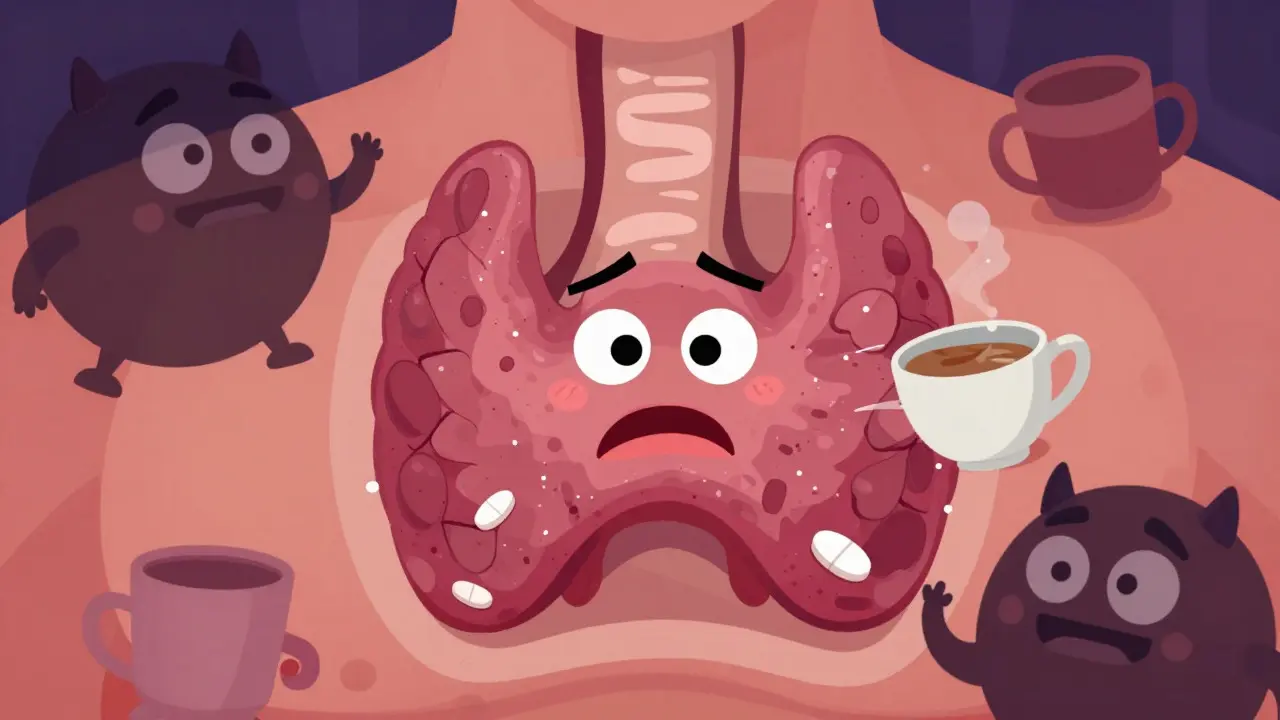
You might think, "I’ll just drink black coffee while I wait." Bad idea. Coffee is a major interference agent. A study in the journal Thyroid found that coffee decreases levothyroxine absorption by 36%. That’s more than a third of your dose going down the drain. The tannins and other compounds in coffee bind to the medication, preventing it from crossing into your bloodstream.
This applies to tea as well. Both contain polyphenols that interfere with absorption. So, no cappuccinos, no lattes, and no green tea until after you’ve had your breakfast. Stick to plain water. If you are a coffee addict who can’t start the day without it, you might need to rethink your entire morning routine. Perhaps moving your medication time is the solution we’ll discuss next.
The Supplement Trap: Calcium, Iron, and Vitamins
If you take supplements, you are likely fighting a losing battle against your thyroid medication. Multivitamins, calcium supplements, iron supplements, and antacids are notorious for blocking levothyroxine absorption. They contain minerals that chemically bind to the thyroid hormone in your gut, forming a complex that your body cannot absorb.
| Substance | Impact on Absorption | Required Separation Time |
|---|---|---|
| Calcium Supplements | Reduces absorption by 27-36% | At least 4 hours |
| Iron Supplements | Reduces absorption by 39% | At least 4 hours |
| Coffee | Reduces absorption by 36% | Wait 60+ mins after dose |
| Proton Pump Inhibitors (e.g., Omeprazole) | Alters stomach pH, reducing absorption | Separate by several hours if possible |
| Soy Products | Can inhibit absorption | Separate by 3-4 hours |
For example, if you take a calcium supplement for bone health, do not take it with your thyroid pill. Wait at least four hours. If you take a multivitamin in the morning, consider switching it to dinner time. This separation is crucial because these minerals don’t just slightly hinder absorption; they can block nearly 40% of the dose in some cases. Consistency is key here. If you accidentally take them together once, it might not ruin your month, but doing it regularly will keep your TSH levels unstable.
Morning vs. Night: Is Bedtime Dosing Better?
Here is where things get interesting. Traditional advice says "morning only." But recent research suggests that bedtime dosing might actually be superior for some people. Why? Because when you go to sleep, your stomach is naturally empty for eight hours. You aren’t rushing to eat breakfast, and you aren’t drinking coffee. You are just sleeping.
A systematic review published in the Journal of Clinical Medicine analyzed 12 studies involving over 1,000 patients. They found that evening administration resulted in significantly lower TSH levels compared to morning administration. Lower TSH generally means better thyroid hormone coverage. For patients who struggled with morning adherence-forgetting the 30-minute wait or having an upset stomach-the switch to bedtime was a game-changer.
However, bedtime dosing comes with its own rule: you must wait at least three to four hours after your last meal before taking the pill. If you eat dinner at 7 PM, you can’t take your medication until 10 or 11 PM. This ensures your stomach is truly empty. If you can commit to this schedule, you might find your TSH stabilizes faster and your symptoms improve. Always talk to your doctor before making this switch, as they may need to adjust your dose during the transition.

Special Populations: Pregnancy and Cancer
Not all thyroid patients are created equal. For pregnant women, the stakes are much higher. Thyroid hormone is critical for fetal brain development, especially in the first trimester. The American Thyroid Association recommends keeping TSH below 2.5 mIU/L during early pregnancy. Any fluctuation due to poor absorption could impact the baby’s neurodevelopment. Therefore, strict adherence to the morning fasting protocol is essential for expectant mothers.
Similarly, patients undergoing suppressive therapy for thyroid cancer need extremely tight control, often with TSH targets below 0.1 mIU/L. For these individuals, consistency is life-saving. Variability in absorption isn’t just inconvenient; it’s dangerous. These groups should avoid experimenting with bedtime dosing unless closely monitored by an endocrinologist.
New Formulations: A Future Without Restrictions?
The pharmaceutical industry knows how frustrating these rules are. That’s why new formulations are emerging. Tirosint-SOL an oral solution of levothyroxine sodium, approved by the FDA in 2017, is designed to bypass many of the food interaction issues. Studies show it maintains consistent TSH levels whether taken with or without food. There are also delayed-release capsules in clinical trials that protect the medication from stomach acid and release it deeper in the intestine.
While these options offer hope, they are not yet the standard. Most patients still rely on traditional immediate-release tablets. Until those become obsolete, mastering the timing and absorption rules remains your best tool for managing hypothyroidism effectively.
Practical Tips for Success
So, how do you make this work in real life? Here are some actionable steps:
- Create a Visual Cue: Place your pill bottle next to your toothbrush or keys. Seeing it triggers the habit.
- Use Technology: Set a recurring alarm on your phone labeled "Take Thyroid Meds" followed by another alarm 60 minutes later labeled "Breakfast/Coffee OK."
- Prepare the Night Before: If you choose morning dosing, have your glass of water ready. If you choose evening dosing, plan your dinner time accordingly.
- Track Your Intake: Use a weekly pillbox. Turning the bottle upside down after you take your dose prevents double-dosing if you’re unsure.
- Communicate with Your Doctor: If you’re struggling with side effects like nausea on an empty stomach, ask about switching to bedtime dosing or trying a different formulation.
Remember, the goal is consistency. Whether you take it at 6 AM or 10 PM, do it the same way, every single day. Your thyroid doesn’t care about your schedule; it cares about steady hormone levels.
Can I take my thyroid medication with juice?
It is best to avoid juice. While not as problematic as coffee, fruit juices can alter stomach acidity and may contain fibers or compounds that slightly interfere with absorption. Water is the safest and most recommended beverage for taking levothyroxine.
How long does it take for TSH levels to stabilize after changing timing?
It typically takes 6 to 8 weeks for your TSH levels to reflect changes in medication timing or dosage. Your doctor will likely order blood tests after this period to ensure your new routine is working effectively.
Does soy sauce affect thyroid medication absorption?
Small amounts of soy sauce in cooking are unlikely to cause significant issues. However, large quantities of soy products like tofu, edamame, or soy milk can interfere with absorption. It is recommended to separate soy intake from your medication by at least 3 to 4 hours.