
When you pick up a bottle of medicine or a medical device like an insulin pump, you expect it to work safely and as designed. But behind every product on the shelf, there’s a factory - and not all factories follow the rules. The U.S. Food and Drug Administration (FDA) inspects thousands of manufacturing sites every year, from small labs in India to large plants in China. In 2025, the agency issued 32% more warning letters for quality system violations in medical devices compared to 2024. These aren’t minor slip-ups. They’re systemic failures that can lead to contaminated drugs, faulty devices, and even patient deaths.
Aseptic Processing: The Silent Killer in Clean Rooms
Aseptic processing is the heart of sterile drug manufacturing. It’s how injectables, eye drops, and IV solutions are made without bacteria or fungi getting in. But this is also where the FDA finds the most dangerous flaws. In 2025, 47% of all warning letters cited problems here.
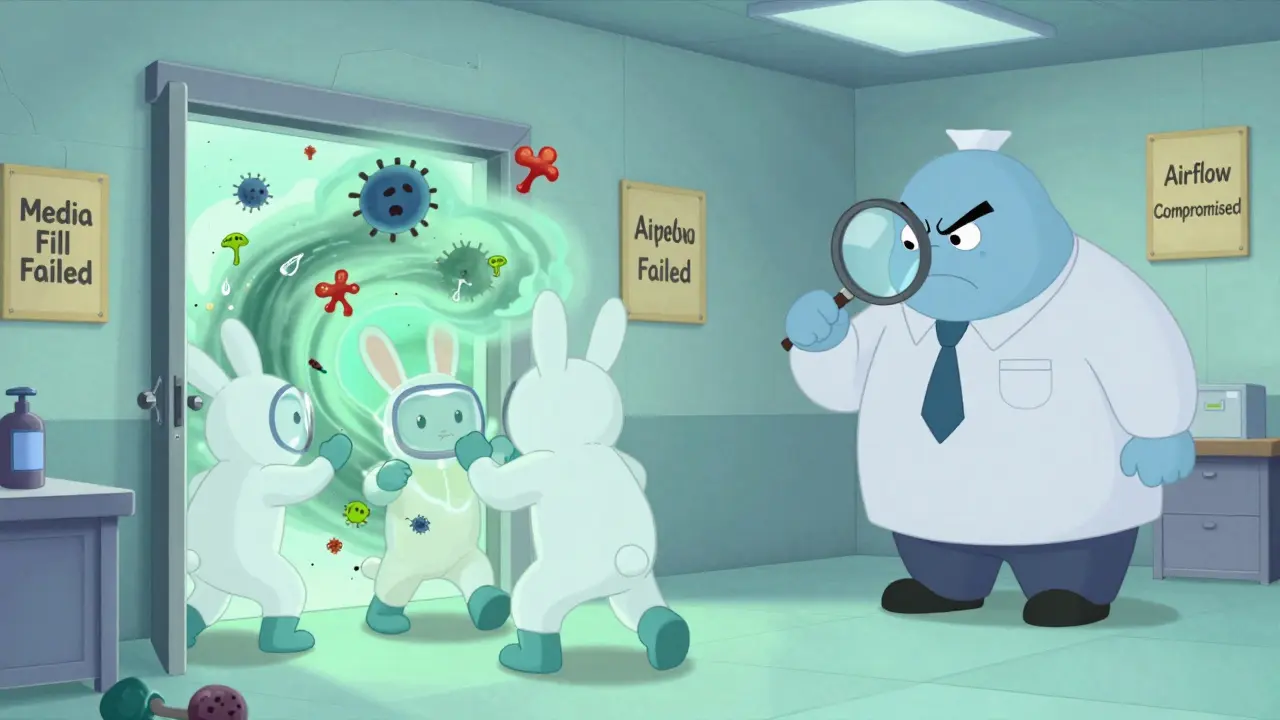
One common issue? Inadequate media fill studies. These are mock runs where manufacturers use a growth medium instead of real drug to test if their clean room can stay sterile. If the medium grows bacteria, the process fails. The FDA found a company, Health and Natural Beauty USA Corp., didn’t run these tests properly - and their sterile eye drops were at risk of contamination.
Another problem? Workers breaking sterile protocols. Gloves touched non-sterile surfaces. Doors opened too often. Airflow systems weren’t calibrated. In one case, a facility in Florida had 14 separate breaches during a single inspection. The FDA didn’t just issue a warning - they put the company on Import Alert 66-40, blocking all products from entering the U.S. until they fix it.
Data Integrity: When Records Are Faked or Lost
Imagine a factory where no one writes down what they did. Or worse - they erase it. That’s what the FDA is seeing in 39% of warning letters in 2025. Data integrity isn’t about paperwork. It’s about trust.
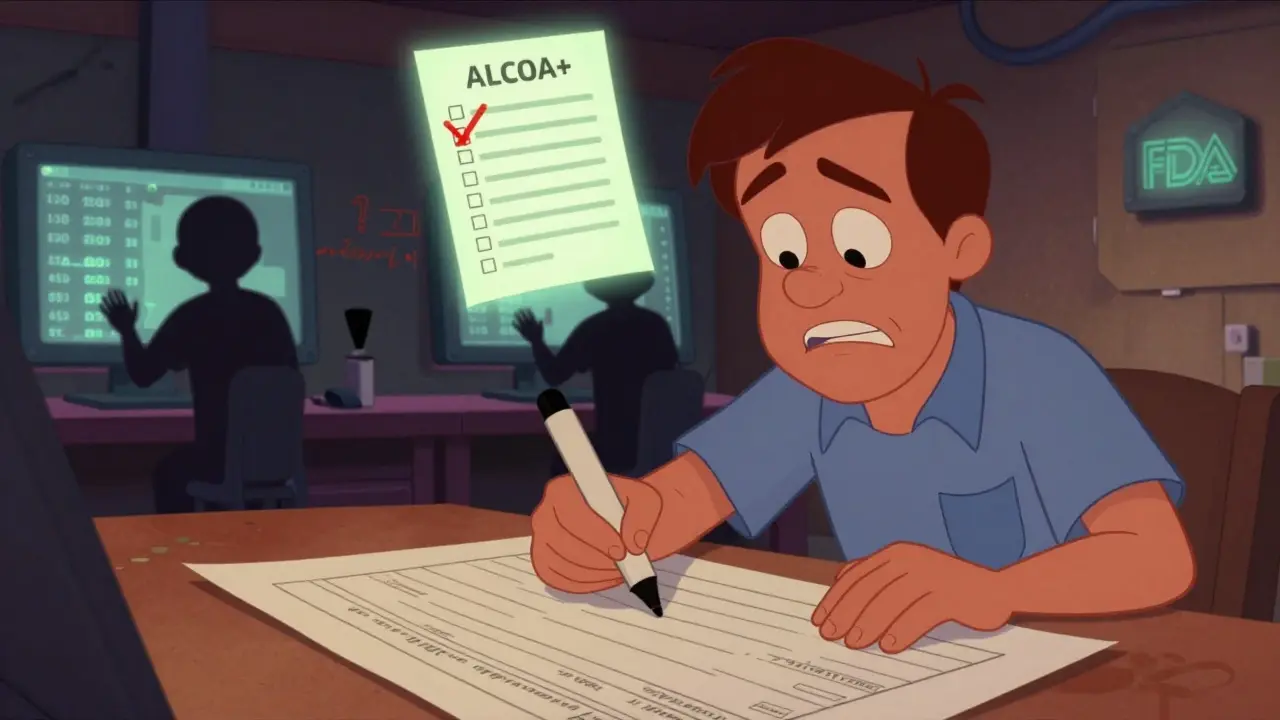
The ALCOA+ principles (Attributable, Legible, Contemporaneous, Original, Accurate, plus Complete, Consistent, Enduring, Available) are the gold standard. But manufacturers are cutting corners. A Chinese company, Guangxi Yulin Pharmaceutical Group, was cited for using UV-Vis and IR instruments without audit trails. That means no one could tell who changed a result or when. Another facility used laminated production logs with erasable markers - meaning someone could wipe out a failed test and rewrite it as passed.
The FDA doesn’t just want records. They want them traceable. Every action must be logged with a timestamp, user ID, and reason for change. In 2025, the agency started requiring validated audit trails with a minimum 180-day retention period. Companies that don’t meet this are stuck in inspection limbo - no product can be shipped until they upgrade their systems.
Material Control: Dirty Raw Ingredients
Garbage in, garbage out. If the raw materials are contaminated, the final product will be too. In 35% of 2025 warning letters, the FDA found companies skipping basic tests on key ingredients.
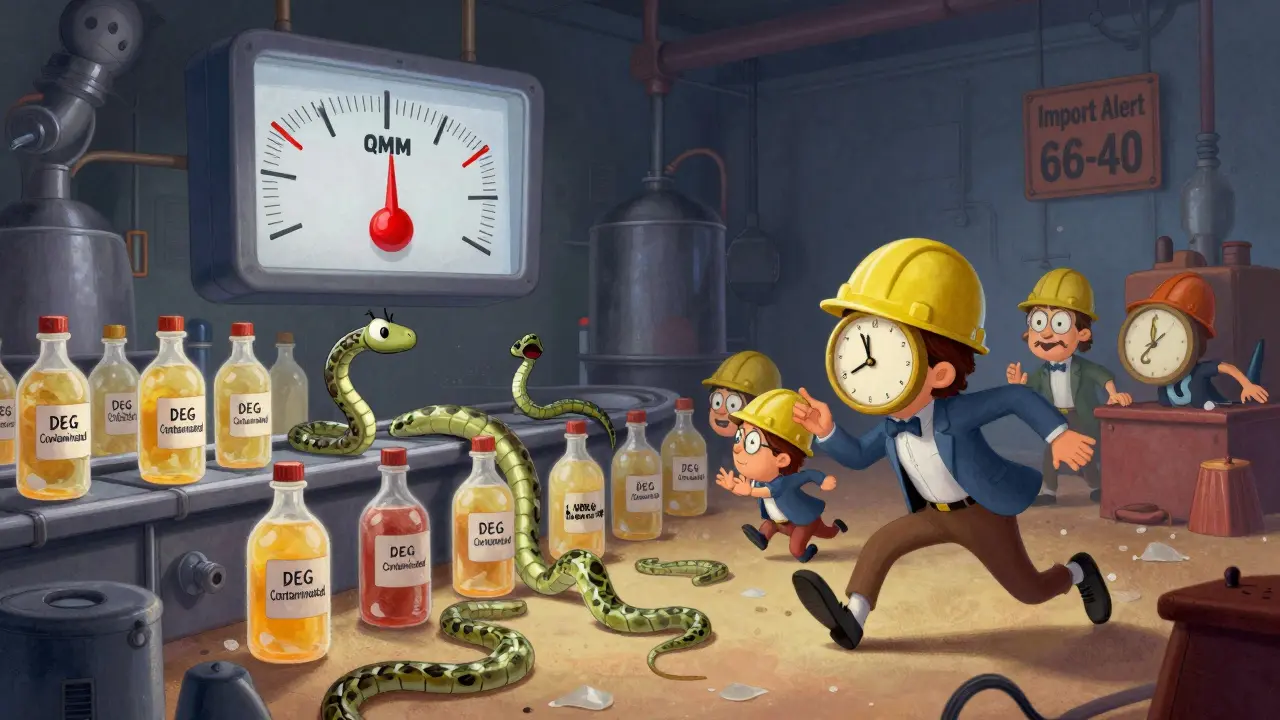
Glycerin and sorbitol are common in oral medicines and topical creams. But they can be contaminated with diethylene glycol (DEG), a toxic chemical that causes kidney failure. In 2007, DEG in a cough syrup killed 100 people in Panama. Since then, the FDA has demanded testing for DEG at levels as low as 0.1% w/w. Yet in 2025, Health and Natural Beauty USA Corp. still didn’t test their glycerin. They relied on a supplier’s certificate - without verifying it.
Another issue? Supplier oversight. One Malaysian facility didn’t audit their contract lab that tested active ingredients. The lab used unvalidated methods. The FDA flagged this as a major risk. If you don’t know if your supplier’s test is accurate, you don’t know if your medicine is safe.
Process Validation: Making Things Work - Consistently
Just because a product works once doesn’t mean it’ll work every time. That’s what process validation is for. The FDA requires manufacturers to prove, with scientific evidence, that their process consistently produces safe, effective products.
In 2025, 28% of warning letters cited missing or flawed validation. One company made toothpaste using a new mixing machine. They never ran validation batches. No one tested for particle size, homogeneity, or stability. When the FDA inspected, they found batches with clumps, uneven active ingredient distribution, and inconsistent flavor. That’s not just bad quality - it’s a safety risk.
The FDA expects three consecutive successful validation batches. Each batch must meet pre-set criteria for critical parameters. For example, a tablet’s dissolution rate must fall within 85-115% of target. If it doesn’t, the process fails. Companies that skip this are gambling with patient health.
Quality Culture: The Root of All Failures
Here’s the truth no one wants to admit: most of these problems aren’t caused by bad equipment or lazy workers. They’re caused by leadership.
Dr. David Lim of Compliance Architects found that 78% of facilities cited in 2025 warning letters had a culture where speed trumped safety. Managers pressured teams to meet deadlines, even if tests failed. Quality teams were underfunded. When someone raised a red flag, they were told to "keep it quiet."
One Indian facility had no independent Quality Unit. The person responsible for quality also handled production. How can you audit yourself? The FDA saw this in four separate warning letters. In China, 28 letters pointed to weak analytical method validation - because engineers were told to "get it approved" instead of "get it right."
The FDA’s Quality Management Maturity (QMM) program, launched in 2024, now includes 87 manufacturers. It’s voluntary - but it’s becoming mandatory in practice. Starting in Q2 2026, the FDA will use QMM scores to decide how often a facility gets inspected. Companies with strong cultures get fewer visits. Those with poor cultures get unannounced inspections every 6 months.
Who’s Getting Hit the Hardest?
The FDA’s 2025 enforcement data shows clear geographic patterns:
- China: 32% of all warning letters. Top issue: analytical method validation. Many labs use outdated methods that don’t detect impurities.
- India: 29% of letters. Top issue: data integrity. Over 24 letters cited missing audit trails or paper records altered with erasable pens.
- Malaysia: 12% of letters. Top issue: lack of authority in the Quality Unit. Quality teams were reporting to production managers - not independent leaders.
These aren’t random. They’re patterns. The FDA has mapped them. And they’re targeting them.
What Happens When You Get Caught?
Getting a warning letter isn’t the end - but it’s the start of a long, expensive journey.
- 92% of 2025 warning letters required hiring an independent CGMP consultant. These consultants cost $150-$300/hour. A full remediation can run over $500,000.
- Facilities on Import Alert 66-40 can’t ship to the U.S. until they pass a re-inspection. That means lost revenue, delayed launches, and canceled contracts.
- Remediation takes 6-18 months. For a new drug launch, that’s a year of lost revenue.
Companies that fix their quality culture see results. The FDA’s own data shows that facilities with strong quality cultures have 63% fewer repeat findings and fix problems 41% faster than those that just patch the paperwork.
The Future Is Here: Digital Systems and Supply Chain Scrutiny
The FDA isn’t slowing down. In 2026, they’re expanding unannounced inspections to U.S. facilities - up from 850 in 2025 to 1,200. That’s a 41% increase.
New focus areas:
- Cloud-based quality systems: 12 warning letters in 2025 cited weak access controls for cloud platforms. If your quality data is stored online, who can access it? Can it be altered? The FDA now requires full audit trails even for cloud systems.
- Contract testing labs: 8 letters cited poor oversight of third-party labs. If you outsource testing, you’re still responsible for the results.
- Continuous manufacturing: 5 letters targeted companies using new tech like real-time monitoring. If you’re using advanced manufacturing, you need advanced validation.
The message is clear: the FDA doesn’t just want compliance. They want accountability. They want transparency. And they want you to prove it - every time.
What happens if the FDA finds a manufacturing deficiency?
If the FDA finds a serious deficiency, they issue a warning letter. The company must fix the problem, often within 6-18 months. They may be placed on Import Alert 66-40, blocking U.S. shipments until they pass a re-inspection. In severe cases, products are recalled, and executives can face criminal charges. The cost of remediation often exceeds $500,000, not including lost sales.
Which countries have the most FDA manufacturing violations?
In 2025, China, India, and Malaysia accounted for 73% of all FDA warning letters. China led in analytical method validation failures, India in data integrity issues, and Malaysia in weak Quality Unit authority. These patterns are consistent with the FDA’s targeted inspection strategy in Asia.
What is the FDA’s Quality Management Maturity (QMM) program?
The QMM program is a voluntary assessment launched in January 2024 to help manufacturers go beyond basic compliance. It evaluates a company’s quality culture, leadership commitment, and systems maturity. As of September 2025, 87 companies participated. Starting in Q2 2026, QMM results will influence how often a facility is inspected - high performers get fewer visits, while low performers get unannounced checks.
Why does the FDA care about data integrity?
Data integrity ensures that test results, production logs, and quality records are accurate, unaltered, and traceable. If a company erases a failed test or doesn’t log who made a change, there’s no way to know if a product is safe. The FDA requires ALCOA+ compliance: records must be attributable, legible, contemporaneous, original, accurate, and complete. Violations here are among the most serious because they hide risks.
Can a company recover after an FDA warning letter?
Yes - but it’s hard. Companies that fix their quality culture, not just their paperwork, have the best chance. The FDA reports that facilities with strong quality cultures see 63% fewer repeat findings and fix problems 41% faster. Recovery requires hiring independent consultants, overhauling systems, retraining staff, and proving long-term compliance through multiple successful inspections. It takes time, money, and real leadership.
Tommy Chapman
February 21, 2026 AT 21:41Let me get this straight - we’re letting China and India make our life-saving drugs while they cut corners like it’s a damn TikTok challenge? The FDA’s just handing out warning letters like candy. If this was a car company, they’d be shut down and the CEOs would be in handcuffs. But nope, we just keep buying their tainted insulin and eye drops. Wake up, America. We’re being poisoned by foreign negligence and our own apathy.
Hariom Sharma
February 22, 2026 AT 08:08Hey, I get the frustration - but let’s not throw the baby out with the bathwater. Many Indian and Chinese labs are doing *amazing* work - just not all of them. The FDA’s spotlight is actually helping raise standards. I’ve seen factories in Pune and Hangzhou that are ISO-certified and run like Swiss clocks. It’s not about the country - it’s about the culture. And honestly? We’re starting to see real change. Slow, but real.
Nina Catherine
February 22, 2026 AT 10:24OMG this post is so eye-opening!! I had no idea about the glycerin thing?? Like, I use that in my face cream and now I’m paranoid 😅 But seriously, the data integrity part? That’s wild. If they’re erasing test results with erasable pens?? That’s like writing your report in crayon and then wiping it. I hope they’re all getting fined into oblivion. Also, why is no one talking about the cloud systems?? That’s next level scary.
Taylor Mead
February 22, 2026 AT 14:52Interesting breakdown. I’ve worked in pharma QA for 12 years, and honestly? The culture thing is 100% spot on. You can have the best tech and training, but if leadership’s pushing for faster turnaround over safety, it’s a ticking time bomb. I’ve seen it firsthand. The fix isn’t more audits - it’s leadership that actually listens to the quality team. And yeah, that’s rare. But it’s not impossible.
Amrit N
February 23, 2026 AT 06:15So the FDA is finally waking up? Took em long enough. I work in a lab in Kerala and we’ve been screaming about audit trails for years. Management just shrugged. Now that the FDA’s threatening to block shipments? Suddenly everyone’s got a new laptop and a password policy. Funny how money talks. Hope this sticks.
Courtney Hain
February 24, 2026 AT 01:33Let’s be real - this isn’t about bad factories. This is about a global conspiracy to poison Americans. The FDA is either complicit or completely clueless. Why do you think they only target India and China? What about the US labs? They’re doing the same thing, but under the radar. I’ve got sources. I’ve seen the documents. The FDA is in bed with Big Pharma. They’re letting the worst offenders slip through because they’re owned by lobbyists. The 32% increase? That’s a smokescreen. They’re just moving the dirt around. And don’t even get me started on the cloud systems - they’re all being hacked by foreign actors. This is a bio-weapon waiting to happen. We’re one contaminated batch away from a national crisis. And no one’s talking about it because they’re too scared.
Greg Scott
February 25, 2026 AT 11:20Good read. I’m not surprised by the numbers - I’ve been in this industry too long. But I do think the QMM program is a step in the right direction. It’s not perfect, but rewarding good culture instead of just punishing bad behavior? That’s smart. The real win will be when companies start competing on quality, not cost. That’s when things will actually change.
Caleb Sciannella
February 26, 2026 AT 07:29While the data presented is compelling and aligns with regulatory trends, it is imperative to contextualize these findings within the broader framework of global supply chain complexity. The rise in warning letters reflects not merely negligence, but the expansion of regulatory scrutiny into previously under-monitored regions. Moreover, the emphasis on ALCOA+ compliance and audit trail integrity underscores a paradigm shift toward evidence-based governance in pharmaceutical manufacturing. The cost of remediation, while substantial, is dwarfed by the potential human and economic toll of systemic failure. Thus, the current enforcement posture, though stringent, is neither excessive nor unwarranted - it is, in fact, a necessary evolution.
Maddi Barnes
February 27, 2026 AT 05:19Okay, but have y’all seen the TikTok videos from those Chinese labs? 😂 Like, one guy’s in a hoodie, sipping boba, while the cleanroom’s got a dust bunny the size of a cat. And the ‘audit trails’? More like ‘audit trails of regret.’ I mean, we’re trusting our insulin to factories where the QA person also does the accounting. And don’t even get me started on the ‘laminated logs with erasable pens’ - that’s not a quality system, that’s a kindergarten art project. 😭 FDA, I love you, but please, for the love of all that is holy, start doing surprise inspections during lunch hour. That’s when the real chaos happens.
Oana Iordachescu
February 28, 2026 AT 21:39While the FDA’s focus on data integrity is commendable, it is worth noting that the root cause lies not in the manufacturing facilities themselves, but in the global economic pressure to reduce production costs. The requirement for 180-day audit trails is a step forward - yet, without binding international regulatory harmonization, enforcement remains fragmented. Furthermore, the notion that ‘culture’ is the primary driver overlooks structural incentives: when raw material procurement is outsourced to third-tier vendors with no regulatory oversight, compliance becomes a mathematical impossibility. This is not a failure of ethics - it is a failure of systemic design.
Michaela Jorstad
March 1, 2026 AT 02:09Wow. This is terrifying. I had no idea how much of our medicine comes from places with zero oversight. And the part about glycerin? I use that in my homemade lotion. I’m going to throw it out right now. But seriously - the fact that companies are just skipping tests? And no one’s checking? It’s like they’re playing Russian roulette with our lives. I hope this gets more attention. We need to demand transparency. Like, NOW. And maybe we should all start boycotting anything made outside the U.S. until they fix this. I’m not kidding.
Chris Beeley
March 2, 2026 AT 17:12Let’s be honest - this isn’t about quality. This is about power. The FDA has become a bureaucratic empire, weaponizing compliance to extort billions from global manufacturers while protecting American monopolies. The real scandal? The fact that U.S.-based companies are doing the exact same things - but they’re shielded by regulatory capture. The warning letters? A theater. The Import Alert 66-40? A trade barrier disguised as public safety. And the QMM program? A PR stunt to make foreign companies beg for mercy. Meanwhile, the FDA quietly approves new drugs from American labs with zero audit trails. The hypocrisy is staggering. This isn’t about safety - it’s about control. And if you think otherwise, you’re either naive… or paid.