
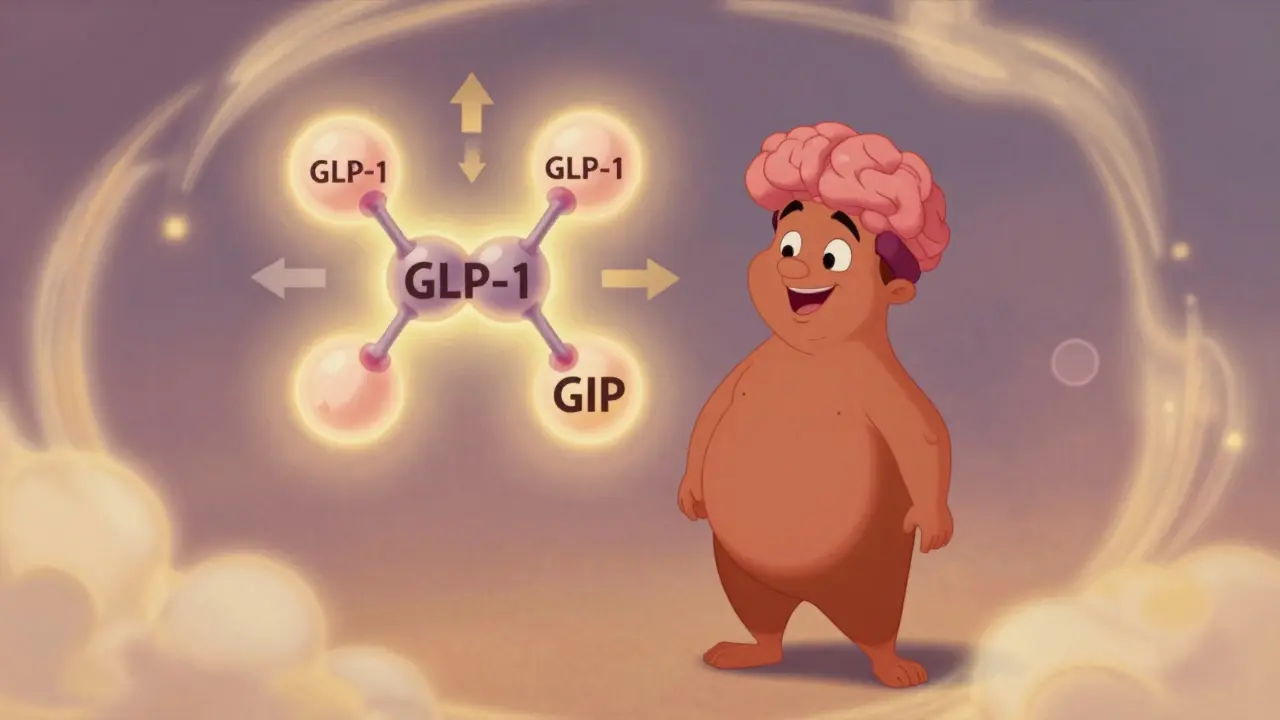
When it comes to weight loss medications, tirzepatide isn’t just another option-it’s a game-changer. Approved by the FDA for chronic weight management in November 2023 under the brand name Zepbound, this drug doesn’t just suppress appetite like older treatments. It rewires how your body handles hunger, fat storage, and energy use-all at once. If you’ve tried diets, exercise, or even other weight-loss drugs without lasting results, understanding tirzepatide might be the missing piece.
What Makes Tirzepatide Different?
Most weight-loss drugs target one hormone: GLP-1. That’s the hormone your gut releases after eating to signal fullness. Drugs like semaglutide (Wegovy) work by mimicking GLP-1. Tirzepatide does that too-but it also mimics a second hormone called GIP. This dual action is why experts call it a “twincretin.” GIP isn’t just a backup player. It helps your body store energy in fat cells under normal conditions. But with tirzepatide, GIP’s role flips. Instead of promoting fat storage, it helps your body burn more calories and improves how your muscles and fat tissue respond to insulin. In simple terms: tirzepatide doesn’t just tell your brain to eat less-it helps your body burn fat more efficiently.How Much Weight Can You Lose?
Clinical trials show results that were once thought impossible. In the SURMOUNT-1 study, people using the highest dose (15 mg weekly) lost an average of 22.5% of their body weight over 72 weeks. That’s not 10 or 15 pounds-it’s over 50 pounds for someone who weighs 250. Compare that to semaglutide, which averaged 14.9% weight loss in the same timeframe. Tirzepatide beat it by more than 50%. But it’s not just about the number on the scale. People lost more fat, especially around the belly, and kept more muscle. Blood sugar improved even in those without diabetes. Insulin sensitivity got better. Inflammation in fat tissue dropped. These aren’t side effects-they’re core benefits of the dual mechanism.How Does It Actually Work in Your Body?
Tirzepatide works on multiple levels:- Brain: It targets areas that control hunger and cravings, making food less tempting and reducing the urge to snack.
- Pancreas: It boosts insulin release only when blood sugar is high-so it doesn’t cause dangerous drops.
- Stomach: It slows down digestion, so you feel full longer after meals.
- Fat tissue: It reduces inflammation and increases adiponectin, a hormone that helps burn fat and improves insulin response.
- Muscles: It helps them take in more glucose, which lowers blood sugar and reduces fat storage.
Side Effects: What to Expect
No medication comes without trade-offs. The most common side effects are gastrointestinal: nausea (20-25%), vomiting (7-10%), and diarrhea (15-18%). These aren’t rare-they’re expected, especially when starting or increasing the dose. The good news? Most people get used to them. Studies show that if you follow the FDA’s recommended titration schedule-starting at 2.5 mg and slowly increasing every 4 weeks-side effects drop significantly. Skipping steps or rushing the dose increase is the #1 reason people quit. Some people report dizziness, fatigue, or constipation. Rare but serious risks include pancreatitis and gallbladder problems. There’s also a theoretical risk of thyroid tumors based on rodent studies, which is why tirzepatide is not approved for anyone with a personal or family history of medullary thyroid cancer.
Real People, Real Results
On Reddit’s r/Mounjaro community, users share stories that match the clinical data. One person lost 58 pounds in six months on 15 mg. Another said the hunger they felt on semaglutide vanished completely on tirzepatide. But not everyone has success. Around one-third of users stop because side effects are too tough. Many say the nausea hit hard during the first few weeks. Those who stuck with it-usually by eating smaller meals, avoiding greasy food, and staying hydrated-often say it got better after week 8. One user wrote: “I thought I’d never lose weight. I’ve tried everything. Tirzepatide didn’t just help me lose weight-it changed how I think about food. I don’t crave it like before.”Dosing and How to Start
Tirzepatide is given as a once-weekly injection under the skin-same as semaglutide. The FDA-approved starting dose is 2.5 mg per week for the first 4 weeks. Then you increase every 4 weeks: 5 mg → 7.5 mg → 10 mg → 15 mg. Most people reach the 15 mg dose by week 20. Some doctors will stretch out the schedule if side effects are strong. That’s okay. There’s no rush. Studies show that even at 10 mg, people still lose 18-20% of their body weight. You don’t need to hit 15 mg to see results. The medication must be stored in the fridge until first use. After that, it can stay at room temperature for up to 4 weeks. Injection sites include the abdomen, thigh, or upper arm. Rotate sites to avoid irritation.Cost and Access
The list price for a 4-week supply is over $1,000. But most people don’t pay that. Thanks to manufacturer co-pay programs and insurance coverage, 89% of commercially insured patients pay less than $100 a month. Some pay as little as $45. The Lilly Cares Foundation offers free medication to eligible low-income patients. Medicare coverage varies by plan, but many are now covering Zepbound for obesity treatment. Medicaid coverage is expanding rapidly in 2025.
What Happens When You Stop?
This is the big question. Tirzepatide doesn’t cure obesity-it manages it. When people stop taking it, they tend to regain weight. In follow-up studies, users regained about 12-15% of the weight they lost within 6 months of stopping. That doesn’t mean it’s useless. It means you need a plan. Many doctors recommend combining tirzepatide with lifestyle changes: regular movement, protein-rich meals, sleep hygiene, and stress management. Think of the drug as a tool to help you retrain your body, not a permanent fix.The Future: What’s Next?
Tirzepatide isn’t the end-it’s the beginning. Lilly is already testing a triple agonist called retatrutide, which targets GLP-1, GIP, and glucagon. Early results show up to 24.2% weight loss in 24 weeks. The FDA just approved Zepbound for treating obstructive sleep apnea in adults with obesity-making it the first weight-loss drug with that specific approval. Trials are also underway for non-alcoholic fatty liver disease (NASH) and heart health. Experts agree: dual and triple incretin therapies are the future. Tirzepatide proved that hitting two targets at once works better than one. The next wave will hit three.Who Should Consider It?
Tirzepatide is approved for adults with obesity (BMI ≥30) or overweight (BMI ≥27) with at least one weight-related condition like high blood pressure, type 2 diabetes, or sleep apnea. It’s not for everyone. Avoid it if you:- Have a personal or family history of medullary thyroid cancer
- Have Multiple Endocrine Neoplasia syndrome type 2
- Are pregnant or planning to become pregnant
- Have severe GI issues like gastroparesis
How long does it take to see weight loss with tirzepatide?
Most people start noticing changes in appetite and slight weight loss within the first 2-4 weeks. Significant weight loss (5% or more of body weight) usually happens by week 12-16. The biggest drops come between months 4 and 8, with peak results around 72 weeks.
Is tirzepatide the same as semaglutide?
No. Both are injectable weight-loss drugs, but semaglutide only activates the GLP-1 receptor. Tirzepatide activates both GLP-1 and GIP receptors. This dual action leads to greater weight loss, better blood sugar control, and more fat loss, even when appetite suppression is similar.
Can I take tirzepatide if I don’t have diabetes?
Yes. Tirzepatide is FDA-approved for chronic weight management in adults with obesity or overweight-even if they don’t have diabetes. The brand name for weight loss is Zepbound, while Mounjaro is used for type 2 diabetes. The same drug, different approval.
Do I need to diet and exercise while on tirzepatide?
You don’t have to, but you’ll get better results. Tirzepatide reduces hunger and helps your body burn fat, but combining it with healthy eating and regular activity improves long-term success and helps prevent weight regain after stopping.
What’s the biggest mistake people make with tirzepatide?
Rushing the dose increase. Many people try to jump to 10 mg or 15 mg too fast to see faster results. That leads to severe nausea and vomiting-and often causes them to quit. Following the 4-week titration schedule dramatically improves tolerance and long-term use.
How do I know if tirzepatide is right for me?
Talk to a doctor who specializes in obesity or endocrinology. They’ll check your BMI, medical history, current medications, and any family history of thyroid cancer. If you’ve struggled with weight loss despite trying other methods, and you’re willing to stick with a long-term plan, tirzepatide could be a powerful option.
Duncan Careless
December 30, 2025 AT 03:39tirzepatide sounds like a miracle but i’m scared of the nausea. i tried semaglutide and barely made it past week 2. maybe i just need to go slower… but my stomach’s still mad at me for even thinking about it.
Nisha Marwaha
December 31, 2025 AT 22:10From a metabolic endocrinology standpoint, the dual GIP/GLP-1 co-agonism represents a paradigm shift in adipose tissue remodeling. The GIP receptor modulation induces a phenotypic switch in white adipocytes toward a beige/brown-like state, enhancing uncoupling protein-1 (UCP1) expression and non-shivering thermogenesis. This is distinct from GLP-1 monotherapy, which primarily acts via central satiety pathways.
Additionally, the insulin-sensitizing effects in skeletal muscle are mediated via AMPK/PI3K cross-talk, leading to improved GLUT4 translocation independent of weight loss. The reduction in adipose tissue macrophage infiltration further supports a systemic anti-inflammatory effect.
These mechanisms collectively explain the superior fat mass reduction and metabolic improvements observed in SURMOUNT-1, particularly in non-diabetic cohorts.
David Chase
January 2, 2026 AT 17:18THIS IS WHY AMERICA IS FALLING BEHIND!!! 🤬 People in other countries are getting fat because they’re too lazy to just eat less and move more!! Why are we giving people a magic pill?? 😤 This isn’t medicine, it’s a crutch for people who can’t control themselves!! 🇺🇸💪
And don’t even get me started on the cost-$1000 a month?!?! That’s a luxury for rich people who can’t even cook a damn chicken!! 🍗🚫
Also, did you know rats got tumors?? 😱 That’s not a side effect-that’s a warning sign!! We’re turning into a nation of weaklings!!
Joe Kwon
January 3, 2026 AT 02:46David, I hear you on the frustration-but I think it’s more nuanced than ‘lazy vs disciplined.’
Obesity is a complex neuroendocrine disorder, not a moral failing. Tirzepatide isn’t about avoiding effort-it’s about giving people a biological advantage to *sustain* effort.
Think of it like insulin for diabetes: you don’t blame someone for needing it. Same logic applies here.
Also, the rodent tumor data? That was at doses 50x higher than humans take, and in strains genetically prone to tumors. FDA reviewed it thoroughly. The risk is theoretical, not observed in humans.
Let’s not throw the baby out with the bathwater. This drug changed lives. Let’s make it accessible, not demonize it.
Nicole K.
January 4, 2026 AT 02:55So you're telling me it's okay to take a drug to avoid eating healthy? That's just cheating. God gave us willpower. If you can't control your eating, maybe you need to pray more and stop looking for shortcuts. This is why our society is so broken-everyone wants a pill for everything. No discipline. No character. Just pills.
Fabian Riewe
January 5, 2026 AT 16:49Just wanted to say-this thread is actually really helpful. I started tirzepatide 3 months ago at 2.5mg, and honestly? The first 4 weeks were rough. Nausea, zero appetite, felt like I was going to throw up every time I smelled food.
But I stuck with it. Ate bland stuff-rice, chicken, broth. Drank water like a maniac. Cut out fried food.
By week 8? The hunger just… disappeared. Not like ‘I’m not hungry’-more like ‘I don’t even think about food anymore.’
Lost 42 lbs so far. My knees don’t hurt. I slept through the night for the first time in 10 years.
It’s not magic. But it’s the first thing that actually worked for me. And yeah, I still work out. But now I *want* to. Not because I’m forced to. Because I feel good.
Amy Cannon
January 5, 2026 AT 17:16It is with profound solemnity that I address the sociocultural implications of pharmaceutical intervention in the realm of metabolic regulation, particularly as it pertains to the dual incretin agonist tirzepatide. The advent of such pharmacologic agents, while undeniably efficacious in clinical trials, simultaneously underscores a systemic erosion of embodied self-regulation within the post-industrial West.
One cannot help but observe the commodification of bodily autonomy, wherein the human organism is rendered a site of technical intervention rather than a vessel of moral and spiritual discipline. The normalization of weekly subcutaneous administration as a prerequisite for social acceptability signals a troubling convergence of medicalization and consumerism.
Moreover, the assertion that ‘it’s not about losing pounds, it’s about gaining health’-while rhetorically soothing-risks obscuring the foundational imperative of lifestyle as the bedrock of physiological equilibrium. The pharmaceutical industry, ever vigilant, has expertly co-opted the language of wellness to mask the perpetuation of dependency.
Yet, I do not condemn those who benefit. I lament the structural conditions that render such dependency necessary. Perhaps the true revolution lies not in the drug, but in the reclamation of food as nourishment, movement as ritual, and rest as sacred practice.
Himanshu Singh
January 7, 2026 AT 14:25i started on 5mg last month and lost 18lbs already. no nausea at all! maybe i just have a strong stomache 😅. my doctor said i should keep going to 15mg. i’m not even trying to diet, just eating normal food. it’s wild how my cravings just vanished. i used to snack all day, now i forget i’m hungry. this drug is a game changer for real.