
Warfarin Binge Drinking Risk Calculator
How Does Your Alcohol Use Affect Warfarin Safety?
This tool helps you understand the bleeding risk associated with alcohol consumption while taking warfarin. Based on data from the National Institute on Alcohol Abuse and Alcoholism and clinical studies.
This tool calculates your bleeding risk based on the latest clinical evidence. For safety, consult your healthcare provider before changing your alcohol consumption habits.
If you're taking warfarin, you know it requires careful monitoring. But what happens when you mix it with binge drinking? This isn't just a "maybe" danger-it's a real threat that can send you to the hospital with life-threatening bleeding. Let's break down exactly why alcohol and warfarin don't mix, what happens to your INR levels, and how to stay safe.
What Warfarin Does and Why It Needs Careful Monitoring
Warfarin is a vitamin K antagonist anticoagulant first approved by the U.S. Food and Drug Administration (FDA) in 1954. It's used to prevent blood clots in conditions like atrial fibrillation, deep vein thrombosis, and pulmonary embolism. Warfarin works by blocking vitamin K, which your body needs to form clots. But this delicate balance means even small changes can lead to dangerous bleeding or clotting. That's why regular blood tests are critical to keep your INR in the safe zone.
Understanding INR and Why It Matters
INR (International Normalized Ratio) is a standardized measure used to monitor the blood's clotting ability. A normal INR is around 1.0, but for people on warfarin, the target range is typically between 2.0 and 3.0 for most conditions. If your INR drops below 2.0, your blood may clot too easily. If it rises above 3.0, you're at higher risk of bleeding. Even a small swing can have big consequences-especially when alcohol gets involved.
What Counts as Binge Drinking?
Binge drinking is defined by the National Institute on Alcohol Abuse and Alcoholism (NIAAA) as consuming 5 or more standard drinks for men or 4 or more for women within about two hours. A standard drink is one 12-ounce beer, 5 ounces of wine, or 1.5 ounces of hard liquor. This isn't just about "having a few drinks"-it's a pattern that overwhelms your body's ability to process alcohol safely.
How Alcohol Disrupts Warfarin's Effect
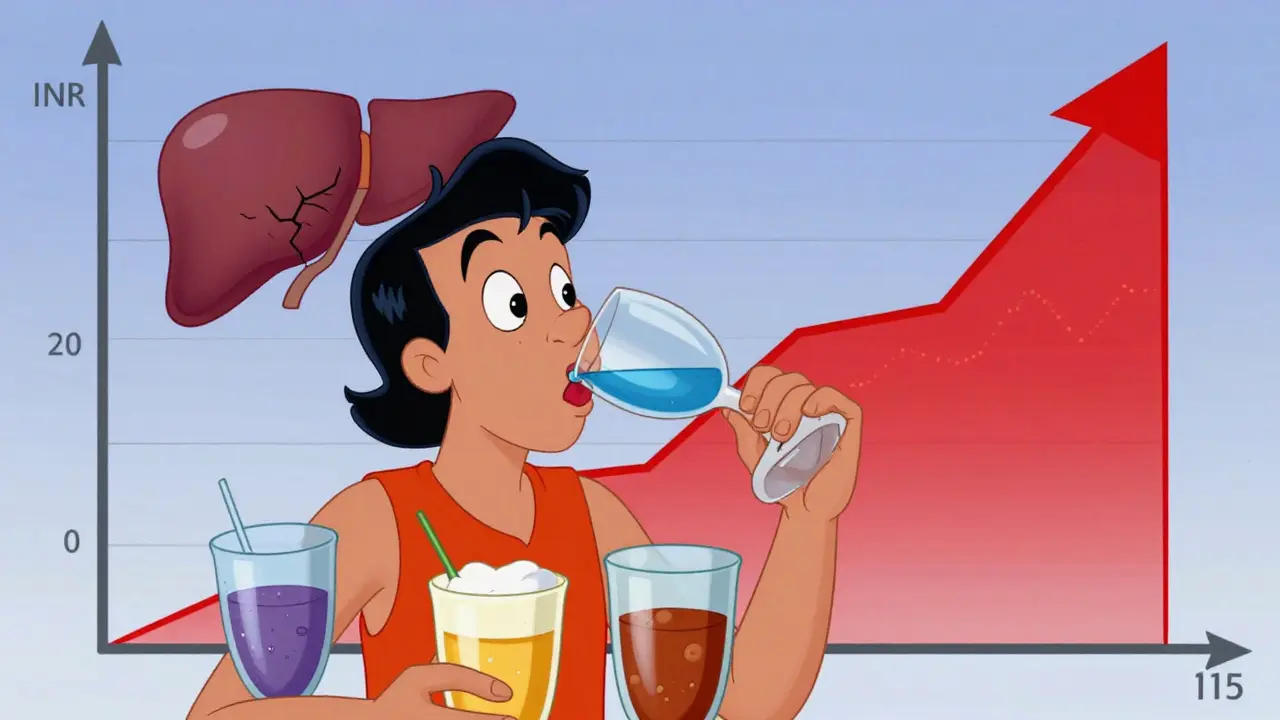
Alcohol affects warfarin in two opposing ways. First, acute binge drinking can temporarily block the liver enzymes (CYP2C9 and CYP3A4) that break down warfarin. This causes warfarin to build up in your system, raising your INR and bleeding risk. Second, chronic heavy drinking damages your liver and reduces vitamin K production. This makes warfarin too effective, also raising INR. The result? Unpredictable swings that make dosing nearly impossible to manage.
The Real-World Danger: Data from Studies
A 2015 study in Pharmacotherapy tracked 1,200 warfarin users and found binge drinkers had a 2.3-fold higher risk of major bleeding compared to non-bingers. For those on warfarin for over a year, the risk jumped to 3.1 times higher. Even scarier: people with certain genetic variants (like CYP2C9*2 or *3) saw a 4.2-fold increased risk. These aren't theoretical numbers-they translate to real hospitalizations. The NHS explicitly warns that "drinking heavily, especially binge drinking lots of alcohol in one go, is dangerous while taking warfarin. The alcohol can increase the risk of bleeding."
Expert Guidelines: What Do Doctors Really Say?
Organization
Recommendation
Notes
NHS (UK)
No more than 14 units per week, spread out
Avoid consuming all units in a single session
British Heart Foundation
Max 14 units weekly
Particularly important to avoid binge drinking
University of Iowa Health Care
≤2 drinks/day for men; ≤1 for women
Any binge drinking is unsafe
American Heart Association
8-10 units per week
Strictly avoid binge patterns
What to Do If You Drink Alcohol While on Warfarin
If you choose to drink, follow these steps:
- Never binge drink-stick to the recommended limits (e.g., one drink per day for women, two for men).
- Check your INR within 72 hours after drinking, especially if you had more than a few drinks.
- Ask your doctor about switching to a direct oral anticoagulant (DOAC) if you regularly drink. While DOACs also carry risks with alcohol, they have fewer interactions than warfarin.
- Know the warning signs of bleeding: unusual bruising, nosebleeds that won't stop, blood in urine or stool, or severe headaches.

Why Patient Education Saves Lives
The Agency for Healthcare Research and Quality (AHRQ) found that structured education reduced warfarin-related bleeding by 37% in a 2022 trial. Simple reminders-like "Don't drink all your weekly alcohol in one night"-make a huge difference. Pharmacists are trained to counsel patients on this risk. If your pharmacist hasn't discussed alcohol with you, ask. It's a critical part of staying safe.
When to Consider Alternatives to Warfarin
The National Institute for Health and Care Excellence (NICE) recommends considering direct oral anticoagulants (DOACs) like rivaroxaban for patients who regularly exceed alcohol limits. While DOACs still interact with alcohol (they increase bleeding risk too), they don't require frequent INR checks. However, switching isn't automatic-your doctor will weigh factors like kidney function, cost, and other medications. The key takeaway: if you struggle to limit alcohol, talk to your doctor about alternatives before a bleeding event happens.
What Happens If You Binge Drink Once?
Even one binge drinking episode can spike your INR for days. A 2020 analysis of 12,450 warfarin users showed binge drinkers spent 42% more time outside the safe INR range compared to abstainers. This isn't just about "one bad night"-it's a pattern that erodes your safety margin. If you binge drink, contact your anticoagulation clinic immediately for an INR check and possible dose adjustment.
Frequently Asked Questions
Can I have a glass of wine with warfarin?
Yes, but only if you stay within limits. The British Heart Foundation says up to 14 units per week is generally safe if spread out. One glass of wine (about 1 unit) is usually fine. But never drink all your weekly allowance in one night. Remember: "It is OK to consume alcohol if you are taking warfarin, so long as you stick to recommended guidelines for a low-risk maximum weekly alcohol intake."
What happens if I binge drink once while on warfarin?
Your INR could spike dangerously high within hours. You might not feel symptoms right away, but internal bleeding could start. Contact your doctor immediately for an INR test. They may temporarily reduce your warfarin dose. If you experience bleeding signs (like blood in urine or black stools), go to the ER. One binge can undo weeks of careful management.
Are there safer blood thinners than warfarin for drinkers?
Direct oral anticoagulants (DOACs) like apixaban or rivaroxaban have fewer food and alcohol interactions than warfarin. However, alcohol still increases bleeding risk with DOACs. The FDA's MAUDE database shows a 1.8-fold higher risk of gastrointestinal bleeding with rivaroxaban in heavy drinkers. Switching isn't always possible-your doctor will consider kidney function, cost, and other health factors. The best approach is to limit alcohol regardless of which blood thinner you take.
How often should I check my INR if I drink alcohol?
If you drink occasionally (within limits), stick to your regular monitoring schedule. But after any binge drinking episode, get your INR checked within 72 hours. The Anticoagulation Forum recommends this because alcohol effects can last days. If you drink regularly, your doctor may increase testing frequency. For example, someone who drinks weekly might need INR checks every 2 weeks instead of monthly.
What are the warning signs of bleeding from warfarin?
Watch for these red flags: unexplained bruising or swelling, persistent nosebleeds or gum bleeding, blood in urine (pink or red) or stool (black/tarry), coughing up blood, severe headaches, or sudden dizziness. If you notice these, seek medical help immediately. Don't wait-bleeding can escalate quickly. The NHS lists these as urgent warning signs requiring emergency care.
Amit Jain
February 6, 2026 AT 04:10Warfarin and binge drinking? What a joke. People think they can handle it, but it's a straight path to the ER. Studies show a 2.3x higher risk-so why debate this? It's not 'maybe dangerous'-it's a guaranteed disaster. If you're drinking like that, you're gambling with your life. End of story.
Heather Burrows
February 6, 2026 AT 21:53You know, it's interesting how society glorifies drinking while ignoring the risks. But perhaps the real issue is the lack of education on medication interactions. We need to stop treating alcohol as harmless, especially when it comes to life-saving drugs like warfarin. It's not just about personal choice-it's systemic.
Sarah B
February 8, 2026 AT 07:27US guidelines are clear 14 units a week max No binge drinking Simple Why can't people follow basic rules
Jesse Lord
February 10, 2026 AT 04:17I get where you're coming from but people have different circumstances Some folks just don't have access to good healthcare or education on this Maybe we should focus on making information more accessible instead of just blaming them
Eric Knobelspiesse
February 11, 2026 AT 04:13Exactly Jesse. It's not about blaming individuals but systemic issues. Like how pharma companies push warfarin over DOACs because it's cheaper. But they don't tell patients about the alcohol risks properly. Toxic systme
Mark Harris
February 11, 2026 AT 10:57Hey everyone! Just wanted to say stay safe. If you're on warfarin, talk to your doctor about alternatives. DOACs might be better if you drink. But always check with a pro. Stay positive!
Ritu Singh
February 12, 2026 AT 08:29Mark, your optimism is appreciated. However, the reality is that DOACs are not universally accessible due to cost and kidney function limitations. We must address healthcare disparities before suggesting alternatives. This isn't just a personal choice-it's systemic
Natasha Bhala
February 13, 2026 AT 02:48Don't drink. Period.
Gouris Patnaik
February 13, 2026 AT 13:32Your experience is valid but you're oversimplifying. Not everyone can quit alcohol. Some have dependencies. The real problem is the lack of support systems for addiction alongside medication management. We need holistic care
Catherine Wybourne
February 15, 2026 AT 12:57Gouris raises a good point. In the UK, we have NHS programs that combine addiction counseling with anticoagulant management. It's not perfect but it's a start. We need more integrated care models globally
AMIT JINDAL
February 17, 2026 AT 02:37Oh wow, this is getting philosophical. Let me tell you something. The real issue is that doctors don't take the time to explain properly. They just say 'don't drink' without context. I had a friend who had a bleed because his INR was off after a single beer. That's why you need to know the specifics. Like, how much alcohol affects your specific genetics. But most docs don't care. They just want you to take the pill and shut up
Marcus Jackson
February 17, 2026 AT 10:37Actually, the docs do explain. It's the patients who don't listen. But yeah, there's a gap in education. I've seen people skip INR tests because they don't want to hear bad news. It's on both sides. We need better communication
Joey Gianvincenzi
February 18, 2026 AT 17:59The FDA has clear guidelines on alcohol and warfarin. Any consumption beyond the recommended limits is a violation of safe practice. It's not a gray area. Period. We must enforce these standards strictly
Tola Adedipe
February 19, 2026 AT 12:48Joey, you're right about the guidelines, but enforcement isn't the issue-it's education. People don't know what '14 units' means. A standard drink is different across cultures. We need clear, culturally sensitive info
Savannah Edwards
February 19, 2026 AT 15:38Exactly Tola. In my work with immigrant communities, I've seen how confusing standard drink measurements can be. A 'glass of wine' in one country might be double in another. This lack of clarity leads to dangerous misunderstandings. We need visual aids and simple explanations-like showing exactly what a 5oz wine pour looks like-alongside the medical advice