
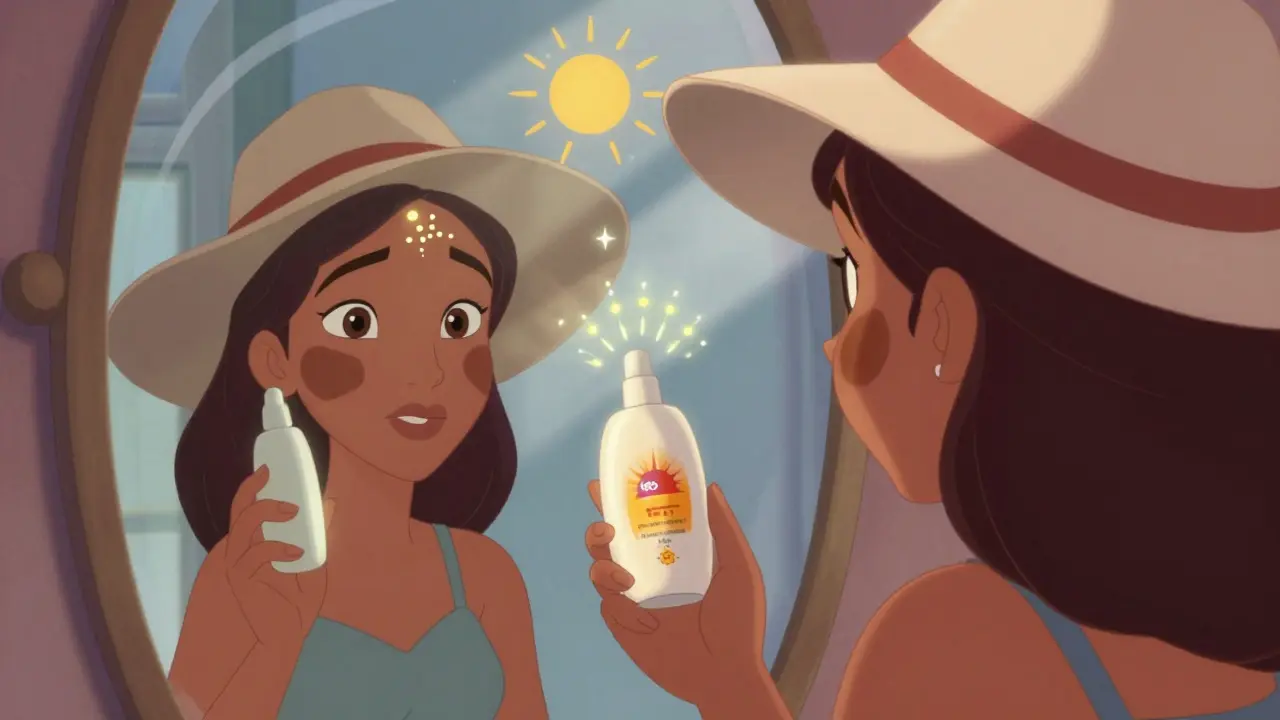
When your skin starts showing dark patches, it’s easy to assume it’s just from too much sun. But not all dark spots are the same. Two of the most common causes of hyperpigmentation - melasma and sun damage - look similar, but they behave completely differently. Treat one like the other, and you could make it worse. Understanding the difference isn’t just helpful - it’s necessary if you want real results.
What’s Really Going On Under Your Skin?
Hyperpigmentation happens when your skin makes too much melanin. That’s the pigment that gives skin its color. But why it overproduces depends on the type. Sun damage, or solar lentigines, is straightforward: UV rays hit your skin, trigger melanocytes (the pigment-producing cells), and you get small, brown spots - usually on the face, hands, or shoulders. These spots are more common in people over 60, especially with fair skin. About 90% of them show visible signs. Melasma is trickier. It doesn’t just come from sun exposure. Hormones play a huge role. If you’re pregnant, on birth control, or going through menopause, your risk goes up. It shows up as larger, symmetrical patches - often on the cheeks, forehead, or upper lip. It mostly affects women with medium to darker skin tones (Fitzpatrick skin types III to VI). Studies show Black, Asian, and Hispanic women are 3 to 5 times more likely to develop melasma than Caucasian women. And it’s not just UV light causing it. Visible light from indoor lighting and even windows can trigger it. Heat does too. That’s why regular sunscreen isn’t enough.Why Your Sunscreen Might Be Failing You
Most people think SPF 30 or 50 means they’re protected. But if you have melasma, that’s not true. Standard sunscreens block UV rays - but not visible light. And visible light contributes to 25-30% of melasma cases. That’s why dermatologists now recommend mineral sunscreens with iron oxides. These ingredients block visible light, which regular chemical sunscreens don’t. Zinc oxide alone helps, but adding iron oxide makes a measurable difference. And it’s not just about applying sunscreen once in the morning. Most people use less than half the amount they should. You need about a quarter teaspoon just for your face. And you have to reapply every two hours if you’re outside - even on cloudy days. A study from YES Medspa found that 70% of melasma patients fail at this. They think they’re protected. They’re not.Topical Treatments: What Works and What Doesn’t
For sun damage, the goal is removal. For melasma, it’s control. That changes everything.- Hydroquinone (4%): This is the gold standard for melasma. It blocks the enzyme tyrosinase, which makes melanin. Used alone, it helps about 30-40% of people. But used in a triple combination - with tretinoin and a corticosteroid - success jumps to 50-70%. The catch? You can’t use it longer than 3 months. After that, you risk exogenous ochronosis - a rare but serious condition where the skin turns darker and bluish-brown. That’s why dermatologists rotate it with other agents.
- Tretinoin (0.025-0.1%): This isn’t just for wrinkles. It speeds up skin cell turnover, so darker patches flake off faster. It’s often paired with hydroquinone. But it can irritate. Start with 0.025% every other night and build up slowly. Most people see improvement after 8-12 weeks.
- Vitamin C (L-ascorbic acid, 10-20%): This antioxidant doesn’t just brighten. It reduces oxidized melanin and blocks tyrosinase. It’s safe for daily use and pairs well with sunscreen. Use it in the morning. It also helps protect against free radicals from pollution and light.
- Tranexamic acid (5%): A newer option. Originally used to reduce bleeding, it was found to reduce melanin production in melasma. In clinical trials, it improved pigmentation by 45% in 12 weeks with almost no side effects. It’s now available in serums and even as a prescription cream.
- Niacinamide and kojic acid: These are popular in over-the-counter products. Niacinamide reduces pigment transfer between cells. Kojic acid inhibits melanin. They’re gentler than hydroquinone but slower. Good for maintenance, not for aggressive treatment.

Laser and Light Therapy: Don’t Jump the Gun
Many people rush to lasers. That’s often a mistake - especially with melasma.- IPL (Intense Pulsed Light): Works great for sun damage. It heats up the dark spots, destroys them, and they peel off in 3-5 days. But for melasma? It has a 30-40% chance of making it worse. Heat triggers melanocytes. And once they’re overstimulated, the dark patches spread.
- Q-switched lasers: These are more precise. They target pigment without heating surrounding skin. Still risky for melasma. Dermatologists only use them after 8-12 weeks of topical treatment to “rest” the melanocytes. Studies show this cuts recurrence from 60% to 25%.
- Chemical peels: Glycolic or salicylic peels can help, especially when combined with topicals. But they must be done carefully. In darker skin, peels can cause post-inflammatory hyperpigmentation (PIH) - another type of dark spot that’s even harder to treat.
Why Melasma Keeps Coming Back
Here’s the hard truth: melasma doesn’t go away. It goes into hiding. A Harvard Health report says 95% of people who stop treatment see melasma return within 6 months. That’s not failure - it’s biology. The triggers (hormones, light, heat) are still there. That’s why maintenance is non-negotiable. Even if your skin looks clear, you need to keep using sunscreen, vitamin C, and maybe a lighter dose of tretinoin or tranexamic acid. And it’s not just about what you put on your skin. Stress, sleep, and even hot yoga can flare melasma. Heat is a trigger. So is hormonal fluctuation. That’s why some women notice it getting worse before their period.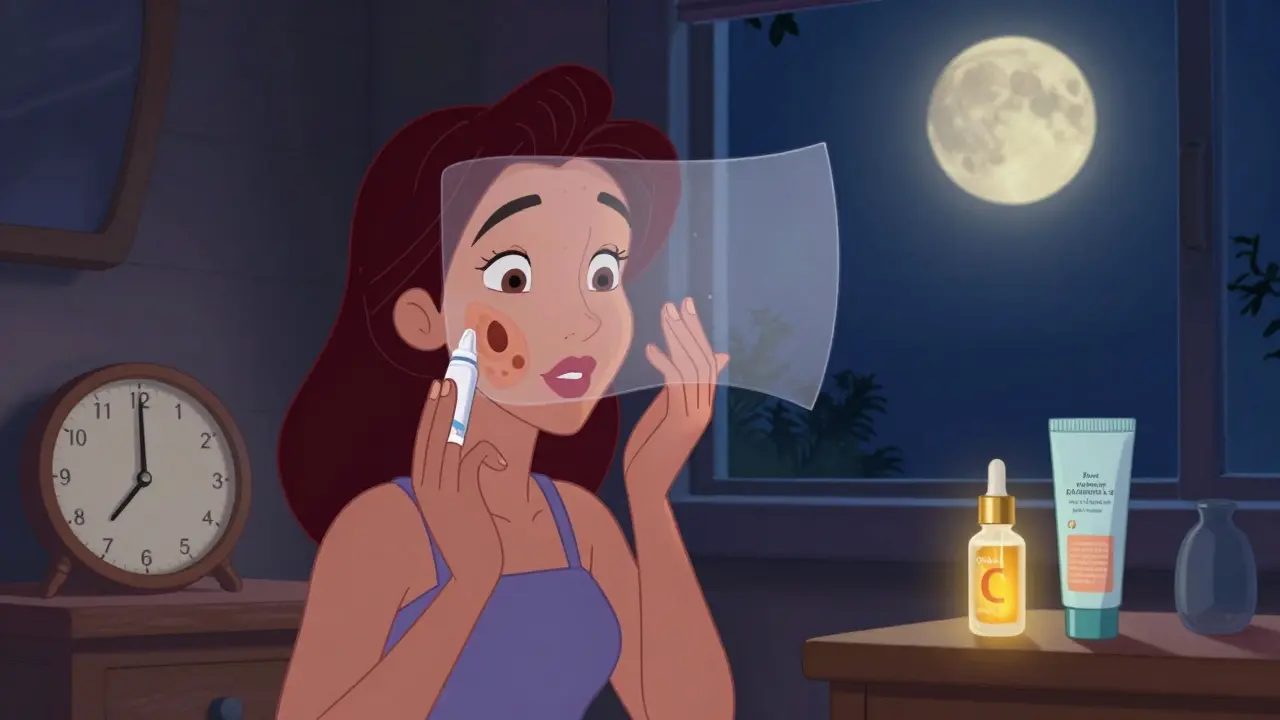
What to Do If You’re Not Seeing Results
If you’ve been using topicals for 3 months and nothing changed, you might be doing one of these things:- You’re not using enough sunscreen - or the wrong kind. Switch to a mineral formula with iron oxide.
- You’re using too many products at once. Layering 5 serums can irritate your skin and make pigmentation worse.
- You’re not giving it time. Most topicals take 8-12 weeks to show results. Patience matters.
- You’re skipping nights. Inconsistent use = no progress. Set a phone reminder.
- You’re using OTC products that are too weak. A 2% niacinamide serum won’t touch melasma.
What’s New in 2026
The treatment landscape is changing. In 2022, the FDA proposed reclassifying hydroquinone from prescription-only to over-the-counter - but with strict safety labeling. That could make it more accessible, but also risk misuse. New agents are emerging:- Cysteamine cream (10%): Showed 60% improvement in melasma in Phase 3 trials with almost no irritation. Not yet FDA-approved, but available in some clinics.
- Tranexamic acid pills: Oral use is being studied for severe melasma. Early results are promising, but not yet standard.
- Personalized treatment: Dermatologists are starting to use genetic tests to predict how someone’s skin will respond. Within five years, your treatment may be based on your DNA.
The Bottom Line
Sun damage and melasma are not the same. You can’t treat them the same way. Sun damage responds fast to lasers and light treatments. Melasma needs patience, consistency, and protection from more than just UV rays. Start with a dermatologist. Get a proper diagnosis. Then build a routine: morning vitamin C + iron oxide sunscreen, evening tretinoin or tranexamic acid, and never skip sunscreen - even indoors. And if you’re using hydroquinone, don’t use it longer than 3 months. Rotate it. Protect your skin like your life depends on it - because for melasma, it does.Can melasma go away on its own?
Sometimes, yes - especially if it’s triggered by pregnancy or birth control. After delivery or stopping the pill, melasma may fade over several months. But for most people, it doesn’t disappear without treatment. Even if it seems to fade, it can return with sun exposure or hormonal changes. That’s why maintenance is critical.
Is hydroquinone safe long-term?
No. Hydroquinone is effective for 3-4 months at most. After that, the risk of ochronosis - a permanent darkening of the skin - increases. Dermatologists now use it in short cycles, alternating with other agents like tranexamic acid, kojic acid, or azelaic acid. Never use hydroquinone for more than 12 weeks without a break.
Why does my melasma get worse in summer?
Sunlight isn’t the only trigger. Visible light from windows and indoor lighting, plus heat from saunas or hot weather, can activate melanocytes. Melasma is more than a sun issue - it’s a light and heat issue. That’s why mineral sunscreens with iron oxide are essential year-round, even if you’re indoors.
Can I use retinol instead of tretinoin?
Retinol is weaker than tretinoin. It may help with mild pigmentation, but for melasma, you need the prescription-strength tretinoin (0.025% or higher). Retinol doesn’t penetrate deeply enough or speed up cell turnover fast enough to make a real difference in melasma. If you’re using retinol and not seeing results, it’s time to talk to a dermatologist about tretinoin.
Are natural remedies like lemon juice or aloe vera effective?
No. Lemon juice is highly acidic and can burn your skin, leading to post-inflammatory hyperpigmentation - which makes the problem worse. Aloe vera soothes irritation but doesn’t reduce melanin. Natural doesn’t mean effective. Stick to ingredients backed by clinical studies: hydroquinone, tretinoin, vitamin C, tranexamic acid, and niacinamide.
How much does melasma treatment cost?
Prescription topicals cost $50-$150 per month. A single laser session runs $300-$600. Chemical peels are $150-$400 per session. Insurance rarely covers these because they’re considered cosmetic. But the cost of not treating it - in time, frustration, and worsening pigmentation - can be higher. Many dermatologists offer payment plans or generic alternatives to reduce the burden.
Nishan Basnet
March 22, 2026 AT 16:43Had melasma after my second kid-vanished after 8 months, but came back worse when I moved to a sunnier city. Iron oxide sunscreen changed everything. Not just SPF 50, but the kind that looks like a light tinted moisturizer. No more ghostly patches on my cheeks. Also, stopped doing hot yoga. Who knew? Heat is the silent saboteur.
Now I rotate: 3 months hydroquinone, 2 months tranexamic acid serum, then just vitamin C and sunscreen year-round. No magic, just consistency. And yeah, I reapply every 90 minutes outside. Even if I’m just walking the dog.
Also, skip the lemon juice. I tried it. My skin looked like a burnt toast sandwich. Don’t be me.
Sandy Wells
March 23, 2026 AT 22:48Ugh. Another skincare essay. I just want my face to stop looking like a Jackson Pollock painting. Why does everything have to be so complicated? Just tell me what to buy already.
Also, I use Neutrogena. It’s fine. I’m not paying $150 a month for a cream that says ‘clinical studies.’
Desiree LaPointe
March 24, 2026 AT 06:12Oh wow. A 2026 prediction? How quaint. Let me guess-next you’ll be telling us that ‘DNA-based skincare’ is the future. As if our melanocytes are waiting for a Spotify playlist to tell them when to chill.
Hydroquinone? Still banned in Europe. Funny how Americans treat dermatology like a cult. ‘Rotate agents.’ ‘Maintenance is non-negotiable.’ Yeah, sure. Just like how we all need to ‘align our chakras’ before applying moisturizer.
And please. Iron oxide? You’re not protecting your skin-you’re wearing foundation with SPF. That’s not science. That’s marketing with a PhD.
Jackie Tucker
March 25, 2026 AT 07:17It’s fascinating how we’ve turned skin into a battlefield. Melasma isn’t a flaw-it’s a biological signature. A whisper from your hormones saying, ‘You’ve lived. You’ve changed. You’ve been through something.’
But instead of honoring that, we weaponize sunscreen and chemical peels like they’re armor against femininity.
Maybe the real problem isn’t melanin-it’s the societal pressure to look perpetually unblemished. Like a porcelain doll on a shelf.
And yet. I still use tranexamic acid. Because even philosophy needs practicality.
Iron oxide sunscreen? Yes. But also? I wear wide-brimmed hats. And I stop apologizing for the sun on my skin. Even if it’s dark.
Thomas Jensen
March 25, 2026 AT 15:03Did you know the FDA is being controlled by Big Pharma? Hydroquinone is being reclassified because they want you addicted to $150/month creams. They don’t want you cured-they want you paying forever.
I tried laser treatment. Two weeks later, my face turned purple. Now I’m convinced it was a government experiment. They’re testing how much melanin we can handle before we break.
Also, vitamin C? That’s just lemon juice in a fancy bottle. They just rebranded it. You’re being scammed.
And why is everyone so obsessed with sunscreen? The sun is life. Don’t be afraid. Let your skin breathe.
...I still wear SPF 70. Just in case.
matthew runcie
March 25, 2026 AT 18:02For me, the biggest shift was realizing melasma isn’t a problem to fix-it’s a signal. I stopped trying to erase it and started protecting my skin like I’m guarding a garden.
Mineral sunscreen with iron oxide. Every morning. No exceptions.
Tretinoin 0.025% every other night. Slow and steady.
Vitamin C in the AM. Always.
And I stopped checking my face in mirrors after 8pm. That helped more than anything.
Still here. Still patchy. Still okay.
shannon kozee
March 26, 2026 AT 12:50Tranexamic acid serum worked wonders for me. No irritation. No burning. Just gradual fading over 10 weeks.
Also, reapplying sunscreen isn’t optional. It’s like brushing your teeth. Twice a day. Outside or not.
And skip the retinol. If you’re serious about melasma, you need tretinoin. No exceptions.
trudale hampton
March 26, 2026 AT 19:01I used to think I was failing because my melasma didn’t disappear.
Turns out, it’s not about erasing-it’s about managing.
Now I use vitamin C + iron oxide sunscreen every day.
At night, I do tranexamic acid or kojic acid on rotation.
It’s not perfect. But it’s better.
And honestly? I’m proud I stuck with it.
Good post. Real talk.
Shaun Wakashige
March 27, 2026 AT 12:08lmao at the $150/month creams. I just use aloe and lemon juice. works great. 😎