

Rifampin Birth Control Safety Checker
Check Birth Control Safety
When you’re taking rifampin for tuberculosis or a stubborn staph infection, the last thing you should be worrying about is whether your birth control is still working. But here’s the hard truth: rifampin doesn’t just kill bacteria-it can also make your hormonal birth control useless. This isn’t a myth, a rumor, or a vague warning. It’s a well-documented, clinically proven interaction that has led to real pregnancies in women who thought they were protected.
Why Rifampin Breaks Birth Control
Rifampin is a powerful antibiotic that works by shutting down bacterial RNA production. But it doesn’t stop there. Inside your liver, it wakes up a set of enzymes called cytochrome P450-specifically CYP3A4-that are normally quiet. Once activated, these enzymes go into overdrive, speeding up how fast your body breaks down hormones like estrogen and progestin. Think of it like this: your birth control pill delivers a steady dose of hormones to prevent ovulation. But rifampin turns your liver into a hormone-disposing factory. Studies show it can slash ethinyl estradiol levels by up to 67% and progestin levels by over 50%. That’s not a small drop. That’s enough to let ovulation slip through the cracks. This isn’t theoretical. In clinical trials, women on rifampin showed signs of ovulation-like rising progesterone levels-when they were supposed to be suppressed. One study found that half of the women taking rifampin along with the pill started ovulating again. That’s not a risk. That’s a guarantee for some.It’s Not Just the Pill
Many assume this only affects the pill. It doesn’t. Any hormonal birth control that relies on estrogen or progestin is at risk:- Combination pills (estrogen + progestin)
- Progestin-only pills (mini-pills)
- The patch (Xulane, Twirla)
- The ring (NuvaRing)
- Hormonal IUDs (Mirena, Kyleena, Liletta)
What About Other Antibiotics?
You’ve probably heard warnings about antibiotics and birth control. Maybe your doctor told you to use condoms when you got a course of amoxicillin or azithromycin. That advice? Mostly outdated. Penicillin, tetracycline, erythromycin, azithromycin-none of these have been proven to interfere with birth control in controlled studies. Yes, there were old case reports from the 1970s to 1990s linking them to pregnancies. But those were anecdotal. They didn’t measure hormone levels. They didn’t track ovulation. They didn’t control for missed pills or vomiting. The only antibiotic with solid, repeatable, measurable proof of causing contraceptive failure? Rifampin. And its close cousin, rifabutin. Rifabutin is used for MAC infections in people with HIV. At 300mg daily, it reduces hormone levels by about 20-30%. That’s less than rifampin, but still enough to be risky. Most other antibiotics? No effect.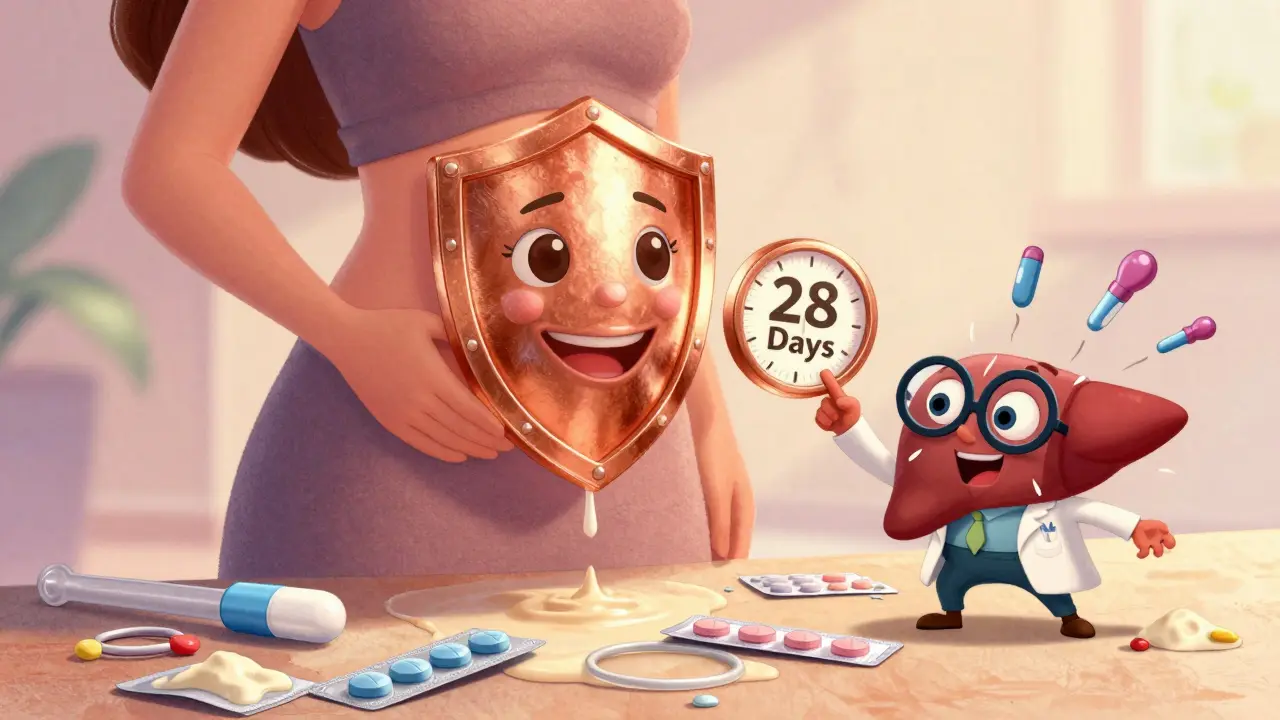
How Long Does the Risk Last?
Here’s where people get it wrong. Rifampin doesn’t just disappear after you stop taking it. Its effect on liver enzymes lingers. The drug itself has a short half-life-around 3 to 4 hours. But the enzymes it induces? They stick around for weeks. Your liver doesn’t turn them off the moment you take your last pill. It takes time to reset. That’s why experts say you need backup contraception for the entire time you’re on rifampin plus 28 days after you stop. That’s not a suggestion. It’s the standard from the CDC, the American College of Obstetricians and Gynecologists, and the World Health Organization. If you stop rifampin on day 60 and switch back to the pill on day 61, you’re still at risk. You could ovulate without knowing it. And if you’re not using another method, you could get pregnant.What Should You Use Instead?
If you’re on rifampin, your best options are non-hormonal methods:- Copper IUD (Paragard): No hormones. Works for up to 12 years. Over 99% effective. The gold standard for women on rifampin.
- Condoms: Must be used every time. Not as reliable as IUDs, but better than nothing.
- Permanent contraception: Tubal ligation or vasectomy for partners. A good option if you’re done having children.
Why Do So Many Doctors Get It Wrong?
A 2017 survey found that only 42% of primary care doctors consistently warn patients about rifampin’s effect on birth control. Almost 30% still tell all patients to use condoms when taking any antibiotic. Why? Because the message got muddy. For decades, warnings were slapped on all antibiotics. Now, the science has clarified it: only rifampin and rifabutin are the real problem. But old habits die hard. Patients are still confused. They think every antibiotic is risky. Or worse-they think rifampin is safe because their doctor didn’t mention it. A 2022 study in the Journal of Women’s Health found that 63% of women prescribed rifampin received no proper counseling about contraception. That’s not negligence. It’s a systemic failure.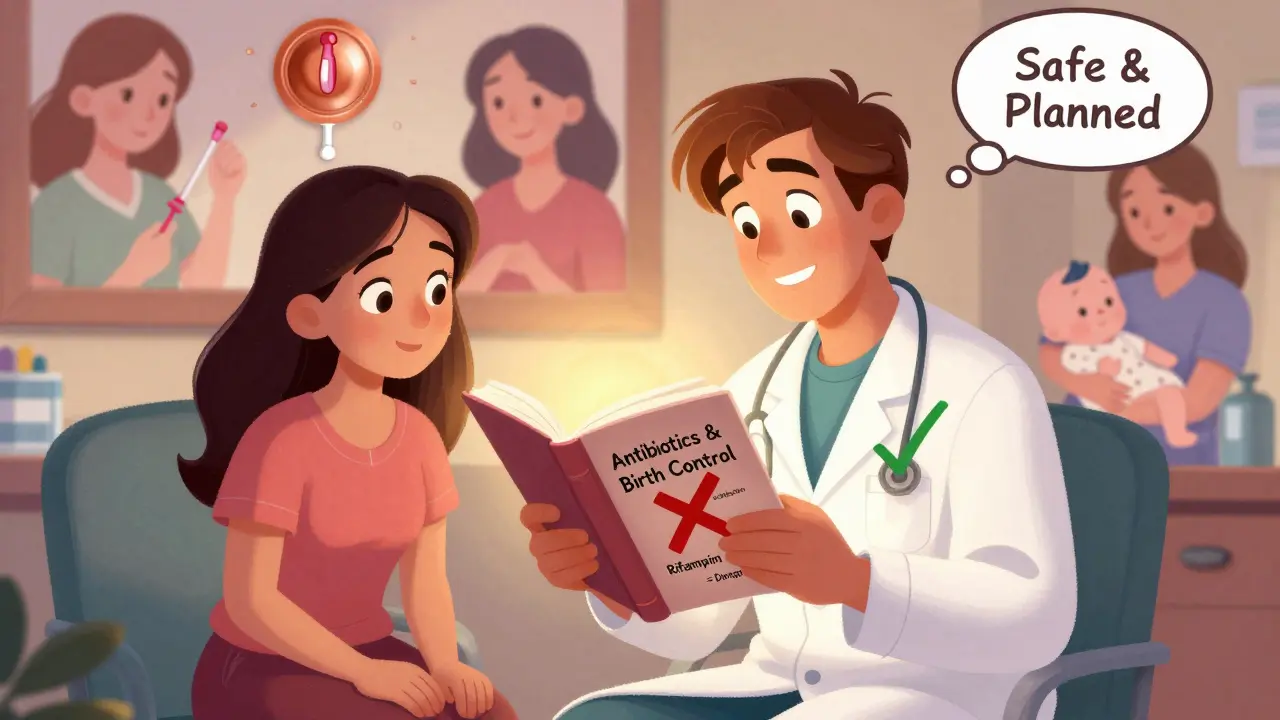
What Happens If You Get Pregnant?
Rifampin itself isn’t known to cause birth defects. But tuberculosis during pregnancy is dangerous-for both mother and baby. TB can spread to the placenta, cause premature birth, low birth weight, or even maternal death. If you become pregnant while on rifampin, don’t panic. Talk to your doctor immediately. You’ll need to adjust your TB treatment plan. But the fact that you got pregnant means your birth control failed-and that’s a red flag for future planning.What’s Changing?
New TB treatment regimens are being tested to avoid rifampin altogether. One promising 4-month regimen uses rifapentine and moxifloxacin. Early results suggest it’s just as effective as the standard 6-month rifampin-based treatment. If approved, it could eliminate this problem for many. Drug manufacturers are now required to test new hormonal contraceptives against rifampin before approval. The FDA and EMA both demand this. That means future pills may be designed to resist enzyme breakdown-but that’s years away. In places like sub-Saharan Africa, where TB and limited contraceptive access overlap, this interaction creates a public health crisis. Women may choose to avoid birth control entirely because they fear rifampin will break it. Or they may get pregnant unintentionally while being treated for a life-threatening disease.Bottom Line: What to Do Now
If you’re taking rifampin:- Stop relying on the pill, patch, ring, or hormonal IUD.
- Use a copper IUD or condoms every time you have sex.
- Keep using backup contraception for 28 days after your last rifampin dose.
- Don’t assume other antibiotics are risky-only rifampin and rifabutin are.
- Ask your doctor for a referral to a reproductive health specialist if you’re unsure.
This isn’t about fear. It’s about facts. Rifampin breaks birth control. No exceptions. No ifs. No buts. And if you don’t plan for it, you could end up with a pregnancy you didn’t want-while fighting a disease that could kill you.
Does rifampin make birth control pills completely useless?
Yes. Rifampin triggers liver enzymes that break down estrogen and progestin so quickly that hormone levels drop below the threshold needed to prevent ovulation. Studies show up to a 67% reduction in estrogen levels. This is not a small risk-it’s a proven cause of contraceptive failure.
Are all antibiotics risky for birth control?
No. Only rifampin and rifabutin have strong clinical evidence of reducing contraceptive effectiveness. Penicillin, azithromycin, tetracycline, and other common antibiotics do not interfere with hormonal birth control in controlled studies. The myth that all antibiotics affect birth control comes from outdated case reports that lacked scientific rigor.
How long should I use backup contraception after stopping rifampin?
You must use backup contraception for the entire time you’re taking rifampin plus 28 days after your last dose. Even though rifampin leaves your body in hours, the liver enzymes it induces take weeks to return to normal. Stopping backup too soon puts you at risk of unintended pregnancy.
Can I switch to a higher-dose birth control pill to avoid this?
No. Even high-dose estrogen pills have failed in women taking rifampin. The liver enzymes break down hormones faster than increasing the dose can compensate for. The only reliable solution is a non-hormonal method like a copper IUD or condoms.
Is the Nexplanon implant safe with rifampin?
There’s limited but promising data. A 2023 study of 47 women using Nexplanon during rifampin treatment showed no pregnancies. However, the sample size was too small to confirm safety. Until larger studies are done, experts still recommend using a backup method like condoms alongside Nexplanon when taking rifampin.
What should I do if I got pregnant while on rifampin?
Contact your doctor immediately. Rifampin itself is not known to cause birth defects, but tuberculosis during pregnancy can be dangerous for both you and your baby. You’ll need to adjust your TB treatment plan, and your provider will help you manage both conditions safely.
Why don’t more doctors warn patients about this?
A 2017 survey found only 42% of primary care doctors consistently counsel patients about rifampin’s interaction with birth control. Many still believe all antibiotics affect contraception. Others assume patients will ask. But patients rarely know to ask. This gap in communication leads to preventable pregnancies.
Are there new TB treatments that don’t affect birth control?
Yes. A new 4-month regimen using rifapentine and moxifloxacin is being studied as an alternative to rifampin. Early results suggest it’s just as effective at curing TB without the same contraceptive risks. If approved, this could become the new standard, especially for women of reproductive age.
Deepika D
December 30, 2025 AT 13:48Okay, I need to say this because I’ve seen too many women get blindsided by this: if you’re on rifampin and still using the pill, you’re playing Russian roulette with your future. I’m a nurse in Mumbai, and I’ve had three patients come in pregnant while on TB meds-none of them knew this was a thing. The system fails women daily, especially in places where reproductive health education is an afterthought. Please, if you’re reading this and you’re on rifampin-go get a copper IUD. It’s cheap, it’s long-lasting, it’s hormone-free, and it doesn’t care if your liver’s on a caffeine binge. Don’t wait until it’s too late. This isn’t scare tactics-it’s triage. Your body deserves better than assumptions and outdated doctor advice.
Also, if your doctor says ‘just use condoms,’ ask them if they’ve ever had to explain to a 19-year-old why her baby’s father is a stranger who didn’t even know she was on antibiotics. It’s not cute. It’s catastrophic.
And yes, I’m yelling. Because someone has to.
Bennett Ryynanen
January 1, 2026 AT 06:28Bro. I just got prescribed rifampin for this stubborn staph and my gynecologist didn’t even mention this. Zero. Zip. Nada. I had to Google it myself because I remembered some weird Reddit thread from 2020. Like, why is this not on the fucking prescription label? Like, ‘WARNING: THIS DRUG WILL RUIN YOUR BIRTH CONTROL AND MAY CAUSE UNINTENDED PREGNANCY’? That’s not too much to ask. I’m 28, not a teenager. I don’t need to be a medical detective just to not get knocked up while fighting a bacterial infection. This is a public health failure. Someone’s getting sued over this one day.
Chandreson Chandreas
January 2, 2026 AT 04:29Man, this hits different when you’re from a country where TB is still a daily reality and birth control is a luxury. 😔 I’ve seen friends choose between treating their TB or staying safe from pregnancy-and that’s not a choice, that’s a sentence. The fact that we still don’t have universal access to copper IUDs in places like rural India is heartbreaking. Why is the solution always ‘use condoms’? Condoms require cooperation, planning, and trust. Not everyone has that. A copper IUD is silent, invisible, and doesn’t ask for consent every time. It’s the only real justice here.
Also, 🤯 the fact that rifabutin is less bad but still risky? That’s like saying ‘your house is on fire but the flames are 20% smaller.’ Still burning. Still need to get out.
Lawver Stanton
January 2, 2026 AT 15:51Let me just say this: I’ve been on rifampin for 45 days. I thought I was fine because I was on the patch. I didn’t know. I didn’t ask. I trusted my doctor. And now? I’m pregnant. And not in a ‘oh wow, this is beautiful’ way. In a ‘I’m terrified, broke, and my TB meds might be making me nauseous’ way. So let me be the asshole here: if you’re not screaming about this from the rooftops, you’re part of the problem. Why is this not in every OB-GYN’s intake form? Why is this not a mandatory 30-second video on the pharmacy’s website? Why do we still treat women’s reproductive health like an optional sidebar? I’m not mad. I’m just… done. And I’m not the only one.
Sara Stinnett
January 3, 2026 AT 19:16Oh, so now we’re treating women like fragile, hormone-sensitive automatons who can’t possibly be trusted to read a drug insert? This is the exact kind of infantilizing medical paternalism that has kept women from bodily autonomy for centuries. If you’re on hormonal birth control, you are responsible for knowing your own physiology. Rifampin is not a ‘secret’-it’s listed in the FDA’s drug interaction database, publicly accessible, with citations dating back to the 1970s. If you didn’t know, that’s on you. Blaming doctors? Please. The real failure is a culture that encourages passive consumption of medical advice instead of empowered self-advocacy. You want safety? Educate yourself. Don’t wait for a pamphlet to save you.
linda permata sari
January 4, 2026 AT 11:18As an Indonesian woman who lived in the U.S. for 7 years, I can tell you-this is NOT just an American problem. In Jakarta, my cousin got pregnant on the pill while on TB meds. No one told her. No one even knew it was possible. The local clinic just said, ‘Take your pills, don’t worry.’ And now she has a 1-year-old and still hasn’t finished her TB treatment. This isn’t just about science-it’s about language, culture, access. In places where English isn’t the first language, medical jargon becomes a prison. We need translated materials. We need community health workers. We need more than Google. We need dignity.
Brandon Boyd
January 5, 2026 AT 18:20Big shoutout to the person who wrote this. This is the kind of info that saves lives. I’m a paramedic and I’ve seen too many women in the ER with unplanned pregnancies while on TB meds. It’s heartbreaking. But here’s the thing-most of them didn’t even know they were on rifampin. They just got a script for ‘anti-TB pills’ and assumed it was like any other antibiotic. We need better labeling. We need pharmacy alerts. We need a damn app that pops up when you fill a prescription for rifampin: ‘WARNING: YOUR BIRTH CONTROL IS NOW USELESS. SEE A DOCTOR.’
Also, copper IUDs are amazing. I got one after my last TB treatment. Best decision I ever made. Zero hormones. Zero stress. Just peace.
Branden Temew
January 7, 2026 AT 16:13So let me get this straight: we’ve got a drug that can cure a deadly disease… but it also turns your birth control into a very expensive paperweight? And the solution is… more bureaucracy? More ‘backup methods’? More ‘consult your doctor’? How about we just stop pretending medicine is a clean, rational system? It’s not. It’s a messy, underfunded, gender-blind machine that treats women’s reproductive health like an afterthought until it’s too late. And then we act shocked when someone gets pregnant. 🤡
Next time someone says ‘trust the science,’ ask them why the science didn’t trust the woman enough to warn her.
Paul Huppert
January 9, 2026 AT 10:34Thanks for this. I was on rifampin last year and didn’t know. Ended up with a pregnancy I wasn’t ready for. Copper IUD now. Best thing ever. Just… please, if you’re reading this, do yourself a favor and talk to a reproductive health provider. No shame. Just safety.
Hanna Spittel
January 10, 2026 AT 11:33Ok but what if the government is secretly using rifampin to reduce population growth in poor communities?? 🤔 Like… why else would they not make this a HUGE deal? I mean, think about it. TB is common in places with high birth rates. Coincidence? I don’t think so. Also, I think the FDA is in cahoots with Big Pharma. Why else would they not require a warning label? 🤷♀️
Brady K.
January 11, 2026 AT 15:01Let’s deconstruct this like a pharmacokinetic model, shall we? Rifampin is a potent CYP3A4 inducer-period. The hepatic first-pass metabolism of ethinyl estradiol is a well-characterized pathway. The 67% reduction in AUC is statistically significant (p < 0.001) across multiple RCTs. The notion that ‘higher-dose pills’ are a workaround is physiologically nonsensical-enzyme induction is nonlinear, not saturable. The only viable pharmacologic solution is non-hormonal contraception. The copper IUD is not just ‘an option’-it’s the gold standard. Anything else is clinical negligence dressed as ‘caution.’ And yes, the 28-day post-treatment window is evidence-based. The half-life of enzyme induction is ~14–21 days, but we extend to 28 for safety margins. This isn’t opinion. It’s clinical protocol. If your provider doesn’t know this, they shouldn’t be prescribing antibiotics.
Frank SSS
January 12, 2026 AT 05:01I just want to say… I’m not mad. I’m just disappointed. I’ve been on rifampin twice. Both times, my doctor said ‘you’ll be fine.’ First time, I got pregnant. Second time, I went to a new doctor and told them the story. They still didn’t say anything. I had to print out the CDC guidelines and hand them a printed PDF. I’m not a doctor. I’m not a scientist. I’m just a woman trying not to get knocked up while trying not to die of TB. Why is this so hard? Why do I have to be the one to fight for my own body?
Also, I’m still on the copper IUD. It’s been 3 years. Still the best thing I’ve ever done for myself.
Joy Nickles
January 12, 2026 AT 08:38Wait… so if you're on rifampin… and you're on the pill… and you get pregnant… is the baby like… part TB? Like… does the baby have little bacteria in it? Or is it just… a normal baby? I'm so confused now. And also, what if you're on the patch… and you're on rifampin… and you don't know… and you get pregnant… and then you find out… and then you're like… 'oh no, I didn't know'… and then you're like… 'oh no, I'm a bad mom'… and then you cry… and then you hate your doctor… and then you hate the world… and then you go to Reddit and find this post… and you're like… 'oh… so it's not my fault'…? 😭😭😭