
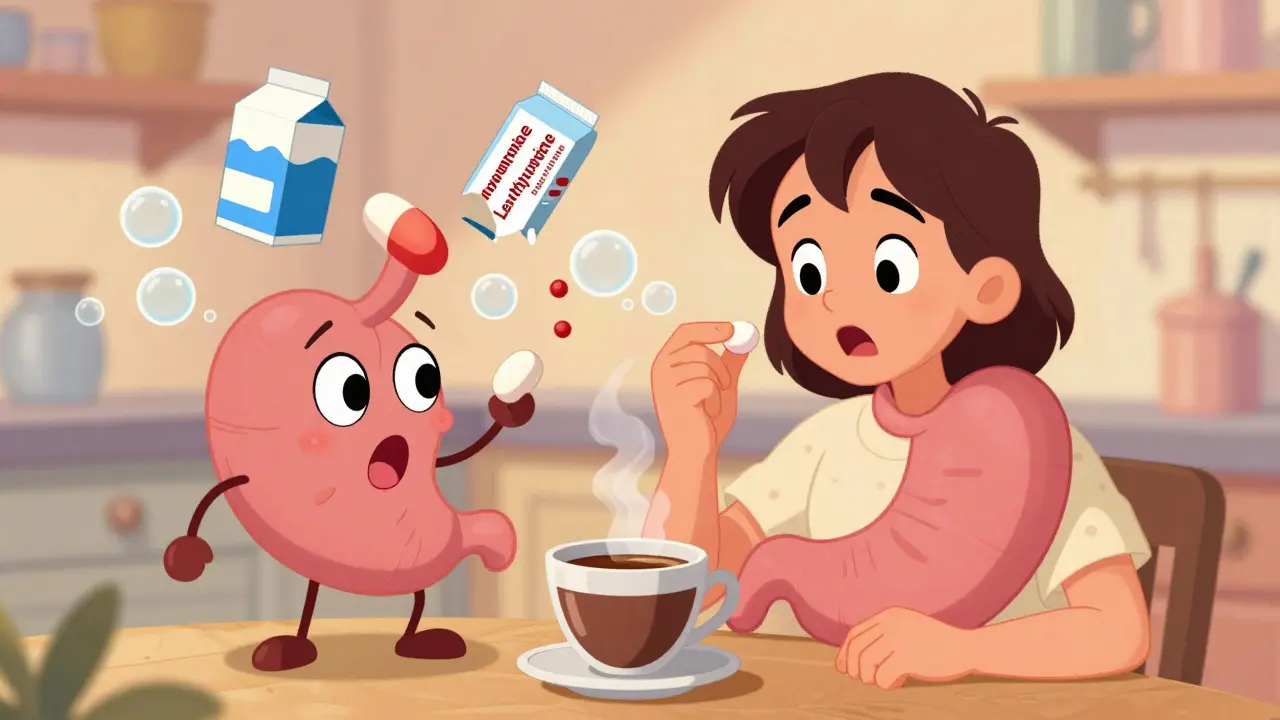
Ever taken a pill with your morning coffee and wondered why it didn’t seem to work? Or maybe you’ve had stomach pain after popping an ibuprofen on an empty stomach. You’re not alone. Millions of people take medications without knowing whether food helps or hurts their effectiveness - and the consequences can be serious.
The difference between taking a pill with food or on an empty stomach isn’t just a suggestion. It’s science. And getting it wrong can cut your medication’s effectiveness in half or double your risk of side effects. For some drugs, it’s the difference between healing and staying sick.
Why Food Changes How Your Medicine Works
Your stomach isn’t just a passive container. It’s an active chemical factory. When you eat, your body shifts gears: acid levels rise and fall, enzymes get released, bile flows, and food sits in your stomach anywhere from 15 minutes to 4 hours. All of that affects how your pills dissolve, get absorbed, and enter your bloodstream.
For example, food can raise your stomach’s pH from a harsh 1-2 (like vinegar) to a milder 3-5. That’s enough to wreck acid-sensitive drugs like penicillin V, which breaks down 40% faster in that environment. Or take calcium-rich foods - they can bind to antibiotics like tetracycline and stop them from being absorbed at all. Studies show up to 75% less drug gets into your system if you take it with milk or antacids.
High-fat meals delay stomach emptying by 90 to 120 minutes. That sounds harmless, but for drugs like levothyroxine - used to treat thyroid problems - that delay can drop absorption by 22%. That means your TSH levels stay high, you feel tired, and your doctor might mistakenly think you need more medication.
On the flip side, food helps certain drugs. Bile, released when you eat fat, acts like a detergent for oily medications. Drugs like griseofulvin (used for fungal infections) absorb 50% better with food. And some medicines simply irritate your stomach unless they’re cushioned by food.
Medications That Must Be Taken on an Empty Stomach
These drugs lose power - or become dangerous - if taken near food. Here are the big ones:
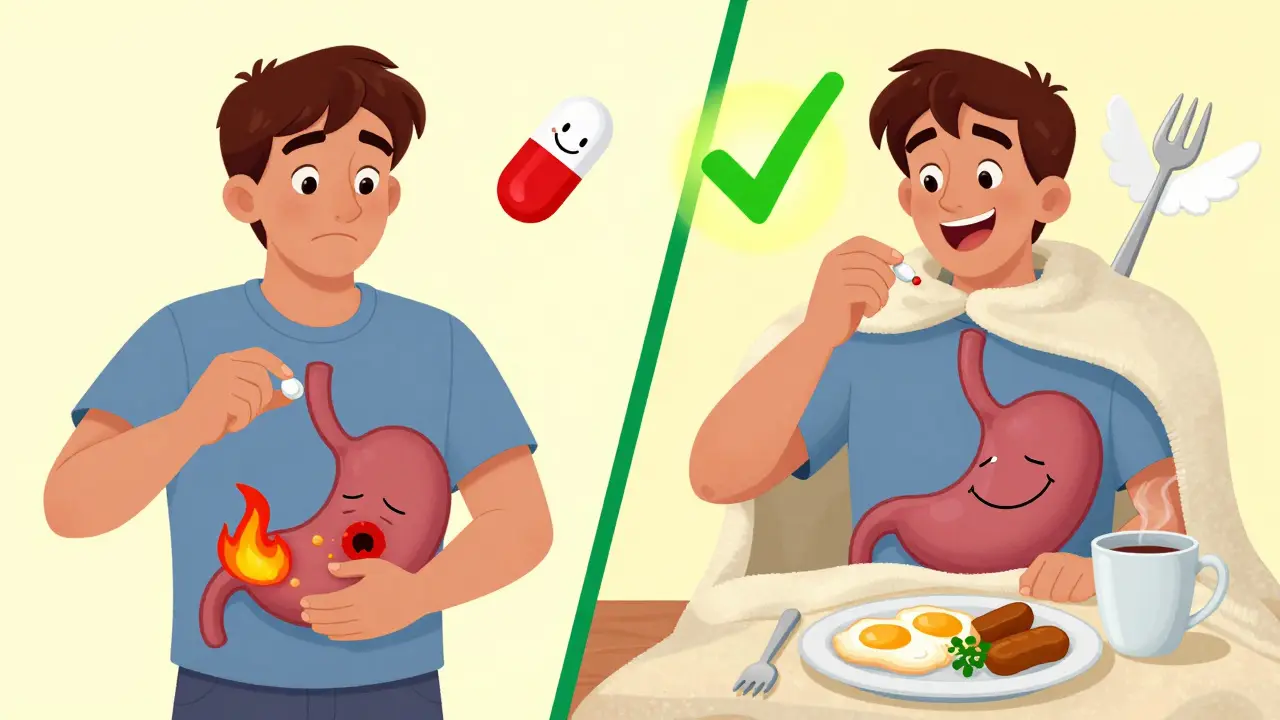
- Levothyroxine (Synthroid): This thyroid hormone replacement is one of the most commonly misused medications. Food, coffee, calcium supplements, and even soy milk can reduce absorption by 20-50%. A 2022 meta-analysis found that patients who took it with breakfast had TSH levels 30% higher than those who took it on an empty stomach. The fix? Take it first thing in the morning, wait 30-60 minutes before eating or drinking anything except water.
- Alendronate (Fosamax): Used for osteoporosis, this drug needs a completely empty stomach. Food cuts absorption by 60%. You also have to sit upright for 30 minutes after taking it. Otherwise, it can burn your esophagus.
- Sucralfate (Carafate): This ulcer coating agent only works if it’s on your stomach lining before food arrives. Take it 1 hour before meals. If you eat first, it just floats around uselessly.
- Ampicillin: This antibiotic’s peak levels drop 35% with food. Total exposure (AUC) falls by 28%. You need it to hit hard and fast - so take it 30 minutes before or 2 hours after meals.
- Zafirlukast (Accolate): For asthma, this drug’s absorption drops 40% with food. The FDA label says take it at least 1 hour before or 2 hours after eating.
- Proton pump inhibitors (PPIs) like omeprazole and esomeprazole: These work by blocking acid production triggered by food. If you take them after eating, they’re too late. They need to be taken 30-60 minutes before breakfast. (Pantoprazole is an exception - it works fine with or without food.)
Experts at the American Pharmacists Association say "empty stomach" means 1 hour before or 2 hours after eating. That’s not a suggestion - it’s the window where your stomach is truly clear.
Medications That Need Food to Work Right
Some drugs are useless without food. Others are dangerous without it.
- NSAIDs (ibuprofen, naproxen): These painkillers can cause ulcers, bleeding, and hospitalization. A 2020 meta-analysis in Gastroenterology showed taking them with food reduces GI complications by 50-70%. The American College of Gastroenterology says 10,000-20,000 hospitalizations a year from NSAID damage could be avoided if people just ate first.
- Aspirin (high doses): For pain relief, not heart protection, aspirin causes stomach irritation in 25% of people on an empty stomach. With food? That drops to 8%. Always take it with a meal or snack.
- Duloxetine (Cymbalta): This antidepressant causes nausea in nearly half of users on an empty stomach. With food? Nausea drops by 30%. If you’re starting this drug, eat a light meal before your first dose.
- Statins (atorvastatin, simvastatin): Food boosts absorption of these cholesterol drugs. But here’s the catch: grapefruit juice can spike statin levels by 300-500%. That raises your risk of rhabdomyolysis - a dangerous muscle breakdown. Avoid grapefruit entirely if you’re on these meds.
- Mesalamine (for IBD): Patients on Reddit’s r/IBD community report that taking this drug with food cuts nausea from daily to once a month. For many, it’s a game-changer.
What About Coffee, Milk, or Supplements?
It’s not just meals. Even your morning habits can mess with meds.
Coffee - even black - contains compounds that interfere with absorption. A Reddit user, u/ThyroidWarrior, spent two years with wild TSH levels until they realized their coffee with cream was blocking Synthroid. Now they take it at 4 a.m. and wait 90 minutes before anything else.
Milk, yogurt, calcium supplements, and antacids? They bind to antibiotics like tetracycline and ciprofloxacin, making them useless. Iron and zinc supplements do the same. If you need both, space them out by at least 2 hours.
And don’t forget grapefruit juice. It’s not just for statins. It can also dangerously boost levels of blood pressure meds, anti-anxiety drugs, and even some cancer treatments. If your pill bottle says "avoid grapefruit," that’s not a suggestion - it’s a warning.
How to Get It Right Every Time
Most people don’t know the rules. A 2022 Express Scripts survey of 10,000 patients found 65% took meds without checking food instructions. Of those, 41% said their meds didn’t work as well, and 29% had worse side effects.
Here’s how to fix it:
- Read the label. Look for "take on empty stomach" or "take with food." If it’s unclear, ask your pharmacist.
- Use the 2-1-2 Rule. For empty stomach meds: take 2 hours after eating, or 1 hour before your next meal. For food-requiring meds: take it during or within 30 minutes of eating.
- Use a pill organizer. One study showed labeling compartments "before food" or "with food" improved adherence by 35%.
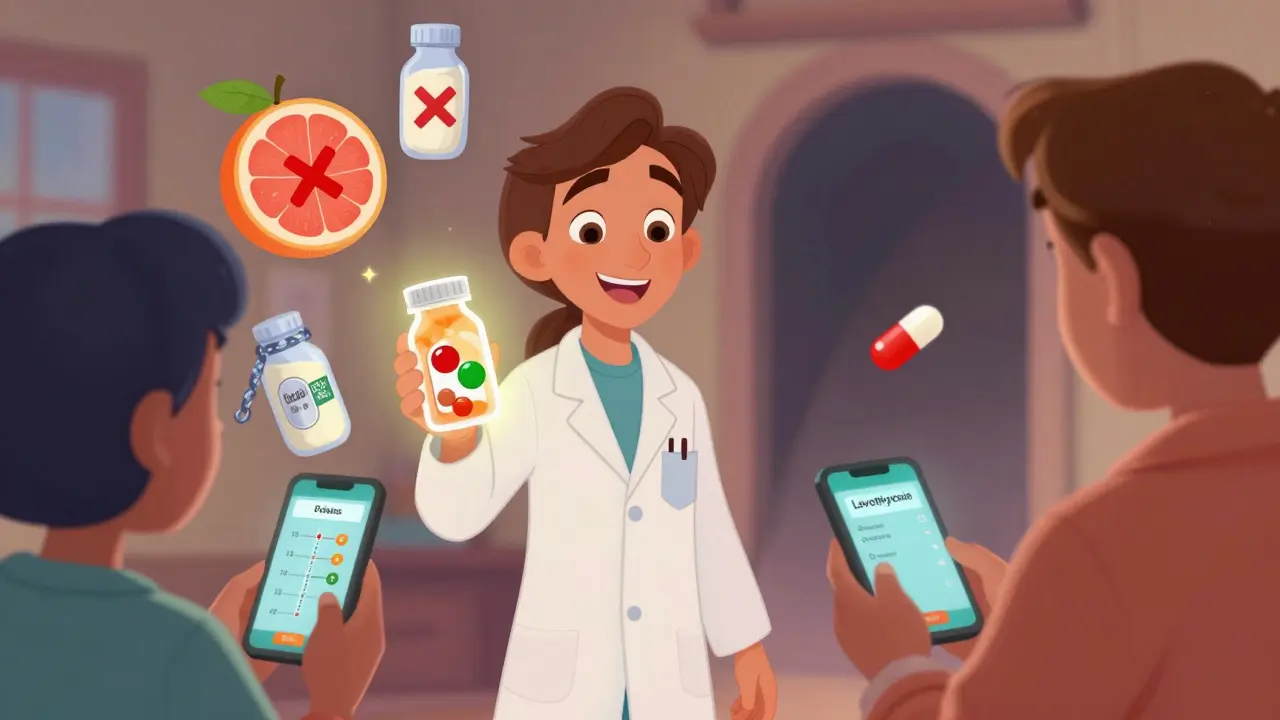
- Ask for color-coded stickers. CVS and Walgreens now put red stickers on bottles for empty stomach meds, green for with food. In a pilot study, this raised correct use from 52% to 89%.
- Set phone alerts. Apps like Medisafe and GoodRx now send food-timing reminders. Users who used them cut errors by 28%.
- Stagger your doses. If you have multiple meds, space them out. Take your empty-stomach pill at 7 a.m., then breakfast at 7:30, then your food-requiring pill at 8 a.m.
Pharmacists are your best allies here. A 2021 JAMA study found 92% of pharmacists give clear food-timing advice - compared to only 45% of doctors. Don’t be shy. Ask your pharmacist when you pick up a new prescription.
The Future: Smart Pills and Personalized Timing
The good news? Science is catching up. Johnson & Johnson’s new Xarelto Advanced formulation absorbs consistently, whether you eat or not. University of Michigan researchers are testing nanoparticles that bypass stomach acid entirely - early results show 92% consistent absorption for levothyroxine, no matter what you ate.
But here’s the truth: even with these advances, 75% of today’s medications still need careful timing. The FDA now requires food-effect testing for 92% of new drugs - up from 65% in 2015. That means more labels will come with clear instructions.
Experts predict that within five years, apps will use your eating habits, gut motility, and even your sleep schedule to suggest the perfect time to take each pill. Until then, the old rules still hold.
What You Need to Remember
Food isn’t just fuel. It’s a drug interaction waiting to happen. Ignoring food timing isn’t just sloppy - it’s risky.
- Levothyroxine? Take it alone, on an empty stomach. Coffee, milk, or cereal will sabotage it.
- NSAIDs? Always take them with food. Your stomach will thank you.
- Statins? Food helps - but grapefruit kills.
- Antibiotics? Check the label. Calcium, iron, and dairy can block them.
- PPIs? Take them before breakfast. Not after.
If you’re unsure, ask. Your pharmacist has 10 minutes. That’s all it takes to prevent a hospital visit.
Can I take my pill with water if it says "on an empty stomach"?
Yes. Water is fine. The rule is about food, not liquids. Just avoid coffee, milk, juice, or anything with calories or minerals for at least 30-60 minutes before and after. Stick to plain water.
What if I forget and take my medicine with food?
Don’t panic. Skip the next dose if it’s close to your next meal. If it’s been more than 2 hours since you ate and the drug is still in your system (like a long-acting statin), wait and take your next dose on schedule. Never double up. If you’re unsure, call your pharmacist. For critical drugs like levothyroxine or alendronate, it’s better to wait 24 hours than to risk incorrect dosing.
Does it matter if I eat a snack instead of a full meal?
Yes. Even a small snack - a banana, a handful of nuts, or a granola bar - can interfere. The FDA defines "with food" as a meal of 500-800 calories. A snack doesn’t count. If the label says "take with food," aim for a real meal. If it says "empty stomach," avoid all food, even light snacks, for the full window.
Why do some pills say "take with food" but others don’t?
Because not all drugs are affected. Some are absorbed just as well with or without food. Others - like levothyroxine or tetracycline - have dramatic changes. Drug makers must test this during approval. If food doesn’t change absorption by more than 20-25%, they don’t have to list a requirement. But if it does, the label must say so.
Can I take my medication at night instead of in the morning?
It depends. For levothyroxine, morning is best because your body naturally absorbs it better then. But if you can’t do it on an empty stomach in the morning, taking it at bedtime - at least 3-4 hours after your last meal - is a common alternative. Studies show it works almost as well. For most other drugs, timing is flexible as long as you’re consistent. The key is routine: same time, same conditions, every day.
Dean Jones
March 4, 2026 AT 16:47Look, I’ve been on levothyroxine for 12 years and I swear by the 4 a.m. routine. No coffee, no water, no dog looking at me funny. Just me, the pill, and the silence before dawn. I used to take it with breakfast like everyone says and my TSH was all over the map. Then I read that study about gastric motility and circadian rhythm and it clicked. Your body doesn’t care about your schedule-it cares about consistency. If you’re going to do this right, treat it like a sacred ritual. No exceptions. Not even on vacation. Not even if you’re hungover. I’ve seen people try to bend the rules and end up back in the doctor’s office with fatigue and brain fog. It’s not complicated. Empty stomach. Wait an hour. Water only. That’s it.
Richard Elric5111
March 4, 2026 AT 22:54It is an incontrovertible fact that pharmaceutical bioavailability is not a matter of convenience, but of physicochemical interaction. The gastric environment, modulated by the presence or absence of dietary substrates, fundamentally alters the kinetic profile of administered agents. To treat medication timing as a suggestion is to misunderstand the very nature of pharmacokinetics. The human body is not a passive vessel; it is a dynamic system governed by enzymatic, ionic, and osmotic principles. To ignore the distinction between fasting and fed states is not merely negligence-it is epistemological hubris.
Chris Beckman
March 6, 2026 AT 18:57you guys are overthinking this. i take my synthroid with coffee and i’m fine. i’ve been doing it for 5 years. my doc never said anything. maybe your doc is just being extra. also, i eat a banana with my zoloft and it dont make me sick. why do we need all this science if it dont change anything for me?
Betsy Silverman
March 7, 2026 AT 21:39I’ve been a pharmacist for 18 years and I can tell you this: the biggest mistake people make isn’t taking meds with food-it’s assuming the label applies to them the same way it applies to everyone else. I had a 72-year-old woman come in last week because her blood pressure was spiking. Turns out she was taking her lisinopril with a grapefruit smoothie every morning. She thought ‘natural’ meant ‘safe.’ I showed her the chart on drug interactions and she cried. Not because she was scared, but because she realized she’d been hurting herself for years trying to be healthy. The real issue isn’t the science-it’s the assumption that we all have the same access to information, the same support, the same ability to follow instructions. If we want people to get this right, we need to meet them where they are, not where we think they should be.
Ivan Viktor
March 9, 2026 AT 05:51So let me get this straight. I can’t have my coffee and my Synthroid together, but I can have a 700-calorie breakfast 90 minutes later? That’s not science. That’s a cult. I’m gonna take my pill with a donut and see what happens. If I die, I die. At least I’ll have had a good breakfast.
Mike Dubes
March 10, 2026 AT 02:27Just wanna say thanks for this post. I’ve been on 6 different meds in the last 3 years and never knew half this stuff. My doc just handed me a bottle and said ‘take once a day.’ I thought that meant ‘whenever you remember.’ I started using Medisafe last month and my anxiety has dropped like a rock. Also, I finally stopped taking my statin with grapefruit juice. Turns out my body doesn’t like being lied to. You’re doing god’s work here. Seriously.
Gretchen Rivas
March 11, 2026 AT 15:20For anyone on mesalamine: take it with food. Seriously. I was in and out of the hospital for 18 months until I tried this. My nausea went from daily to once a month. It’s not magic-it’s just biology. And if you’re scared of side effects? Start with a light meal. Toast. Bananas. Something simple. Your gut will thank you.
John Cyrus
March 13, 2026 AT 07:35Anyone who says you can take levothyroxine at night is giving bad advice. The body absorbs it best in the morning. Period. End of story. If you’re too lazy to get up early, that’s your problem. Don’t ruin the science for everyone else. I’ve been doing this since 2007 and I’ve never missed a dose. You want results? You got to be disciplined.
Zacharia Reda
March 15, 2026 AT 00:26So you’re telling me I can’t have my morning protein shake with my antibiotics? I thought that was the whole point of protein shakes-helping your body absorb stuff. Now I’m confused. Also, if I take my statin with a salad, is that ‘with food’? Or do I need a cheeseburger? I’m not joking. This is real life. Help.
Stephen Vassilev
March 15, 2026 AT 20:47Have you considered that this entire system is designed to keep you dependent? Big Pharma doesn’t want you to know that sunlight, fasting, and hydration can restore thyroid function naturally. They profit from your confusion. The ‘empty stomach’ rule? A marketing ploy. The real solution is holistic: reduce stress, eliminate processed foods, and stop trusting corporations that patent your biology. I’ve been off all meds for 3 years. My TSH is 1.8. I don’t need Synthroid. I need freedom.
Jeff Card
March 16, 2026 AT 15:31I just want to say that I used to be one of those people who took everything with coffee. I thought it was fine. Then I got hospitalized for a GI bleed from ibuprofen. I didn’t even realize I was at risk. Now I take everything with food. I carry snacks in my bag. I set alarms. I talk to my pharmacist. It’s not glamorous, but it saved my life. If you’re reading this and you’re still taking meds without thinking-please, just stop. Ask someone. You don’t have to be a genius to stay alive.
Helen Brown
March 18, 2026 AT 07:58I think the government is hiding something. Why do they make the rules so confusing? Who decided that milk blocks antibiotics? What if they’re lying to make us buy more medicine? I read online that your body can heal itself if you just stop taking pills. I’m thinking of stopping everything and drinking apple cider vinegar instead. I’m not scared. I’m awake.
John Smith
March 20, 2026 AT 04:43Man, this post is a godsend. I’ve been taking my alendronate with orange juice because I thought ‘vitamin C helps absorption.’ Turns out I was slowly burning my esophagus. I had to get an endoscopy. I’m alive, but I’m not proud. Now I sit upright, drink water, and wait 30 minutes like a monk. If you’re taking this stuff, don’t be dumb. Read the label. Or better yet-ask your pharmacist. They’re the real MVPs. And if you’re still taking your meds with grapefruit juice? You’re not a rebel-you’re just a statistic waiting to happen.