
Telepharmacy Safety Checker
Safety Assessment
Answer these questions to evaluate your telepharmacy safety risk. Based on real-world studies, these factors directly impact medication safety outcomes.
Safety Assessment Results
Recommendation: Your telepharmacy setup meets key safety standards. Maintain your current practices, but always verify high-risk medications through dual verification.
When you live in a rural town with no pharmacy within 30 miles, getting your prescriptions filled isn’t just inconvenient-it’s risky. Missed doses, delayed refills, and lack of pharmacist guidance can lead to dangerous mistakes. That’s where telepharmacy comes in. It’s not science fiction. It’s real. And since 2020, it’s gone from a niche experiment to a lifeline for millions.
But here’s the real question: Is it safe?
Early adopters thought telepharmacy was just about convenience. Turns out, it’s about survival. Studies show it doesn’t just make access easier-it can actually reduce errors, prevent hospitalizations, and save lives. But it’s not perfect. Poor internet, untrained staff, and missed non-verbal cues still pose real dangers.
How Telepharmacy Actually Works
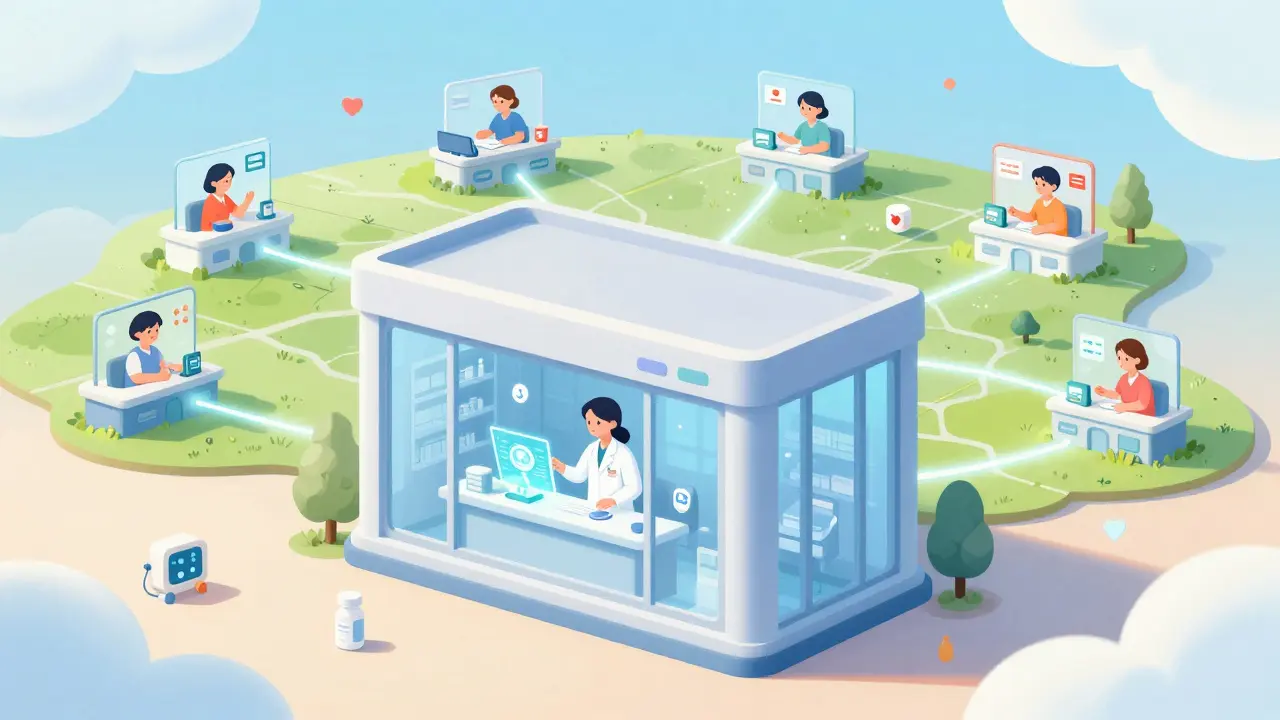
Telepharmacy isn’t just a video call with a pharmacist. It’s a full system: remote dispensing units, secure video platforms, electronic prescription checks, and automated verification tools. Most operate in one of two ways.
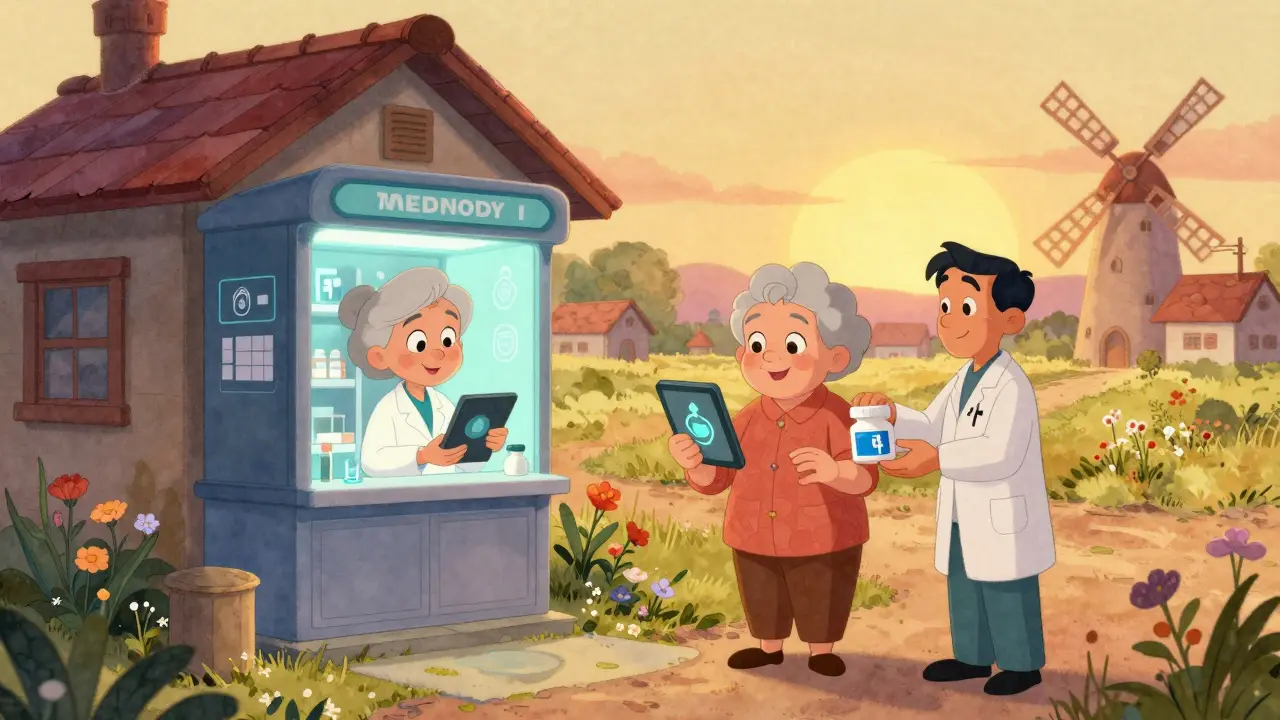
The first is the hub-and-spoke model. A central pharmacy-often in a city-oversees multiple remote sites, like rural clinics or small-town stores. Pharmacists at the hub review prescriptions, verify dosages, and approve dispensing through automated machines. Patients interact with a pharmacy technician on-site, who hands them their meds after a video consult with the remote pharmacist.
The second is direct-to-patient. This is growing fast. Patients video chat with a pharmacist from home, get prescriptions sent electronically, and pick up meds from a nearby pharmacy or have them delivered. This model is common in states with tight pharmacy shortages.
Both rely on high-definition video (720p minimum), encrypted systems that meet HIPAA rules, and backup communication lines. If the connection drops, the system flags the prescription until it’s manually reviewed. No shortcuts.
What the Data Says About Safety
Let’s cut through the noise. A 2021 systematic review by Pathak et al., analyzing six major studies from 2010 to 2020, found something surprising: telepharmacy matches traditional pharmacies in accuracy.
Dispensing error rates? Telepharmacy: 0.2%-0.8%. Traditional: 0.1%-0.7%. Almost identical. In one study, telepharmacy sites caught 1.2 errors per 100 prescriptions-same as brick-and-mortar. That’s not luck. It’s process.
But safety isn’t just about counting mistakes. It’s about preventing harm before it happens. A 2021 study in Telemedicine and e-Health tracked 3,782 patients over a year. Those with telepharmacy access had a 12.9% increase in hospitalizations due to medication issues. Those without? 40.2%. That’s a huge gap.
Why? Because telepharmacy means faster access to advice. A patient on warfarin can get their INR levels checked and dosage adjusted the same day. No waiting days for a clinic appointment. No driving hours to a pharmacy. That’s what cuts hospital visits.
And it’s not just about emergencies. A 2022 patient survey of 450 users found 76.4% were satisfied with telepharmacy. One woman in Montana said video chats about her blood thinner prevented two ER trips. That’s the kind of story you don’t see in spreadsheets.
Where Telepharmacy Falls Short
But here’s the other side.
Not all telepharmacy setups are equal. A Reddit user from North Dakota shared how a poor video connection led to a missed insulin allergy. The technician didn’t see the patient’s rash. The pharmacist couldn’t hear the wheeze. The result? A bad reaction.
That’s not rare. A 2022 survey by the National Community Pharmacists Association found 35% of telepharmacy sites struggled with unreliable internet. In rural areas, that’s not a glitch-it’s the norm.
Another issue? Training. A 2016 study found pharmacy students were 15-20% less effective at remote consultations than in-person ones. Why? They missed body language, tone shifts, hesitation. A pharmacist can’t tell if a patient is hiding pain, confusion, or fear over video if they’re not trained to look for it.
And then there’s the human factor. Dr. Jerry Fahrni warned in 2022 that the lack of physical presence makes it harder to spot signs of misuse. Someone hoarding pills? A trembling hand? A voice that cracks when they say, “I’m fine”? These cues vanish on screen.
That’s why top programs-like the Indian Health Service’s telepharmacy for Navajo Nation communities-require dual verification for high-risk drugs like opioids and anticoagulants. If something looks off, it’s automatically routed to an in-person pharmacist. No exceptions.
Who Benefits the Most?
Telepharmacy isn’t for everyone. But for certain groups, it’s life-changing.
Take rural communities. A 2023 JAMA Network Open study showed states with pro-telepharmacy laws reduced pharmacy deserts by 4.5% in just one year. That means thousands more people now live within 10 miles of pharmacy access.
It’s also helping aging populations. Seniors with mobility issues can get medication reviews without leaving home. Chronic disease patients-diabetics, heart failure, COPD-get more frequent check-ins. One program in South Dakota reported a 22% drop in dispensing errors after training technicians to spot red flags during video calls.
And it’s not just the U.S. The global telepharmacy market hit $1.87 billion in 2022 and is projected to grow to $6.84 billion by 2030. Countries with limited healthcare infrastructure are adopting it faster than developed ones.
What’s Changing Right Now
Telepharmacy is evolving fast.
In 2022, CMS expanded Medicare Part D reimbursement for telepharmacy services. That means more seniors can use it without extra cost. In 2023, the FDA launched a national monitoring project to track adverse drug events tied to telepharmacy. And PCORI is funding a $3.2 million randomized trial across 12 rural sites-finally, a gold-standard study to compare safety outcomes head-to-head.
AI is stepping in too. Companies like MedsAI are using machine learning to predict which prescriptions are most likely to cause harm. Early trials show a 18.7% improvement in catching dangerous interactions before they happen.
But the biggest shift? Standards. The American Pharmacists Association set a goal: establish evidence-based safety guidelines for telepharmacy by 2025. That’s huge. Right now, rules vary wildly by state. Some require video calls. Others allow audio-only. Some mandate dual verification. Others don’t.
Without uniform standards, safety will stay uneven.

What You Need to Know If You’re Using Telepharmacy
If you’re considering telepharmacy-whether you’re a patient or a provider-here’s what matters:
- Check the connection. If your video freezes, the consultation isn’t valid. Push for a reschedule. Never accept audio-only for complex meds.
- Ask about training. Are the technicians certified? Do they know how to spot warning signs? If not, ask if you can speak directly to the pharmacist.
- Know your meds. If you’re on blood thinners, insulin, or psychiatric drugs, insist on dual verification. Don’t assume it’s automatic.
- Report issues. If something feels off-delayed refills, unclear instructions, a pharmacist who rushes you-tell someone. These systems only improve if users speak up.
And if you’re a pharmacist or clinic owner: invest in training. Don’t just buy the tech. Train your team to read between the lines on screen. A 16-hour course on remote assessment can cut errors by a fifth.
The Bottom Line
Telepharmacy isn’t a magic fix. But it’s not a gamble either.
The evidence is clear: when done right, it’s as safe as a traditional pharmacy-and far more accessible. It’s preventing hospitalizations. It’s saving lives in places that had no other option.
The risks? They’re real, but they’re manageable. Poor tech, poor training, poor regulation. Not the model itself.
The future of pharmacy isn’t just about where you get your pills. It’s about who’s watching over them. And right now, telepharmacy is proving it can do that-even from 100 miles away.
Tony Du bled
December 21, 2025 AT 18:38Been using telepharmacy for my dad’s blood pressure meds since last year. No more 90-mile drives to the nearest pharmacy. He’s had zero issues. Just wish the tech didn’t freeze every time it snows.
Kathryn Weymouth
December 22, 2025 AT 01:33The data on error rates is compelling, but the real issue isn’t accuracy-it’s contextual awareness. A pharmacist can’t assess whether a patient is lying about their adherence if they can’t see the trembling hands or the avoidance in eye contact. Training must evolve beyond technical proficiency to include remote behavioral cues.
Herman Rousseau
December 23, 2025 AT 12:52This is exactly why we need standardized training across states. I’m a pharmacist in rural Nebraska-we got a grant last year to train our techs in non-verbal detection. We now use a checklist: facial tension, speech hesitation, hand movements. It’s not perfect, but we’ve cut red-flag misses by 30%. If you’re setting up a telepharmacy, don’t skip the human skills part. Tech is just the delivery system.
Ajay Brahmandam
December 24, 2025 AT 13:09My cousin in Andhra Pradesh uses telepharmacy for her diabetes meds. The system there is way more advanced than here-AI flags interactions, local nurses do in-person checks weekly, and video calls are mandatory for all controlled substances. We’re still stuck with audio-only in some counties. It’s embarrassing.
Julie Chavassieux
December 25, 2025 AT 10:39They say it saves lives. But what about the guy whose insulin was dispensed because the video glitched and the pharmacist didn’t see the rash? What about the kid who got ADHD meds because the tech didn’t notice the tremors? This isn’t healthcare-it’s a gamble with your life. And they’re calling it progress?
Jamison Kissh
December 26, 2025 AT 02:40There’s a deeper philosophical question here: If safety is defined by error rates and hospitalization stats, are we measuring the right thing? What about dignity? What about the quiet reassurance of a pharmacist who knows your name, your dog’s name, and that you hate the taste of your blood thinner? Can a screen replicate that? Or are we optimizing for efficiency while erasing the humanity of care?
Maybe telepharmacy is the future. But if the future doesn’t include warmth, it’s not really a future worth having.
I’m not against technology. I’m against replacing empathy with algorithms and calling it improvement.
When a patient says ‘I’m fine’ over video, and their voice cracks-do we train the AI to detect that? Or do we just assume the system did its job?
We’re not just dispensing pills. We’re dispensing trust. And trust doesn’t upload via Wi-Fi.
Maybe the real safety metric isn’t error rates-it’s whether the patient still feels seen.
That’s the number no study is measuring.
And if we don’t start measuring it, we’ll wake up one day with perfect dispensing accuracy and a nation of lonely, medicated people who never felt heard.
jenny guachamboza
December 27, 2025 AT 23:50Wait-so you’re telling me the government is letting robots give out opioids and anticoagulants?? This is how they’re gonna get us all addicted or poisoned!! I heard they’re using facial recognition to track if you’re lying about pain levels!! This is Big Pharma’s plan!! They don’t care if you live or die-they just want your data!!
Vikrant Sura
December 29, 2025 AT 08:34Study says error rates are similar. So what? That’s like saying a self-driving car is as safe as a human driver because both crash 0.2% of the time. Doesn’t mean you’d want to ride in either.