
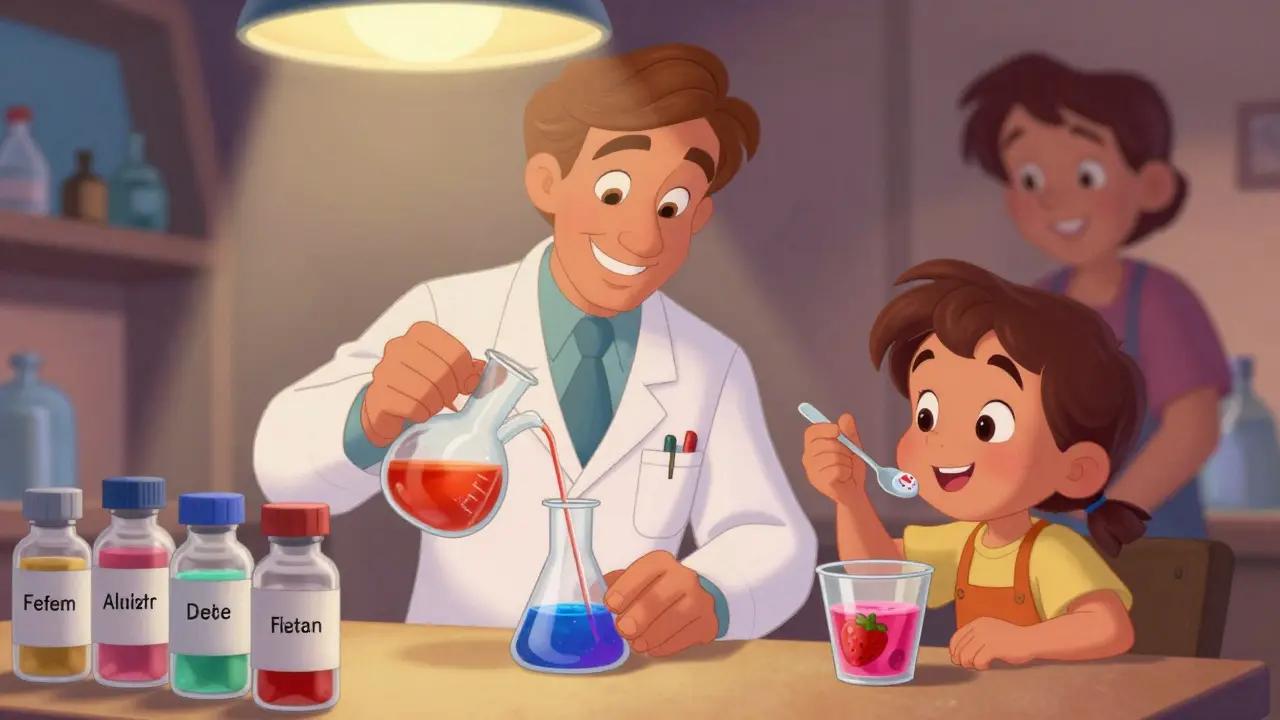
When your doctor prescribes a medication and the pharmacy says it’s out of stock-again-you’re not alone. In 2025, over 350 drug shortages hit U.S. hospitals and community pharmacies, leaving patients stuck. Some of these drugs aren’t just hard to find-they’re completely gone, with no end in sight. That’s where compounding pharmacies come in. They don’t just fill prescriptions. They build them from scratch when nothing else works.
What exactly is a compounding pharmacy?
A compounding pharmacy is not your local CVS or Walgreens. It’s a specialized lab where pharmacists mix, blend, or alter ingredients to make medications that don’t exist in stores. Think of it like custom baking a cake when the store only sells pre-made ones. If you’re allergic to dye, need a smaller dose, or can’t swallow pills, this is where solutions are made.
These pharmacies follow strict rules under USP <795> (for non-sterile mixes) and USP <797> (for sterile ones). They use pure, pharmaceutical-grade ingredients and work in clean rooms with air filters, just like hospitals. Unlike mass-produced drugs, each batch is made for one patient, based on a doctor’s exact order.
Why do people need them?
Let’s say your child has epilepsy and needs a liquid version of a drug-but the only available form is a large pill. Or maybe your elderly parent can’t swallow anything and needs a topical cream instead. Or perhaps you’re allergic to lactose, gluten, or artificial colors in every brand-name pill on the shelf. These aren’t rare cases. About 15-20% of people have sensitivities to common drug fillers. For them, standard meds aren’t just inconvenient-they’re dangerous.
Children make up 12% of compounded prescriptions. Older adults? That’s 28%. And for people with allergies, it’s 22%. Compounding pharmacies fix these problems by turning pills into drops, creams, or even lollipops (called troches). One parent on Reddit said switching from a bitter oral medication to a strawberry-flavored liquid increased her son’s adherence from 3 out of 7 days a week to every single day.
How do they help during drug shortages?
In 2025, the FDA listed over 350 drugs in short supply. These include antibiotics, heart medications, anesthetics, and even cancer drugs. When a manufacturer stops production or can’t get raw materials, hospitals scramble. That’s when compounding pharmacies step in.
For example, when the supply of injectable morphine dropped, some hospitals turned to compounding pharmacies to make sterile IV solutions using available raw chemicals. Same with thyroid hormone-when one brand vanished, pharmacists reformulated it into capsules with exact microgram doses. In one study, 85% of patients who switched to compounded versions during shortages reported better adherence and fewer side effects.
It’s not magic. Compounding pharmacies can’t recreate biologics like insulin or monoclonal antibodies. But for simple chemical compounds? They’re often the only lifeline.
What can they make?
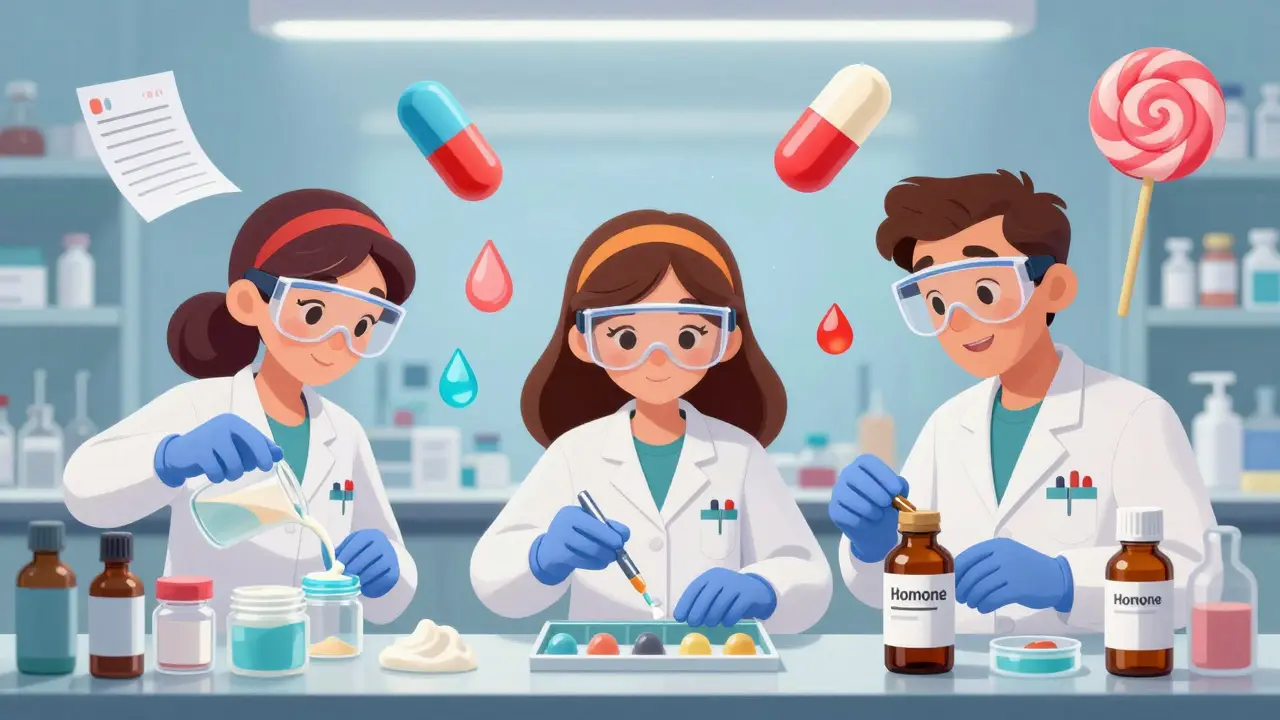
Here’s a quick look at what’s possible:
- Liquids - For kids or seniors who can’t swallow pills
- Topical creams - To avoid stomach upset from oral meds
- Transdermal gels - For hormone replacement without liver stress
- Troches - Dissolvable lozenges for fast absorption
- Flavored suspensions - Bubblegum, chocolate, or cherry to make medicine palatable
- Dye-free, gluten-free, preservative-free - For sensitive patients
- Exact dosages - Like 2.7 mg instead of the closest 5 mg pill
One pharmacist in Texas told me about a patient with chronic pain who couldn’t tolerate the filler in her pain patch. After switching to a compounded gel with the same active ingredient, her skin irritation dropped by 90%. She’s been using it for three years now.
How is it different from regular pharmacies?
Regular pharmacies stock pre-made drugs. Compounding pharmacies build them. That means:
| Feature | Regular Pharmacy | Compounding Pharmacy |
|---|---|---|
| Medication Source | Pre-manufactured, FDA-approved | Custom-made from raw ingredients |
| Availability | Immediate (if in stock) | 24-72 hours to prepare |
| Dosage Flexibility | Fixed strengths only | Custom microgram or milligram doses |
| Allergen Control | Cannot remove fillers | Can exclude gluten, dyes, lactose |
| Insurance Coverage | Usually covered | Often out-of-pocket (45% of cases) |
| Regulation | FDA oversight | USP standards + state pharmacy board |
The trade-off? You wait longer. And you often pay more. But for many, it’s worth it.
Who uses these services the most?
It’s not just rare cases. Here’s who benefits most:
- Pediatric patients - 40% of kids can’t swallow pills. Flavored liquids fix that.
- Elderly patients - 30% have trouble swallowing. Creams and gels help.
- Allergy-sensitive people - 1 in 5 react to dyes or preservatives.
- Chronic pain patients - 22% of compounded scripts are for pain relief.
- Hormone therapy users - 28% of compounding is for bioidentical hormones.
One 68-year-old woman in Florida stopped taking her blood pressure pill because it gave her a rash. Her compounding pharmacist made her a topical version. She’s been stable for two years.
What are the downsides?
Compounding isn’t perfect.
First, insurance rarely covers it. About 45% of patients pay out-of-pocket-sometimes $100-$300 per month. That’s a big barrier.
Second, wait times. While a regular prescription is ready in 10 minutes, compounded ones take 1-3 days. Sterile ones? Up to a week.
Third, not all compounding pharmacies are equal. Only about 1,200 out of 7,500 in the U.S. are accredited by the Pharmacy Compounding Accreditation Board (PCAB). If your pharmacy isn’t PCAB-certified, ask about their clean room, testing, and training. Ask for their batch records. If they can’t show you, walk away.
And here’s the big one: don’t use compounding just because you want a different brand. If a generic version exists and works, use it. About 15% of compounded prescriptions are unnecessary-meaning patients were put at risk for no reason.
How do you get one?
It starts with your doctor. They need to write a prescription that says something like: “Compounded suspension, 5 mg/mL, no dye, no gluten, cherry flavor.”
Then, find a compounding pharmacy. You can search for PCAB-accredited ones at pcab.org (though links aren’t allowed, you can ask your pharmacist for a list). Many hospitals have in-house compounding labs too.
Once you have a pharmacy, expect to talk with the pharmacist. They’ll ask about allergies, dosing history, and why the standard version won’t work. This isn’t a formality-it’s part of the safety process.
What’s next?
Compounding is growing fast. The market hit $11.2 billion in 2022 and is expected to hit $15.8 billion by 2027. Why? Because drug shortages aren’t going away. And people want more control over their meds.
New tools are helping too. Digital formulation software cuts errors by 37%. Better testing extends shelf life by up to 40%. Some pharmacies now use genetic data to tailor doses-like adjusting thyroid meds based on a patient’s metabolism.
But the core hasn’t changed. It’s still about a pharmacist listening, adapting, and building something just for you when the system fails.
Are compounded medications safe?
Yes-if they’re made by a licensed, accredited pharmacy following USP standards. Compounded drugs aren’t FDA-approved like mass-produced ones, but they’re held to strict quality rules. Always choose a PCAB-accredited pharmacy and ask to see their testing records.
Can I get compounded drugs without a prescription?
No. Compounded medications require a prescription from a licensed provider. Pharmacies cannot legally compound drugs without a specific patient order. Any pharmacy offering them without one is breaking the law.
Why aren’t compounded drugs covered by insurance?
Because they’re custom-made and not FDA-approved. Insurance plans cover standardized drugs with proven safety and cost data. Compounded meds are seen as exceptions, not replacements. Some plans cover them if your doctor proves medical necessity, but it’s rare.
How long does it take to get a compounded prescription?
Typically 24 to 72 hours. Simple non-sterile mixes (like creams or liquids) can be ready in a day. Sterile ones (injections, IVs) take longer-up to 5 days-because they require extra testing for safety. Always ask your pharmacy for a timeline.
Can a compounding pharmacy replace any missing drug?
Not all. They can replicate simple chemical compounds, like antibiotics or hormones. But they can’t make biologics (like insulin), vaccines, or complex drugs that require specialized manufacturing. If the drug is too complex, compounding won’t work-and your doctor will need to find another solution.
Tim Hnatko
March 6, 2026 AT 20:50Compounding pharmacies saved my life. My kid had a severe allergy to every commercial version of his seizure med. The stuff tasted like battery acid and gave him rashes. We switched to a compounded cherry-flavored liquid and suddenly he was taking it daily. No more ER visits. No more panic. Just a happy kid who doesn’t hate medicine anymore. Pharmacist even mailed us a little sticker chart. I cried.
It’s not perfect. Insurance won’t touch it. We pay $220/month out of pocket. But if you’re in this boat? Don’t give up. Ask your doc. Ask the pharmacist. They’re not magic, but they’re close.
Patrick Jackson
March 7, 2026 AT 13:40OMG YES 😭 I’ve been down this road for 5 years. My mom had thyroid cancer and the only brand that worked for her vanished. We tried generics-her TSH went haywire. Then we found a compounding pharmacy in Ohio. They made her a custom capsule with 87.5 mcg (yes, decimal points matter). She went from dizzy and exhausted to hiking mountains again.
And the pharmacist? He called her every month to check in. Like, actually called. Not automated. A human voice. That’s not pharmacy-that’s *care*.
Also, I’m convinced the reason big pharma hates this is because they can’t charge $1200/month for a 50-cent chemical. 🤔
Pranay Roy
March 9, 2026 AT 11:57Let me tell you what they don’t want you to know. Compounding pharmacies are a front. The FDA doesn’t regulate them properly. Many are run by guys with a degree from an online school. I did a deep dive-some labs use industrial-grade chemicals, skip sterility tests, and don’t even have HEPA filters. The 2012 fungal meningitis outbreak? That was compounding. And nothing changed.
Now they’re pushing this as some miracle solution? It’s a loophole. Insurance won’t cover it because it’s risky. And if you’re paying out of pocket? You’re the experiment. Don’t be fooled. There’s a reason generics exist.
Joe Prism
March 10, 2026 AT 15:43Simple truth: medicine is broken. We mass-produce pills like soda cans. One size fits none.
Compounding isn’t niche. It’s the future. Personalized. Precise. Patient-centered.
Big Pharma won’t adapt. So someone else will.
And that’s not a bug. It’s a feature.
William Minks
March 10, 2026 AT 16:03My aunt took a compounded version of her heart med after her kidney failed and the regular pill gave her nausea. They made her a transdermal gel. She said it felt like magic-no stomach pain, steady levels, no more vomiting.
She’s 79. Still gardening. Still cooking.
And yeah, she pays $180 a month. But she’s alive. That’s the math.
Jeff Mirisola
March 11, 2026 AT 11:15People act like this is some radical idea. Nah. This is how medicine worked before corporations took over. Before profit margins decided if a 2.7 mg dose was ‘too niche’ to make.
Compounding pharmacies are the last honest players in this game. They don’t care about quarterly earnings. They care if your kid can swallow something.
Let’s not romanticize it. Let’s fund it. Let’s make it insurance-covered. This isn’t a luxury. It’s healthcare.
Susan Purney Mark
March 12, 2026 AT 14:06As a pharmacist, I can’t tell you how many parents come in crying because their child can’t take their medication. One little girl had a severe allergy to cornstarch-common filler. Every pill made her break out. We made her a sugar-free, dye-free, flavor-free suspension. She started gaining weight. Started talking again.
It’s not about being ‘alternative.’ It’s about being human.
And yes, we’re PCAB-certified. Ask us anything. We’re here to help.
Ian Kiplagat
March 13, 2026 AT 05:17Interesting read. In the UK, we don’t have this system much-but we do have bespoke formulations for rare conditions. The difference? NHS covers it. No out-of-pocket. No waiting lists for accreditation. Just… care.
Maybe the real issue isn’t compounding. It’s that we’ve outsourced compassion to profit.
Food for thought. 🇬🇧