
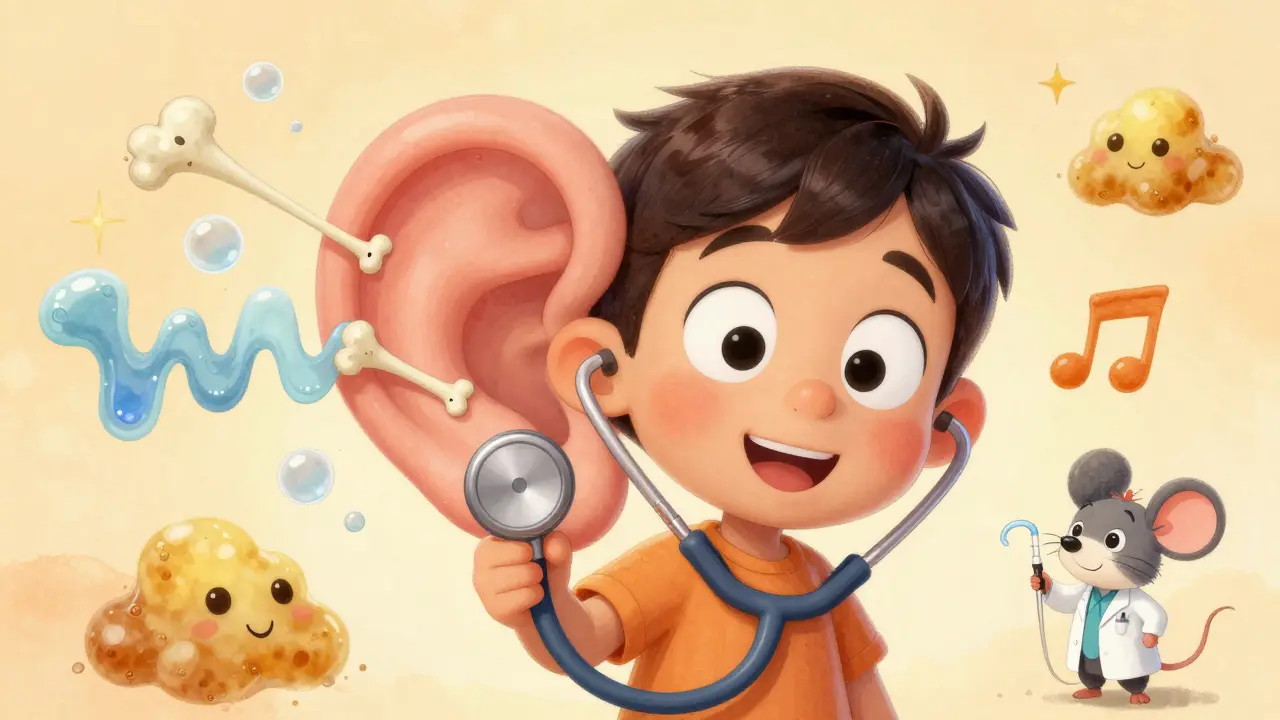
When you can’t hear soft sounds, but loud ones still sound muffled, it’s not just your ears being picky. It could be conductive hearing loss - a problem where sound gets stuck before it reaches the inner ear. Unlike sensorineural hearing loss, which damages the nerves or inner ear, conductive hearing loss is often caused by something physical blocking or disrupting sound in the outer or middle ear. The good news? Many cases can be fixed - sometimes with a simple procedure, sometimes with advanced surgery.
What’s Really Going On in Your Middle Ear?
Your middle ear isn’t just empty space. It’s a tiny, complex system of bones, membranes, and air pockets designed to carry sound vibrations from your eardrum to the inner ear. When anything goes wrong here - whether it’s fluid, bone growth, a hole in the eardrum, or a malformed canal - sound can’t travel properly. That’s conductive hearing loss. The most common culprits aren’t always obvious. In kids, it’s often glue ear - fluid trapped behind the eardrum after an infection. This is so common that by age three, 80% of children have had at least one episode. In adults, it’s more likely to be otosclerosis, where the stapes bone (one of the three tiny ear bones) fuses to the surrounding bone and stops vibrating. Cholesteatomas - abnormal skin growths in the middle ear - can also eat away at ear structures over time. And then there’s the simple but frequent: a perforated eardrum from trauma, loud noise, or infection. These aren’t just minor annoyances. Left untreated, they can lead to chronic infections, balance problems, and permanent damage. That’s why knowing the exact cause matters more than ever.How Do You Know It’s Conductive - Not Just Earwax?
Many people assume hearing trouble means earwax. And yes, wax buildup is a common and easy fix. But if your hearing doesn’t improve after cleaning, or if you’ve had recurring issues for months, you need more than a cotton swab. A proper diagnosis requires an audiologist - not a quick test at a pharmacy. They’ll do two key tests: air conduction and bone conduction. Air conduction sends sound through the ear canal; bone conduction sends it directly through the skull. If there’s a gap between the two - called an air-bone gap - it’s conductive hearing loss. That gap can range from 15 to 60 decibels, depending on how bad the blockage is. Tympanometry is another critical tool. It measures how well your eardrum moves. A flat reading (Type B tympanogram) almost always means fluid is behind the eardrum - a sign of otitis media with effusion. In kids, this happens in 92% of cases with persistent ear fluid. CT scans are often needed before surgery. They show the exact shape of the middle ear bones, whether there’s bone erosion from cholesteatoma, or if the ear canal is underdeveloped. These aren’t cheap - $800 to $1,200 out-of-pocket in the U.S. - but they’re essential. Guessing the problem leads to failed surgeries.Surgery Isn’t One-Size-Fits-All
There’s no single fix for conductive hearing loss. Each cause needs its own approach. For kids with glue ear, the go-to solution is a simple procedure: myringotomy with tube placement. Tiny tubes are inserted into the eardrum to drain fluid and let air in. About 667,000 of these are done every year in the U.S. alone. Most kids recover quickly - 75% stop having ear infections within three months. But 18% of parents report ongoing drainage, needing extra antibiotics. In adults with otosclerosis, a stapedectomy or stapedotomy is the standard. The stapes bone is either partially removed or pierced and replaced with a tiny prosthesis. Modern laser-assisted techniques have cut complication rates from 15% to under 2%. After surgery, 80-90% of patients close their air-bone gap to within 10 dB - meaning they hear almost normally. Many report hearing whispers again or no longer needing the TV turned up. For a perforated eardrum, tympanoplasty is the fix. Surgeons use a graft - often from the patient’s own tissue - to patch the hole. Success rates? 85-95% for small tears, 70-85% for larger ones. Recovery takes 6-8 weeks. You can’t get water in the ear, and you must avoid flying or scuba diving until cleared. Cholesteatomas are the most serious. These aren’t tumors, but they act like them - slowly destroying bone, causing infections, and sometimes leading to facial paralysis or meningitis. Surgery is urgent. The goal isn’t just to restore hearing - it’s to remove the growth and create a “safe, dry ear.” About 45% of middle ear surgeries at major centers like Mass Eye and Ear are for cholesteatoma. Recovery is longer - 4-6 weeks for most - and 27% of patients report changes in how sounds feel afterward. For children born with aural atresia - where the ear canal never formed - canalplasty is possible. But it’s complex. Only 60-70% achieve functional hearing improvement, and multiple surgeries are often needed. Still, for these kids, it can mean the difference between isolation and normal development.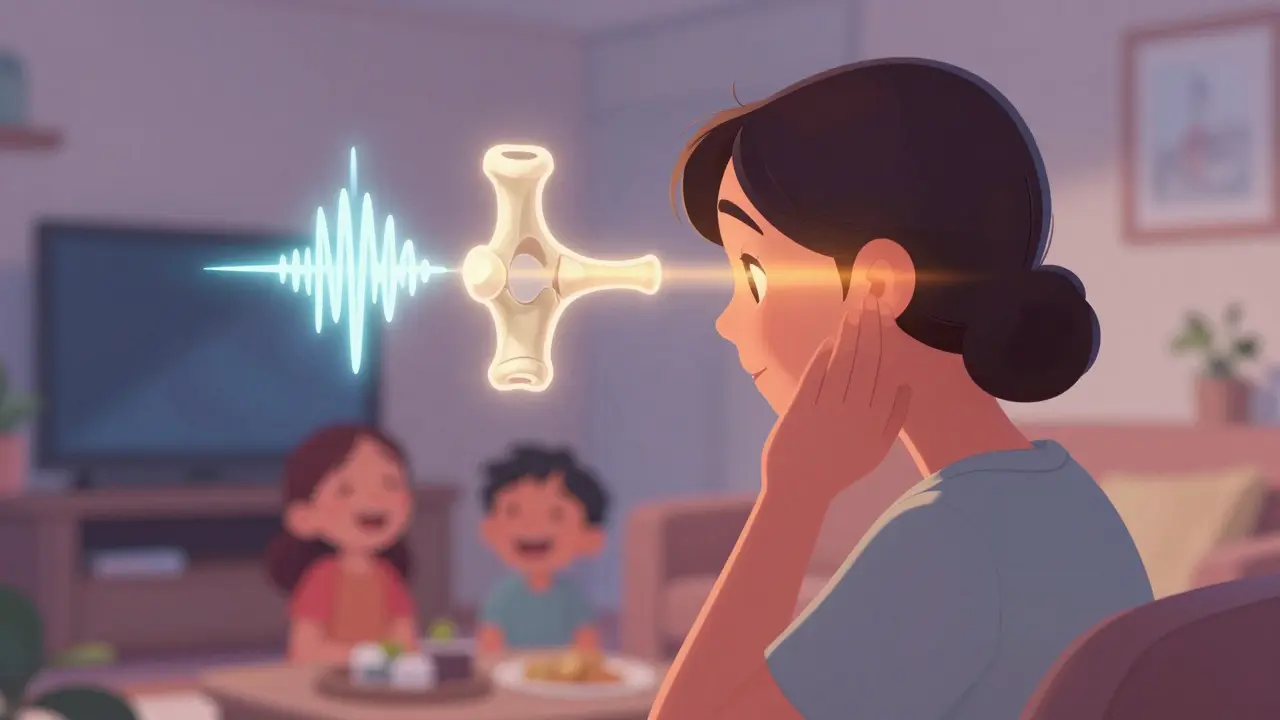
What to Expect After Surgery
Surgery doesn’t mean instant hearing. Healing takes time. You’ll need to avoid water, pressure changes, and strenuous activity for 6-8 weeks. Even then, some side effects linger. Temporary vertigo is common after stapes surgery - about 7% of patients feel dizzy for a few days. Taste changes? That happens in 4% because the nerve to the tongue runs near the stapes. Tinnitus can get worse temporarily in 3% of cases. These usually fade, but they’re real. Patient satisfaction is high overall. At Mass Eye and Ear, 87% of stapedectomy patients reported significant improvement in daily life. Parents of kids with ear tubes report 92% satisfaction with infection control. But satisfaction doesn’t mean perfection. Some people notice sounds are “off” - too sharp, tinny, or distant. That’s because the ear is rebuilding its sound-processing system. It can take months to adjust.When Surgery Isn’t the Answer
Not everyone needs surgery. In fact, 65% of pediatric conductive hearing loss cases resolve with medical treatment alone - antibiotics, ear drops, or just waiting for fluid to clear. For adults with mild loss, hearing aids can be a great alternative. Bone-anchored hearing aids (BAHAs) or air-conduction aids can bypass the middle ear entirely. Doctors usually wait 3-4 months to see if medical treatment works before recommending surgery - unless it’s cholesteatoma. Then, they act fast. Delaying surgery increases the risk of permanent damage.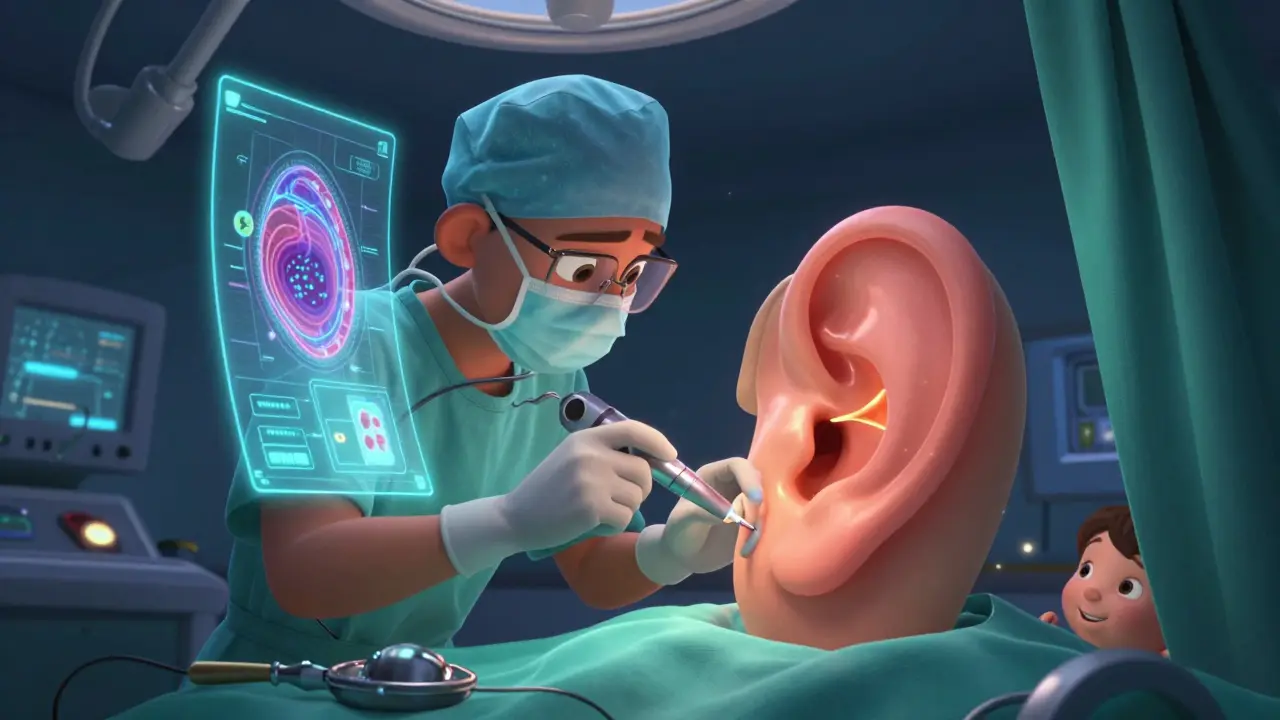
swarnima singh
January 17, 2026 AT 02:34also, why is this even a thing? why do our bodies just... let this happen?
Isabella Reid
January 18, 2026 AT 23:48And yes, the ‘tinny’ sound after surgery? Real. Took me 8 months to stop flinching at my own voice.
Jody Fahrenkrug
January 20, 2026 AT 14:49Also, 92% satisfaction for parents? That’s huge. Makes me want to push my niece’s pediatrician to test her again.
Kasey Summerer
January 20, 2026 AT 17:27Meanwhile, my dog hears better than I do after my stapedotomy. Guess I’m just the human version of a broken speaker.
kanchan tiwari
January 22, 2026 AT 01:52Why are we letting kids grow up with muffled worlds while Big Pharma sells hearing aids like candy? This isn’t medicine - it’s a cover-up. They want you dependent on devices, not cured.
I read about 3D-printed bones and I cried. Not from hope. From rage.
Bobbi-Marie Nova
January 22, 2026 AT 08:27Also, 87% satisfaction? That’s more than my last relationship. Honestly, if you’re even slightly curious about your hearing, just go get tested. No shame. You’re not ‘old’ or ‘dramatic’ - you’re just human.
Allen Davidson
January 23, 2026 AT 06:42It’s not ‘just a cold’. It’s not ‘stress’. It’s physics. Sound isn’t traveling. And physics doesn’t care how busy you are.
Get the test. Get the CT. Get the second opinion. Your future self will thank you.
john Mccoskey
January 25, 2026 AT 05:31And let’s not pretend that 3D-printed ossicles are some miracle. They’re still experimental. The FDA hasn’t even cleared them for widespread use. Meanwhile, the article glosses over the fact that 65% of pediatric cases resolve with watchful waiting - which means most kids don’t need surgery at all.
There’s a profit motive here. Tube placement is reimbursed at $1,200 per procedure. Stapedotomy? $18,000. Cholesteatoma removal? $32,000. The ENT industry is a $12 billion market. And you’re being sold a narrative of ‘fixable’ when the truth is far more complex.
Don’t be fooled by the hopeful tone. Medicine is rarely this clean.