
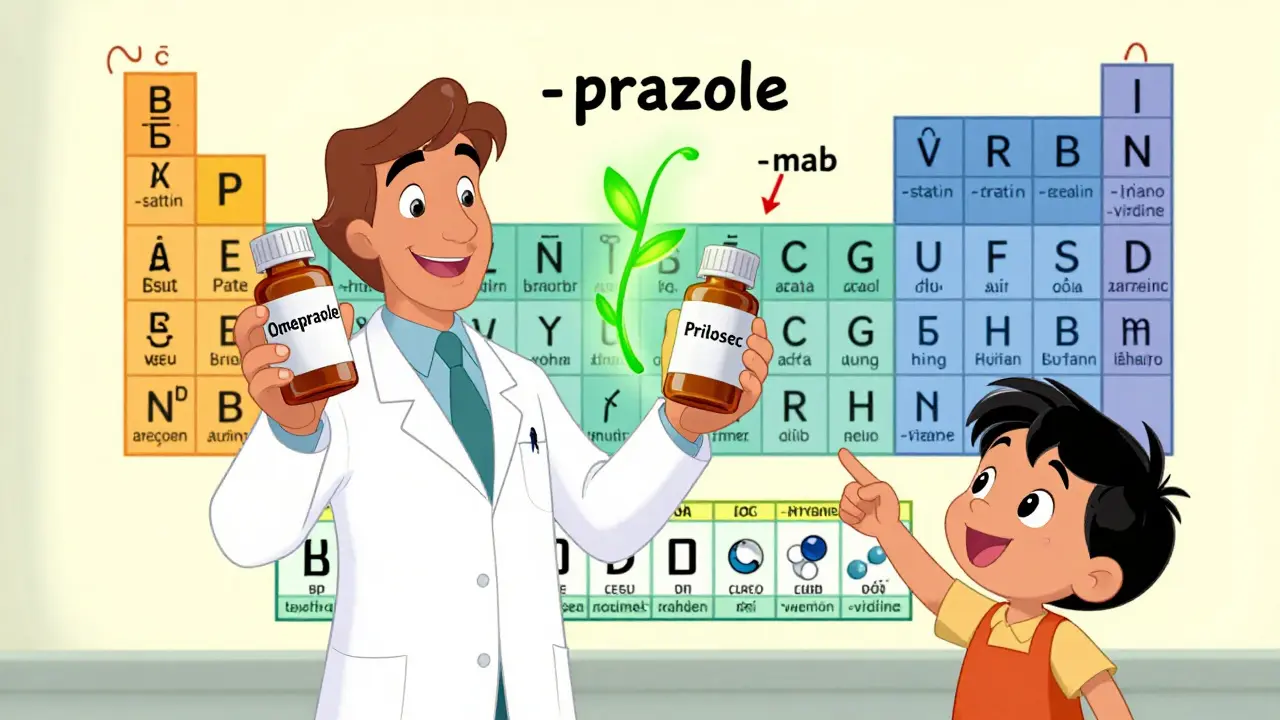
Have you ever wondered why some drugs have names like omeprazole or albuterol, while others are sold as Prilosec or ProAir? It’s not random. Behind every generic drug name is a strict, science-backed system designed to keep you safe. These aren’t just labels-they’re tools that help doctors, pharmacists, and patients avoid deadly mistakes. In the U.S., the system is called USAN. Around the world, it’s INN. And then there’s the brand name you see on TV ads. Let’s break down how all three work-and why they matter.
What Are USAN and INN?
USAN stands for United States Adopted Names a standardized naming system for drugs used in the United States, established in 1964 and managed by the USAN Council. INN is short for International Nonproprietary Names a global system managed by the World Health Organization since 1950 to give drugs the same name across countries. Both exist to make sure every drug has one clear, non-trademarked name that anyone can use.
Think of them like license plates for medicines. Just as your car has a unique number, every active drug ingredient has its own official name. This stops confusion. Imagine if one hospital called a blood thinner "warfarin" and another called it "coumadin"-that’s the kind of mess these systems prevent. In fact, about 95% of USAN and INN names match exactly. The big exceptions? Acetaminophen (USAN) vs. paracetamol (INN), and albuterol (USAN) vs. salbutamol (INN). These differences aren’t accidents-they’re historical footprints from different medical traditions.
The Stem System: How Names Reveal Drug Class
The real genius behind these names isn’t the whole word-it’s the ending. That’s the stem. Stems tell you what the drug does. If you see -prazole at the end-like omeprazole or esomeprazole-you know it’s a proton pump inhibitor, used for acid reflux. -statin? That’s a cholesterol-lowering drug, like atorvastatin. -mab? That’s a monoclonal antibody, used in cancer and autoimmune diseases.
Even within those stems, there’s more detail. A drug ending in -ximab, like rituximab, is a chimeric antibody (part mouse, part human). One ending in -zumab, like trastuzumab, is humanized. This isn’t just for scientists. Nurses and pharmacists use these clues to spot patterns and catch errors before they happen. A nurse might think, "Wait-this patient’s on a -virdine drug. That’s an HIV medication. Why is it being given for a sinus infection?" That’s the system working.
The beginning of the name-the prefix-is mostly made up. It’s designed to sound smooth and be easy to remember, but it doesn’t mean anything. Ome-prazole, ator-vastatin, ris-peridone. Those prefixes are just there to make each drug unique. No two drugs in the same class can have similar-sounding names. That’s why companies spend months testing dozens of options before submitting one.
How a Drug Gets Its Name
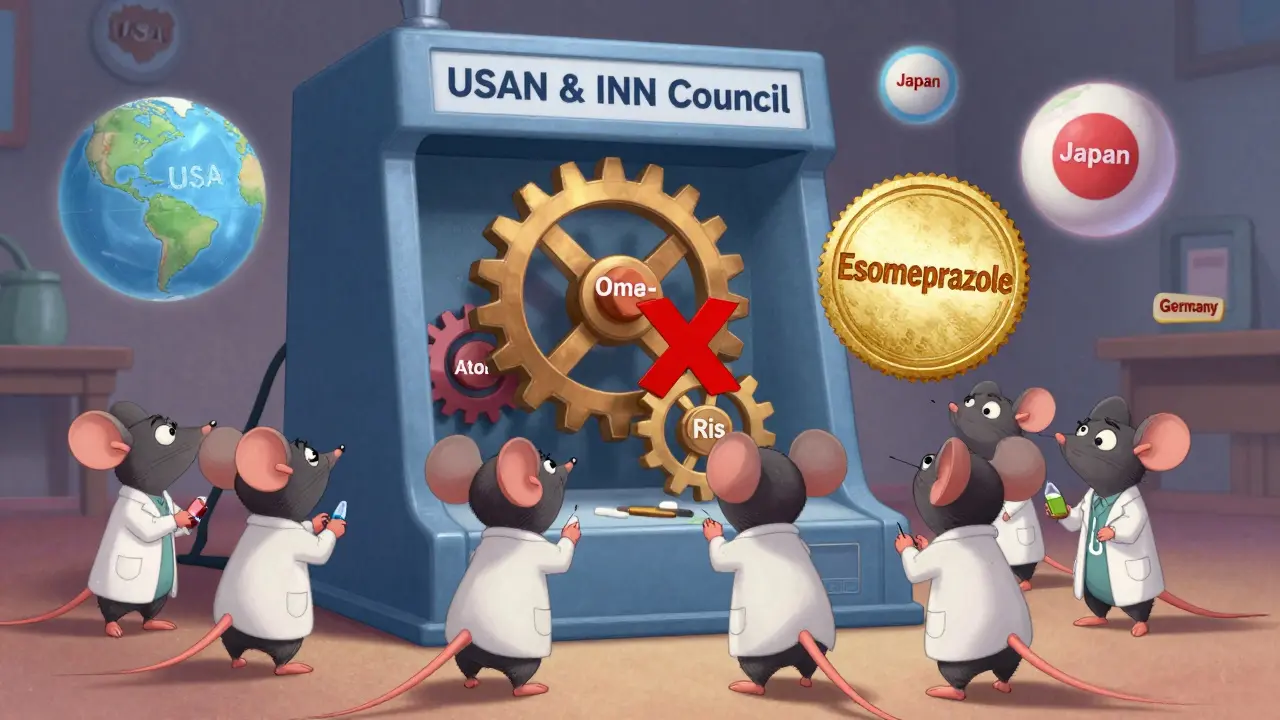
The process starts before a drug even hits the market. When a pharmaceutical company gets approval to begin human trials (called an IND application), they start working on names. They submit up to six name options to both the USAN Council and WHO’s INN program. Each name gets checked against every other drug name ever used-across all languages, all countries.
Here’s where it gets intense. A name can be rejected if it sounds too much like another drug. For example, if a new drug was called "Lunesta," but there was already a drug called "Lunazin," the name gets tossed. Even small differences matter. "Doxazosin" and "Doxepin" sound similar. That’s why the USAN Council rejects about 30-40% of proposed names on the first try. Companies often go through 15 to 20 name ideas before finding one that passes.
Once a name is approved by USAN, it goes to WHO. WHO might accept it as-is, or suggest a tweak to make it match the global standard. The final name is published with a 4-month public review window. If no one objects-which almost never happens-it becomes official. The whole process takes 18 to 24 months. That’s why companies start naming drugs early: if they wait too long, the drug’s launch gets delayed.
Brand Names vs. Generic Names
Here’s the twist: the generic name (USAN or INN) is public property. Any company can use it. The brand name? That’s owned by the original developer. So omeprazole is the generic. Prilosec is the brand. Once the patent expires, other companies can sell omeprazole under its generic name-and often at a fraction of the cost.
Brand names are designed to be catchy, memorable, and trademarkable. They’re often short, easy to say, and sometimes hint at the drug’s use. "ProAir" suggests quick relief for asthma. "Zoloft" sounds smooth and calming. But they can’t be misleading. The FDA won’t approve a brand name like "CureAll" because it implies something the drug doesn’t do.
There’s another layer: stereoisomers. These are molecules that are almost identical but have a mirror-image structure. That tiny difference can change how the drug works. That’s why you see names like esomeprazole (the S-isomer of omeprazole) or levetiracetam (the active left-handed version). The prefixes es- and lev- tell you exactly which version you’re getting.
Why This System Matters for Patient Safety
Medication errors kill thousands every year in the U.S. alone. The Institute of Medicine estimates that drug name confusion contributes to about $2.4 billion in avoidable healthcare costs annually. A patient in Canada gets salbutamol, but their U.S. doctor writes albuterol on the prescription. If the pharmacist doesn’t know they’re the same drug, the patient might get the wrong dose-or no dose at all.
That’s why the system is so rigid. Every stem, every prefix, every rejection rule is built around one goal: reduce confusion. A 2022 study in the Journal of Clinical Pharmacology pointed out that as drugs get more complex-like gene therapies or RNA-based treatments-the old stem system struggles to keep up. But the USAN and INN teams are adapting. New stems are being created only when absolutely necessary, and with heavy data backing.
What’s Next for Drug Naming?
Biologics-drugs made from living cells-are now 42% of global pharmaceutical sales. These include monoclonal antibodies, fusion proteins, and gene therapies. They don’t fit neatly into the old "-mab" or "-feron" categories. So the WHO updated its guidelines in 2021 to handle newer formats. The USAN Council now has rules for naming antibody-drug conjugates and other advanced therapies.
Still, challenges remain. Some experts worry that as drugs become more personalized-like cancer treatments tailored to a single patient’s DNA-the one-size-fits-all naming system may not hold. But for now, it’s the best tool we have. The system isn’t perfect, but it’s the reason you can walk into a pharmacy in Tokyo, Berlin, or Atlanta and get the same drug under the same generic name.
Real-World Impact
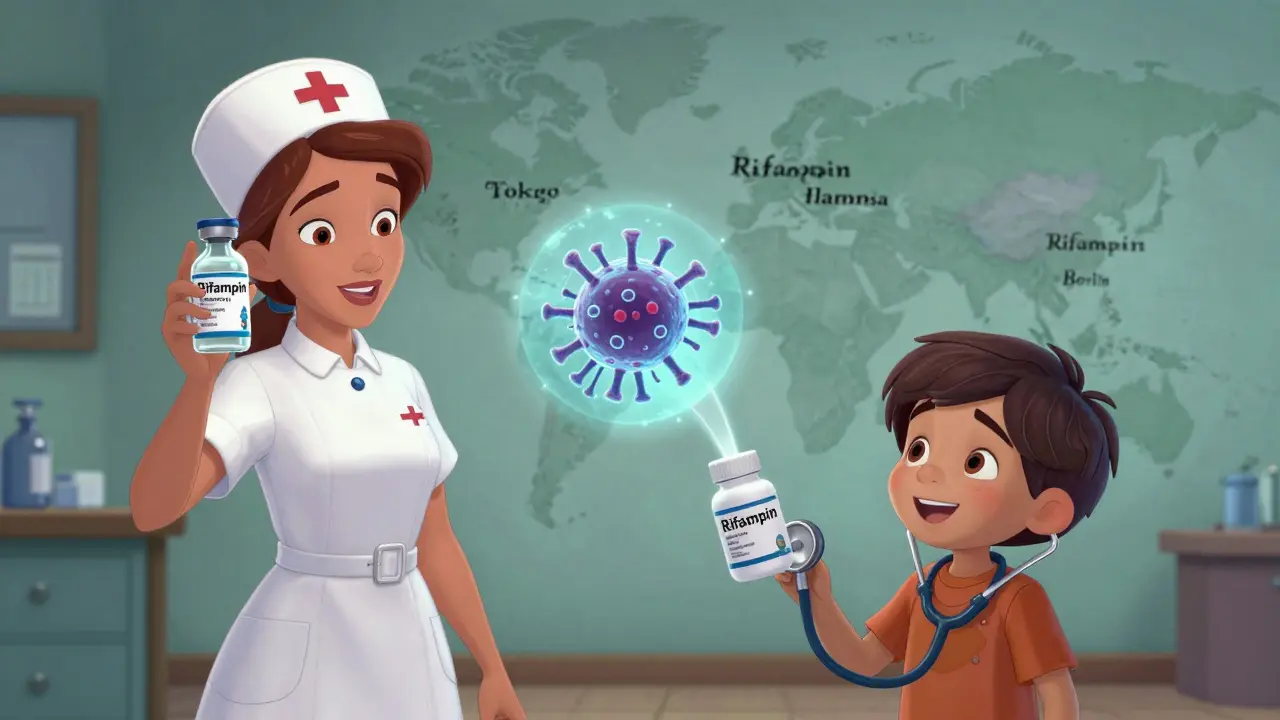
Consider this: a nurse in a rural clinic pulls a vial labeled "Rifampin". She’s never seen it before. But she knows the stem "-fampin" means it’s an antibiotic for tuberculosis. She checks the patient’s chart. They’re on a TB regimen. She gives the right dose. No questions asked. That’s the power of a good name.
Behind every pill, injection, or inhaler is a naming system that’s been refined for over 70 years. It’s not flashy. It doesn’t make headlines. But when a child gets the right medicine because their doctor didn’t confuse two similar-sounding names-that’s when this system saves lives.
Why do some drugs have different names in the U.S. and other countries?
Some drugs have different names because the U.S. and other countries developed their own naming traditions before global standards were fully aligned. For example, the U.S. uses "acetaminophen," while most other countries use "paracetamol." These differences come from historical usage, not scientific reasons. Today, USAN and INN work closely to minimize these gaps, but a few remain for practical reasons-like established use in local medical practice.
Can a drug have more than one generic name?
No. Once a drug is approved under USAN or INN, it has one official generic name. However, some drugs may have been known by different names before standardization. For example, before "omeprazole" was adopted, it was called "Losec" in Europe and "Prilosec" in the U.S. Once the generic name was set, those brand names became separate from the official nonproprietary name. Today, only one generic name is used in scientific and regulatory documents.
How do companies come up with brand names?
Pharmaceutical companies hire naming specialists who generate hundreds of name ideas. These names are tested for ease of pronunciation, memorability, and how they sound in different languages. They’re also checked against trademarks and existing drug names. The goal is to create a name that’s unique, easy to remember, and doesn’t imply false benefits. For example, "Zoloft" was chosen because it sounds calming and flows easily off the tongue.
Why do some drug names end in "-virdine" or "-prazole"?
These endings are called stems, and they tell you the drug’s class. "-virdine" means it’s a nucleoside reverse transcriptase inhibitor-used for HIV. "-prazole" means it’s a proton pump inhibitor-used for acid reflux. This system lets doctors and pharmacists instantly recognize what a drug does, even if they’ve never seen it before. It’s a built-in safety feature.
Do generic drugs have different effects than brand-name drugs?
No. Generic drugs contain the exact same active ingredient as the brand-name version, in the same dose and form. The only differences are in inactive ingredients like fillers or dyes, which don’t affect how the drug works. The FDA requires generics to be bioequivalent-meaning they work the same way in the body. The difference is price, not performance.
If you’re ever unsure about a drug’s name, check the label. The generic name is always listed. It’s your best tool for understanding what you’re taking-and why.
Daniel Dover
February 16, 2026 AT 01:11Charlotte Dacre
February 17, 2026 AT 22:21Kaye Alcaraz
February 19, 2026 AT 17:28Mandeep Singh
February 19, 2026 AT 23:48Josiah Demara
February 20, 2026 AT 03:40Joe Grushkin
February 20, 2026 AT 13:26Virginia Kimball
February 20, 2026 AT 21:17Kapil Verma
February 21, 2026 AT 15:53Michael Page
February 22, 2026 AT 19:28Betty Kirby
February 23, 2026 AT 03:17Erica Banatao Darilag
February 24, 2026 AT 00:12Esha Pathak
February 25, 2026 AT 17:46Mike Hammer
February 27, 2026 AT 07:50Chiruvella Pardha Krishna
March 1, 2026 AT 02:51