
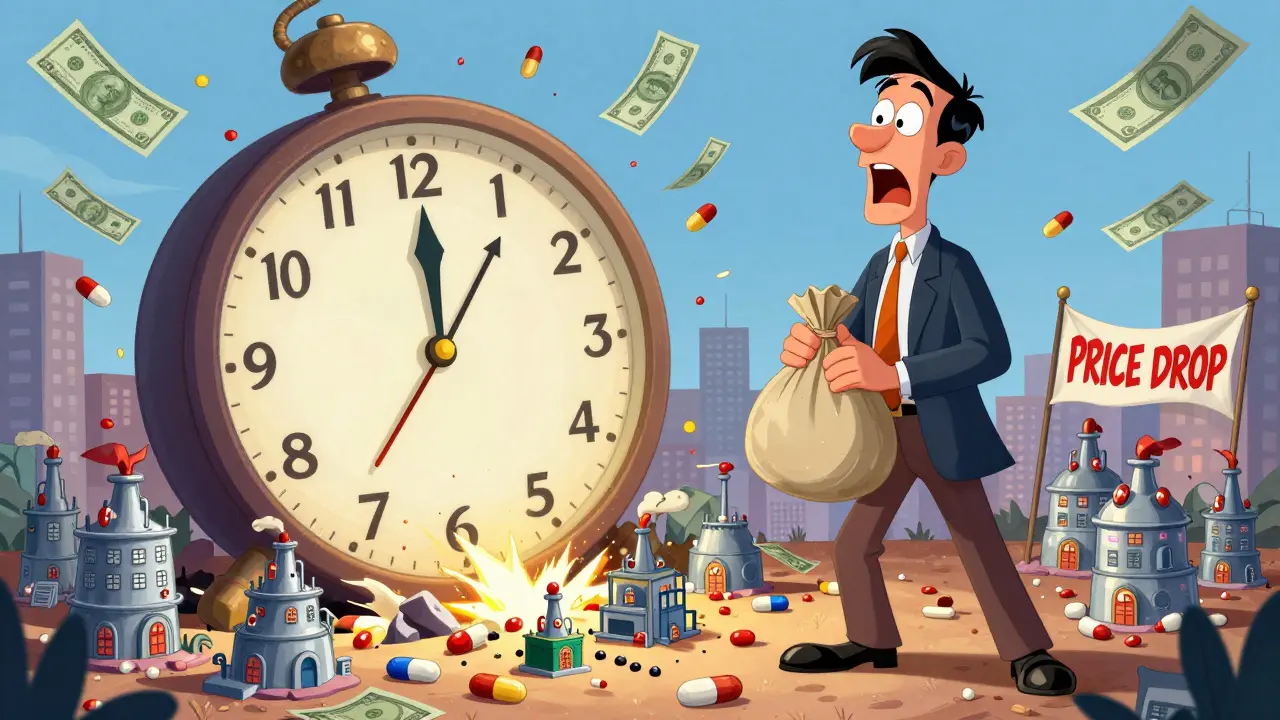
When a brand-name drug loses its patent, everything changes. The price doesn’t just drop a little-it plummets. Sometimes by 90%. And that’s not a rumor. It’s what happens every time a blockbuster drug like Humira or Lipitor goes generic. Suddenly, dozens of companies start making the exact same pill, at a fraction of the cost. Patients pay less. Insurers pay less. But the original drugmaker? They lose most of their revenue overnight. This isn’t just business. It’s economic warfare, and generics are winning.
The Patent Cliff: When Revenue Collapses
Every brand-name drug has a countdown clock. Patents last 20 years, but after accounting for development and FDA review, most drugs have only 7-12 years of exclusive sales. When that window closes, the floodgates open. Generic manufacturers, who spent little on research and nothing on advertising, rush in. The FDA approves them quickly because they don’t need to prove the drug works again-they just have to show it’s the same as the original. The numbers don’t lie. In the U.S., generics make up 90% of prescriptions but only 20% of total drug spending. That means for every $100 spent on prescriptions, $80 goes to brand drugs-even though most of the pills being taken are generic. Why? Because brand drugs are still priced like monopolies. Once generics arrive, prices crash. A drug that cost $300 a month might drop to $20. Within a year, the brand manufacturer often loses 80-90% of its sales. Pfizer saw its stock dip sharply after Lipitor went generic. AbbVie’s Humira, which once brought in $21 billion in a single year, lost nearly all its revenue when biosimilars entered in 2023.How Generics Drive Down Prices-And Why They Keep Falling
Generics don’t just compete. They outcompete. The more companies that make a generic drug, the lower the price gets. The FDA tracked over 2,400 new generics approved between 2018 and 2020. Their findings? Just three competitors can cut prices by 20% within three years. With five or more, prices often fall below 10% of the original brand cost. This isn’t accidental. It’s economics 101. When a product becomes a commodity-like aspirin or metformin-no one wins by charging more. The race is to the bottom. Manufacturers cut costs: smaller batches, cheaper packaging, lower margins. Some even operate out of low-cost countries. The result? Consumers save $8-10 billion a year just on generic medications. The Congressional Budget Office estimated generics saved the U.S. $253 billion in 2014 alone. By 2023, that number had climbed to $330 billion annually. But here’s the twist: even though generics are cheaper, patients sometimes still overpay. Why? Because pharmacy benefit managers (PBMs)-the middlemen between insurers, pharmacies, and drugmakers-use opaque pricing tricks. A generic might cost $5 at the wholesaler, but the PBM negotiates a $15 reimbursement rate. The pharmacy gets paid $15, but the patient’s copay is still $20. The extra $5? That’s profit for the PBM. A 2022 study from the Schaeffer Center found patients pay 13-20% more for generics than they should because of these hidden markups.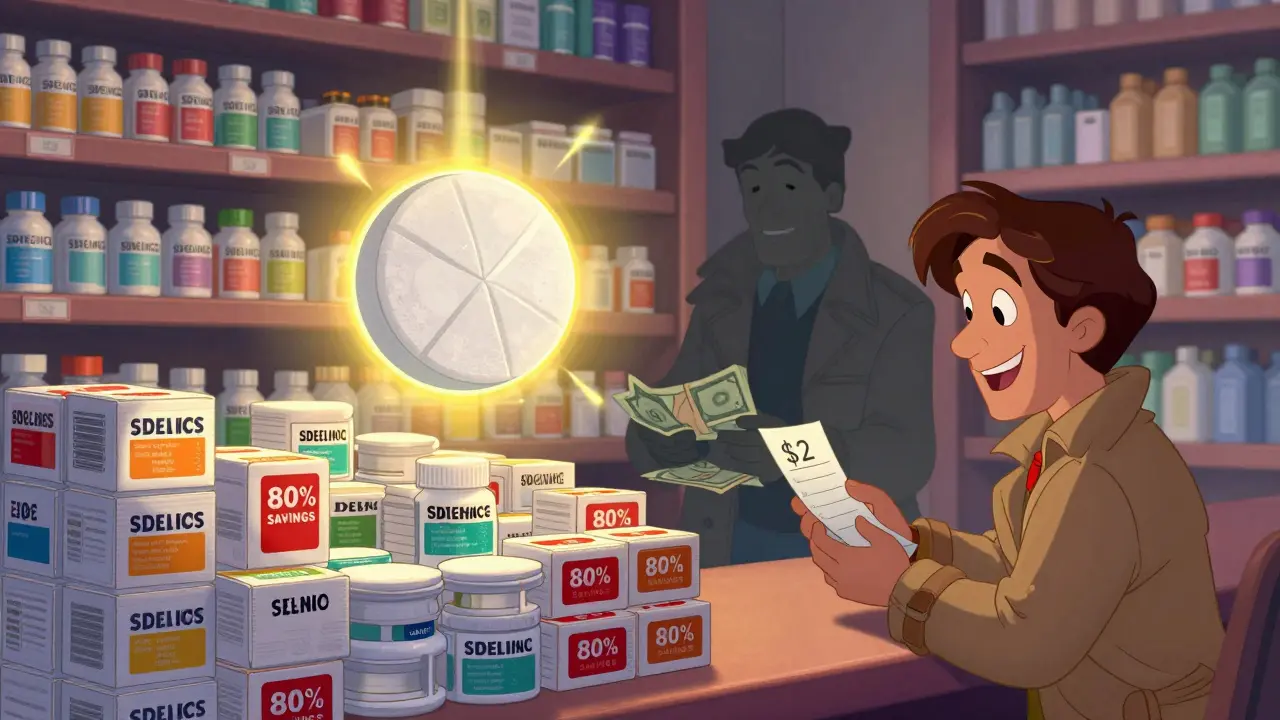
Brand Manufacturers Fight Back-And How They Do It
No brand company wants to see its biggest seller turn into a $2 pill. So they fight. One tactic? Pay-for-delay. This is when a brand manufacturer pays a generic company to hold off on launching its version. It sounds shady-and it is. A 2023 study by the Blue Cross Blue Shield Association found these deals cost patients $3 billion a year in higher out-of-pocket costs. The Congressional Budget Office estimates ending them would save $45 billion over 10 years. Another trick? Product hopping. A brand company slightly changes its drug-switches from a pill to a liquid, adds a new coating, tweaks the dosage-and files a new patent. Suddenly, the old version isn’t covered anymore. Patients have to switch. This delays generics by years. The CBO says stopping this practice would save $1.1 billion over 10 years. Some companies even create their own generics. Novartis spun off its generic division into Sandoz in 2022. Pfizer and Johnson & Johnson have done similar moves. Why? To capture a slice of the generic market before competitors do. It’s not altruism-it’s survival. These companies now run two businesses: one for innovation, one for volume. They’re not just fighting generics. They’re becoming them.The Hidden Cost: Supply Shortages and Quality Risks
The race to the bottom has a dark side. When prices are too low, manufacturers cut corners. Some stop making certain generics because they can’t profit. Others move production overseas, where oversight is weaker. The FDA has repeatedly warned that generic drug shortages are rising-not because of demand, but because of economics. A 2023 FDA report noted that when too many companies enter a market, the lowest bidder wins. That often means the manufacturer with the cheapest labor, the least regulatory oversight, or the most fragile supply chain. In 2021, a shortage of a common blood pressure drug led to hospital delays. Why? Because the only U.S.-based producer shut down after losing money for two straight years. This isn’t a future problem. It’s happening now. The FDA’s own data shows that 1 in 5 generic drugs face at least one shortage per year. And it’s getting worse. The ASPE Drug Competition Series found that consolidation in generic manufacturing-with nearly 100 mergers between 2014 and 2016-is reducing competition. Fewer players means less pressure to cut prices… and more risk of supply failure.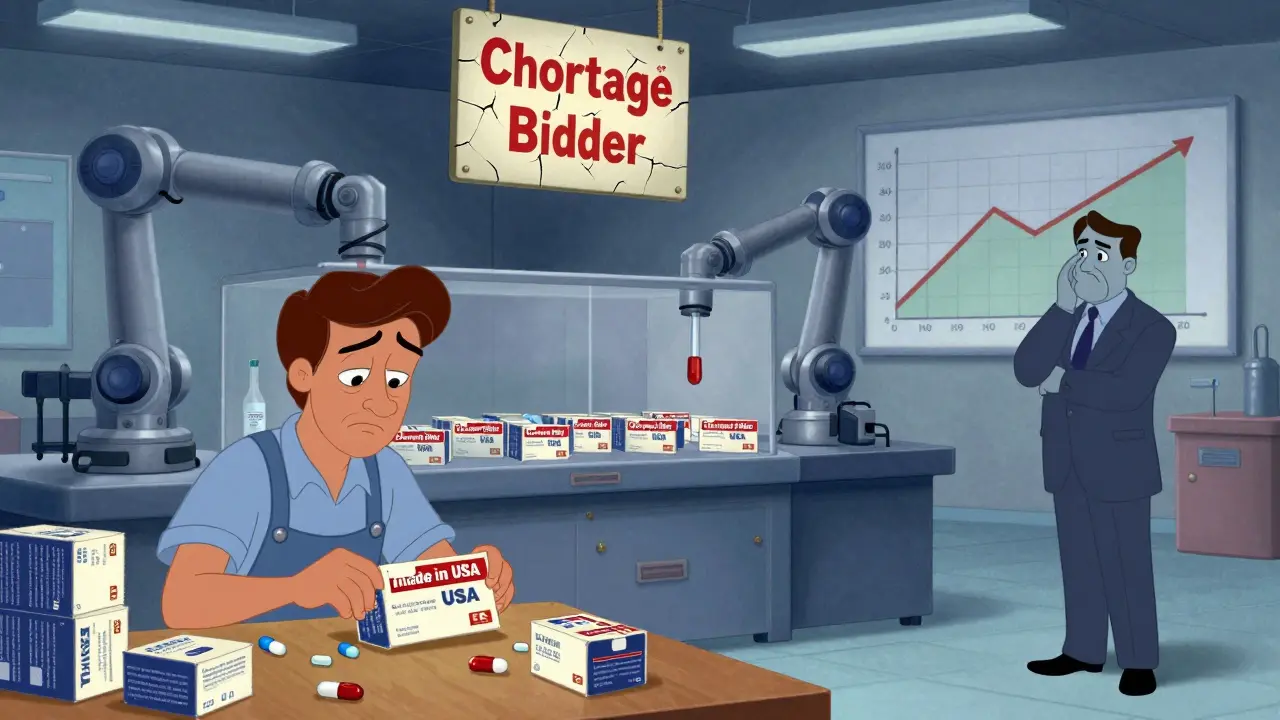
What’s Next? The 0 Billion Challenge
By 2028, an estimated $400 billion in brand drug revenue will be at risk from patent expirations. That’s not just a number. It’s the future of big pharma. Drugs for diabetes, cancer, heart disease, and mental health are next in line. When they go generic, the revenue collapse will be massive. Some companies are adapting. They’re shifting from selling pills to selling outcomes-offering patient support programs, digital monitoring tools, and bundled services. Others are focusing on complex drugs that are harder to copy: injectables, inhalers, biosimilars. These aren’t simple pills. They’re expensive to make. That means slower generic entry. That gives brands more time. Meanwhile, lawmakers are pushing back. Bipartisan bills in Congress aim to ban pay-for-delay deals. The FDA’s Generic Drug User Fee Amendments (GDUFA), reauthorized in 2022 with $1.1 billion in funding, are speeding up approvals. But the system is still broken. PBMs still game the system. Manufacturers still stretch patents. Patients still pay too much.The Real Winner? The Patient-If the System Works
Generics aren’t the enemy. They’re the fix. Without them, millions couldn’t afford their medicine. But the system isn’t designed to make generics work for patients. It’s designed to make them work for intermediaries. PBMs. Distributors. Insurance companies. Even some generic manufacturers. The solution isn’t to stop generics. It’s to fix the middlemen. To force transparency. To end pay-for-delay. To stop product hopping. To make sure the savings actually reach the person holding the prescription. Right now, the math is clear: generics save billions. But too often, those savings vanish before they reach the pharmacy counter. Until that changes, the real cost of generics won’t be what’s on the price tag-it’ll be what’s missing from the patient’s pocket.Why do generic drugs cost so much less than brand-name drugs?
Generic drugs cost less because they don’t need to repeat expensive clinical trials. The original brand company already proved the drug is safe and effective. Generic makers only need to show their version is bioequivalent-meaning it works the same way in the body. They also skip costly marketing campaigns. With no R&D or advertising to recoup, they can sell the same medicine for 80-85% less. The FDA confirms this gap consistently across thousands of drugs.
Do generic drugs work as well as brand-name drugs?
Yes. The FDA requires generics to have the same active ingredient, strength, dosage form, and route of administration as the brand-name drug. They must also meet the same strict manufacturing standards. Studies show generics perform identically in the body. The only differences are in inactive ingredients like fillers or coatings-which rarely affect how the drug works. Millions of patients switch to generics every year without any loss in effectiveness.
What is a "pay-for-delay" deal?
A "pay-for-delay" deal happens when a brand-name drug company pays a generic manufacturer to delay launching its cheaper version. Instead of competing, the two companies strike a secret agreement. The brand company pays millions-or even hundreds of millions-to keep the generic off the market. This keeps prices high and profits flowing. The FTC and Congressional Budget Office estimate these deals cost patients and taxpayers billions each year.
Why are there shortages of generic drugs?
Generic drug shortages happen because prices are too low to sustain production. When dozens of companies make the same drug, the lowest bidder wins. Many manufacturers operate on razor-thin margins. If costs rise-due to raw materials, labor, or regulations-they stop making the drug. Some move production overseas, where oversight is weaker. Others simply walk away. The FDA has flagged over 100 generic drugs with recurring shortages, mostly common, low-cost medicines like antibiotics and blood pressure pills.
How do pharmacy benefit managers (PBMs) affect generic drug prices?
PBMs negotiate drug prices between insurers and pharmacies, but their pricing models are often opaque. They may set reimbursement rates that look like savings but actually hide markups. For example, a generic drug might cost $3 at the wholesaler, but the PBM tells the pharmacy to charge $15. The patient pays a $20 copay, and the pharmacy gets $15. The extra $12? That’s profit for the PBM. This system means patients often pay more than the actual cost of the drug-even when generics are available.
Nicholas Gama
March 9, 2026 AT 08:47Let’s be real-this isn’t about healthcare. It’s about corporate surrender. The moment a patent expires, Big Pharma doesn’t innovate. They just beg for handouts. And now they’re crying because their monopoly gravy train got derailed? Pathetic.
Generics aren’t the problem. The problem is that we let corporations write the rules. You think $20 pills are cheap? Try telling that to someone who still pays $50 because their PBM ‘negotiated’ a markup. This system is rigged.
And don’t even get me started on product hopping. That’s not innovation. That’s fraud dressed up as IP law. If you’re changing a coating to delay competition, you’re not a pharmaceutical company-you’re a con artist with a lab coat.
Mary Beth Brook
March 10, 2026 AT 08:25Let’s not romanticize generics. This isn’t some noble public health win-it’s economic warfare waged by foreign manufacturers with zero regulatory accountability. Over 80% of generic APIs come from China and India. Half of those facilities fail FDA inspections. We’re outsourcing our medicine to countries with lax oversight and slave labor wages.
And now we’re supposed to cheer because a blood pressure pill costs $3? Great. Until it’s contaminated with NDMA or the supply chain collapses because no one’s profitable enough to maintain quality. This isn’t savings. It’s systemic risk masked as affordability.
Neeti Rustagi
March 12, 2026 AT 04:02While I appreciate the thorough analysis presented, I must respectfully emphasize that the underlying issue transcends mere economic mechanics.
The true challenge lies in the structural imbalance between profit motives and patient welfare. Generics, though economically indispensable, remain entangled in a web of intermediaries whose incentives are misaligned with accessibility.
It is not enough to reduce price tags; we must also dismantle opacity. Transparency in PBM rebates, elimination of pay-for-delay, and stringent oversight of overseas manufacturing are not policy suggestions-they are moral imperatives.
Let us not mistake affordability for justice. The patient’s dignity must not be contingent on the lowest bidder.
Dan Mayer
March 12, 2026 AT 11:42so like… i just read this whole thing and like… wow. generics are like 90% of prescriptions but only 20% of spending?? that makes no sense unless you’re talking about like… markup or something. and yeah pbms are total scammers. i had a friend who got metformin and paid $40 for it and then found out it cost $2 at costco. like wtf. and dont even get me started on the fact that the same pill made in india is sold for $0.10 but we pay $15. its insane. and the fda says its ‘bioequivalent’ but how do they even test that? do they just… look at it? i think we need like… public audits or something. like, why are we trusting this system? its a joke.
Janelle Pearl
March 12, 2026 AT 16:31I’ve been on generics for over a decade. I’ve seen the price drop from $120 to $12. I’ve also seen the pharmacy run out. Twice.
It’s not that I don’t appreciate the savings. I do. But I also remember the panic when my blood pressure med disappeared for three months. My doctor had to scramble. I had to switch. I got dizzy. I was scared.
This isn’t just economics. It’s human. We treat medicine like a spreadsheet. But it’s not. It’s someone’s life. And when we chase the lowest price without safeguarding the supply, we’re not saving money-we’re gambling with lives.
Ray Foret Jr.
March 13, 2026 AT 11:15bro this is wild 😍
like imagine your favorite soda gets ripped off by 50 other brands and suddenly costs 10 cents… but then the vending machine charges you $2 because ‘oh we have to pay the middleman’
that’s literally what’s happening. and the worst part? no one talks about it. everyone’s just like ‘oh cool generics are cheap!’
but wait-why am I still paying $20 for a $3 pill??
pbms are the real villains here. and i’m not even mad… i’m just disappointed. we could fix this. we just don’t want to. 😔
Samantha Fierro
March 14, 2026 AT 21:58The narrative surrounding generics is often oversimplified. While it is true that they reduce out-of-pocket costs for patients, the broader system of drug pricing remains deeply flawed. The focus on manufacturing cost ignores the value of innovation that precedes generic entry.
Furthermore, the erosion of domestic manufacturing capacity-driven by unsustainable pricing models-poses a national security risk. The supply chain vulnerabilities exposed during the pandemic should have been a wake-up call.
True reform requires balancing affordability with resilience. We cannot afford to sacrifice quality, reliability, and domestic capacity on the altar of lowest price alone.
Robert Bliss
March 16, 2026 AT 21:08just wanna say i’m glad we have generics. i couldn’t afford my meds without them. no joke.
but yeah… the system is broken. i get my pills and they’re fine. but i know people who got sick because their med was out of stock. and then they had to pay $80 for a 30-day supply because there was only one brand left.
we need more factories. more competition. less middlemen.
and maybe… just maybe… stop letting corporations play games with our lives. 🙏
Peter Kovac
March 16, 2026 AT 22:35Analysis is superficial. You cite aggregate savings but ignore marginal cost structures. The $330 billion figure includes only retail transactions-excluding hospital use, long-term care, and government programs, where pricing is even more distorted.
Moreover, the 90% prescription share is misleading. It conflates volume with value. A single insulin injection costs more than 500 metformin tablets. The real revenue collapse is concentrated in a handful of blockbuster drugs-most of which were overpriced to begin with.
What’s missing is elasticity modeling. The price elasticity of demand for life-sustaining generics is near zero. Therefore, marginal cost reductions do not translate to proportional patient savings. The system is not broken-it is optimized for corporate profit retention, not consumer welfare.
APRIL HARRINGTON
March 18, 2026 AT 16:36okay so like i just read this and i cried. not because im sad. because im FURIOUS.
we have a system where a drug made in china costs $0.05 and we pay $20. and the person who runs the pharmacy doesn’t even get the extra $15. it goes to some guy in a suit in Connecticut who never even seen a pill.
and then when the drug runs out? no one cares. until someone dies. then we have a tweet.
how is this legal? how is this normal? why are we still letting this happen? i’m done. i’m done.
someone please fix this. please. i beg you.
Leon Hallal
March 20, 2026 AT 02:07Every time I see someone say ‘generics save billions’ I want to scream. You think those billions are going to patients? Nah. They’re going to insurance companies and PBMs who raise premiums next year because ‘look how much we saved!’
It’s a shell game. We’re told we’re getting cheaper drugs. But our deductibles go up. Our co-pays stay the same. Our premiums rise.
Generics didn’t fix healthcare. They just made it look like it was fixed. And now we’re all stuck with the same broken system-just with cheaper pills.