
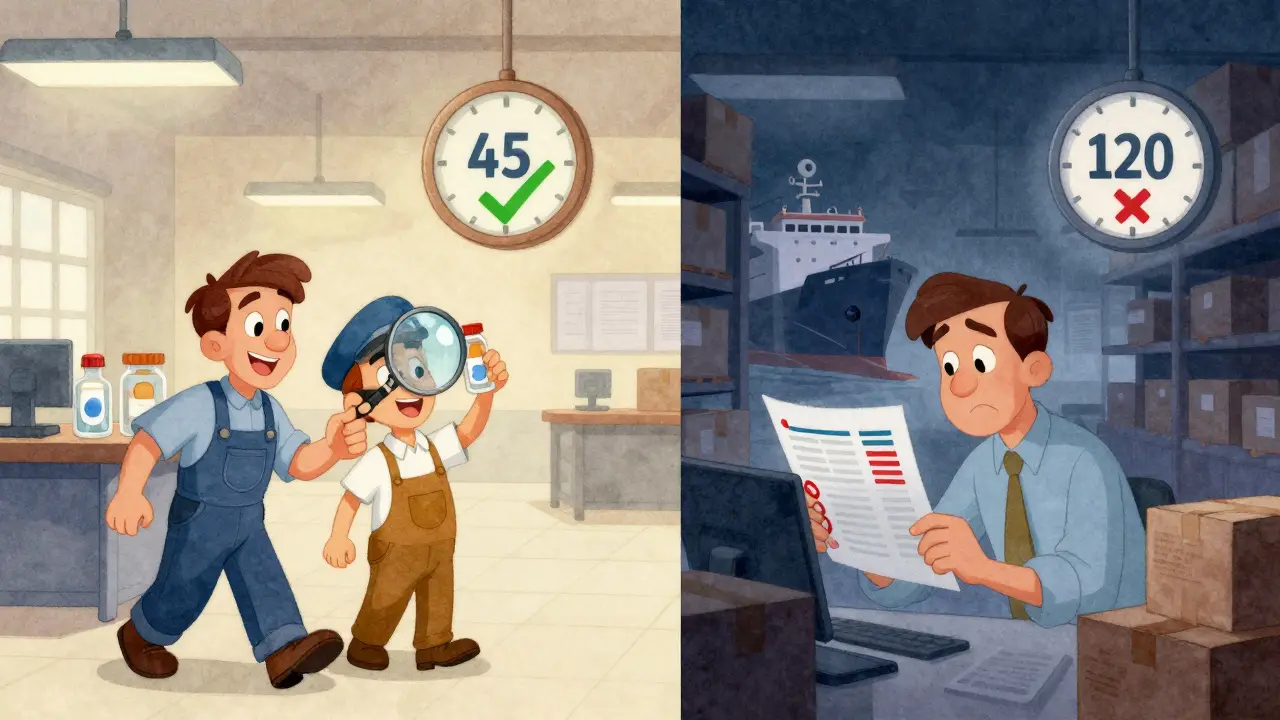
When you’re making generic products-whether it’s pills, medical devices, or health supplements-the choice between making them at home or overseas isn’t just about price. It’s about control, speed, risk, and trust. You might think overseas is always cheaper, and sure, it often is. But what happens when your shipment gets stuck in customs for six weeks? Or when 40% of your batch arrives defective? Or when a customer asks where it was made, and you can’t answer without checking a spreadsheet? That’s when the real cost shows up.
Cost Isn’t Just the Price Tag
Overseas manufacturing looks tempting on paper. Vietnamese and Thai factories pay workers about one-tenth of what U.S. workers earn. That means a product that costs $8.75 to make in Georgia might only cost $2.10 in Yiwu. Sounds like a no-brainer, right? But that $2.10 doesn’t include the $300 inspection fee, the $1,200 in shipping delays, or the $48,000 you lost when 37% of your order was unusable because no one checked the seal integrity. Domestic manufacturing typically runs $300 to $3,000 more per unit, depending on the product. But that extra cost buys you something money can’t always replace: certainty. You walk into the factory. You see the machines. You watch the quality team test the first batch. You know exactly what went into it-and who did it.Time Is Your Hidden Currency
Domestic production takes 45 to 60 days from order to delivery. Overseas? Three months, minimum. That’s 45-60 days to make it, plus 30-45 days to ship, clear customs, and get it to your warehouse. For a seasonal product-like flu season supplements or summer wellness kits-that delay can kill your sales. One startup in Florida lost $187,000 in Q4 2023 because their Vietnamese-made vitamin bottles arrived after Christmas. They saved 52% on production, but lost 80% of their holiday revenue. If you need to tweak your formula, change the label, or fix a packaging error, domestic manufacturers can do it in 3 to 5 days. Overseas? You’re looking at 14 to 21 days just to get a new sample back. And that’s if your email even gets answered. Language barriers cause 22% of overseas delays, with average communication taking 72 hours to resolve. Domestically? You call, they fix it in four hours.Quality Control: What You Can’t See Hurts You
You can’t inspect what you can’t reach. That’s why 61% of businesses using overseas manufacturers hire third-party inspectors. They cost $300 to $500 per shipment. And even then, you’re relying on someone halfway across the world to catch a tiny defect you didn’t even know to look for. In the U.S., you can walk onto the floor, grab a random bottle, and test it yourself. No permission needed. No translator. No waiting. That’s why domestic manufacturers average 4.3 out of 5 stars on review platforms, with customers praising responsiveness and quality. Overseas manufacturers? 3.8 out of 5. The top complaint? Communication. The top praise? Cost. Some argue that overseas factories have better quality control for technical products. But 78% of industry experts say direct oversight leads to better results. One Reddit user lost $48,000 on a batch from Alibaba because the third-party inspector missed a 37% defect rate. Another user used the same factory for a 300-unit prototype-and it worked. Why? Because it was a simple product, low volume, and they had a clear agreement. Context matters.Intellectual Property and Legal Risk
If you’re making a proprietary formula, unique packaging, or a patented delivery system, you’re playing with fire overseas. In many Asian manufacturing hubs, product replication is common. Ouui Love’s 2023 analysis found that IP theft risk increases by 37% when manufacturing outside the U.S. There are no easy legal remedies. You can’t sue a factory in Shenzhen the way you can sue one in Ohio. Domestic manufacturing operates under U.S. law. If someone copies your product, you have recourse. You can file for injunctions. You can pursue damages. You can sleep at night knowing your innovation isn’t being sold under a different brand on Amazon.
Hidden Costs You’re Not Counting
The real cost of overseas manufacturing isn’t the unit price. It’s everything else:- Inventory carrying costs (you have to order 5,000 units because that’s the MOQ)
- Expedited shipping fees when you miss a deadline
- Customs brokerage and HS code errors (one wrong code = $10,000 in penalties)
- Documentation: commercial invoices, certificates of origin, FDA filings (adds 15-20 hours per shipment)
- Travel costs to visit the factory (if you even go)
- Training your team on Incoterms 2020 and import regulations
The Reshoring Wave Is Real
Since 2010, 356,000 manufacturing jobs have come back to the U.S. Why? The pandemic showed us what happens when you rely too much on one country. A single port shutdown in Shanghai can ripple through your entire supply chain. The U.S. added 544,000 manufacturing jobs between 2021 and 2024. The CHIPS Act poured $52.7 billion into reshoring semiconductors. The Inflation Reduction Act added $250 million to help small manufacturers scale up. Tariffs are changing the math too. Section 301 tariffs on Chinese goods add 7.5% to 25% to your cost-depending on what you’re making. That eats up the savings. And now, with 68% of consumers willing to pay 5-12% more for locally made products, the brand value of “Made in the USA” is rising fast.The Hybrid Model Is Winning
Most smart companies don’t pick one or the other. They use a hybrid approach. 44% of mid-sized manufacturers now make core components domestically-things like active ingredients, packaging seals, or safety-critical parts-and outsource bulk, low-risk items like labels, boxes, or secondary packaging overseas. This balances cost and control. You protect your IP and quality on the critical stuff. You save money on the stuff that doesn’t make or break your product. Mexico is becoming a popular middle ground. Labor costs are 12-15% of U.S. rates, but shipping takes only 7-10 days. No language barrier. Same time zone. Stronger legal protections than Asia. It’s not China. It’s not Ohio. But it’s often the best of both worlds.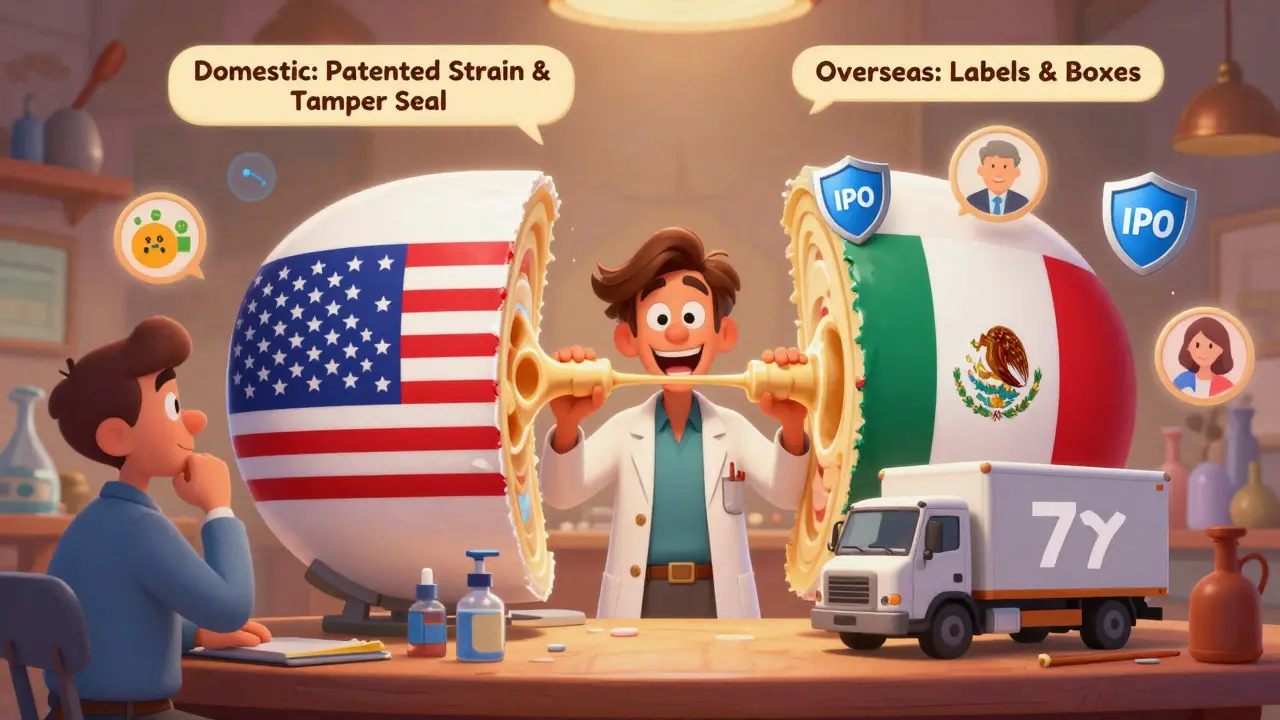
What Should You Do?
Ask yourself these questions:- Is speed critical? If you need to respond to market changes in days, not weeks, go domestic.
- Is your product safety-critical? If it’s ingested, injected, or worn on the skin, don’t gamble on overseas QC.
- Do you have IP to protect? If yes, keep the core production at home.
- Are you scaling fast? High volume? Then overseas might still make sense-for non-core parts.
- Can you afford to lose $50,000 on a bad batch? If not, you can’t afford to skip direct oversight.
Real-World Example: A Supplement Brand’s Choice
A small wellness brand in Colorado needed to produce 10,000 bottles of a new probiotic. They got two quotes:- Domestic: $6.50 per unit, 45-day turnaround, free sample approval, direct QA visits.
- Overseas: $2.30 per unit, 120-day turnaround, third-party inspection required, MOQ of 5,000.
Final Thought: It’s Not Either/Or
The future of manufacturing isn’t about choosing between home or abroad. It’s about building a smart, flexible system. Use domestic for quality-critical, time-sensitive, or IP-heavy products. Use overseas for high-volume, low-risk, non-core items. And always, always-know your supplier. Visit. Test. Verify. Don’t trust a quote on Alibaba. Trust what you see with your own eyes.Is overseas manufacturing always cheaper than domestic?
No. While labor costs overseas are significantly lower, hidden expenses like shipping, customs, inspections, delays, and quality failures often erase the savings. When you factor in inventory holding costs, expedited shipping, and lost sales from delays, the real cost difference for many products has narrowed to just 12-15%, according to MIT supply chain experts.
How long does domestic manufacturing take compared to overseas?
Domestic manufacturing typically takes 45 to 60 days from order to delivery. Overseas manufacturing averages 90 days or more-45-60 days for production plus 30-45 days for shipping, customs, and clearance. For time-sensitive products like seasonal health supplements, that extra time can mean lost revenue.
What are the biggest risks of overseas manufacturing?
The biggest risks are quality control failures, communication delays (22% of delays stem from language barriers), intellectual property theft (risk increases by 37% overseas), customs issues, and long lead times. Third-party inspections add cost and still don’t guarantee quality-1 in 3 overseas batches have unacceptable defect rates according to industry surveys.
Should I use a hybrid model for manufacturing?
Yes, for most businesses. A hybrid approach-making critical components like active ingredients or safety seals domestically and outsourcing packaging or non-essential parts overseas-is used by 44% of mid-sized manufacturers. This balances cost savings with quality control and IP protection.
Why is Mexico becoming a popular manufacturing option?
Mexico offers labor costs at 12-15% of U.S. rates, with shipping times of just 7-10 days-far faster than Asia. It shares a border with the U.S., has fewer language barriers, stronger legal protections than Asia, and similar regulatory standards. Many companies now use Mexico as a "China Plus One" alternative to reduce supply chain risk.
Do consumers care if a product is made domestically?
Yes. According to NielsenIQ’s 2024 survey, 68% of consumers are willing to pay 5-12% more for products made in the U.S. This is especially true in health and wellness, where trust in safety and ingredient sourcing drives purchasing decisions.
What’s the minimum order quantity for domestic vs. overseas manufacturers?
Domestic manufacturers often accept orders as small as 100-500 units, making them ideal for startups and small batches. Overseas manufacturers typically require 1,000-5,000 units minimum. This forces businesses to tie up capital in inventory and increases risk if the product doesn’t sell.
How do tariffs affect the cost of overseas manufacturing?
Section 301 tariffs on Chinese goods add 7.5% to 25% to the cost of many products, depending on category. These tariffs have significantly narrowed the traditional cost advantage of manufacturing in China, making domestic or nearshore options more competitive for a wider range of products.
Teresa Marzo Lostalé
December 29, 2025 AT 16:59Man, I just sat here thinking about how we treat factories like magic boxes that spit out perfect products. We don’t even know who’s screwing the caps on our supplements. It’s wild. We outsource trust. And then we’re shocked when it breaks. 🤷♀️
ANA MARIE VALENZUELA
December 29, 2025 AT 22:04Stop romanticizing domestic manufacturing. You’re just scared of global competition. That ‘certainty’ you talk about? It’s just a luxury for people who don’t care about margins. Your ‘4.8-star reviews’ don’t pay rent. I’ve seen too many small businesses die because they paid $7 per unit instead of $2.50. Wake up.
Bradly Draper
December 30, 2025 AT 03:14I run a tiny supplement brand. We switched to domestic last year. It cost more. But I can walk in, shake hands, and ask if the guy making my bottles had coffee that morning. That matters. Not because it’s patriotic. Because it’s human.
Gran Badshah
December 31, 2025 AT 14:14bro from india here… i worked in a factory that made stuff for usa. they paid us 100 rupees a day. your $2.10 unit? we made 100 of them in one shift. you think we care about your ‘seal integrity’? we care about eating. don’t act like this is moral. it’s just money.
Ellen-Cathryn Nash
January 1, 2026 AT 12:30It’s not just about cost-it’s about complicity. Every time you choose overseas for the ‘savings,’ you’re quietly endorsing exploitation. You want your probiotic to be safe? Fine. But don’t pretend you’re not okay with someone else’s child stitching your labels in a 90-degree warehouse with no AC. The guilt is real. And it’s yours.
Samantha Hobbs
January 2, 2026 AT 21:30my friend’s company used a factory in vietnam and the whole batch smelled like fish. like, actual fish. turned out they used the same tanks for fish oil and probiotics. no one told them. they just… didn’t ask. i’m not even mad. i’m just hungry for answers.
Kelsey Youmans
January 4, 2026 AT 12:05The notion that domestic manufacturing equates to superior quality is a myth perpetuated by marketing departments and nostalgic policymakers. The data on defect rates, when normalized for scale and oversight, shows negligible difference. What you’re paying for is psychological comfort-and the premium attached to the phrase ‘Made in the USA.’
Sydney Lee
January 5, 2026 AT 16:40Let’s be brutally honest: if you’re not manufacturing your core IP domestically, you’re not a manufacturer-you’re a distributor with delusions of grandeur. You’re outsourcing your soul to a factory that doesn’t speak your language, doesn’t care about your brand, and will replicate your product before your next invoice clears. This isn’t supply chain strategy. It’s corporate suicide dressed up as ‘efficiency.’
Debra Cagwin
January 5, 2026 AT 22:47For anyone feeling overwhelmed by this decision-start small. Don’t try to do everything domestically. Pick one thing. One critical component. Your seal. Your active ingredient. Your label. Master that. Then expand. You don’t need to rebuild your whole supply chain overnight. Just make one brave choice. And celebrate it. You’re not failing-you’re evolving.
Hakim Bachiri
January 6, 2026 AT 23:15USA! USA! USA! You think the Chinese don’t have quality control? They’ve been making your iPhone since 2007. You think your ‘domestic QA’ is perfect? Last year, 14% of U.S.-made supplements had illegal additives! But sure-let’s cry about ‘trust’ while we import $1.2 trillion worth of stuff every year. Wake up. It’s not about patriotism. It’s about profit. And guess what? Profit doesn’t care where your label says ‘Made in.’
Celia McTighe
January 7, 2026 AT 22:28I love how this post doesn’t just say ‘go domestic’-it says ‘think smart.’ 🤍 I’ve been using Mexico for packaging and labels for 2 years now. Same time zone, same laws, way faster than Asia. And my customers still see ‘Made in USA’ on the box. Win-win. Also, the owner of the factory in Tijuana sends me memes when my shipment’s delayed. We’re human. 😊
Ryan Touhill
January 9, 2026 AT 02:53Did you know the FDA doesn’t inspect 90% of overseas facilities? And yet, we’re supposed to trust them with our children’s vitamins? This isn’t capitalism-it’s a Ponzi scheme where the middle class pays for the elite’s convenience. And the ‘hybrid model’? That’s just a fancy word for ‘I’m too lazy to take full responsibility.’ Wake up. The system is rigged. And you’re part of it.