
When you're prescribed a medication that costs hundreds of dollars a month, and your insurance still leaves you paying $150 out of pocket, it's not just inconvenient-it's dangerous. Many people skip doses, split pills, or go without because they can't afford it. That's where prescription assistance programs from drug manufacturers come in. These aren't charity campaigns or vague promises-they're real, working systems designed to get life-saving drugs into the hands of people who need them, whether they're insured, underinsured, or uninsured.
How These Programs Actually Work
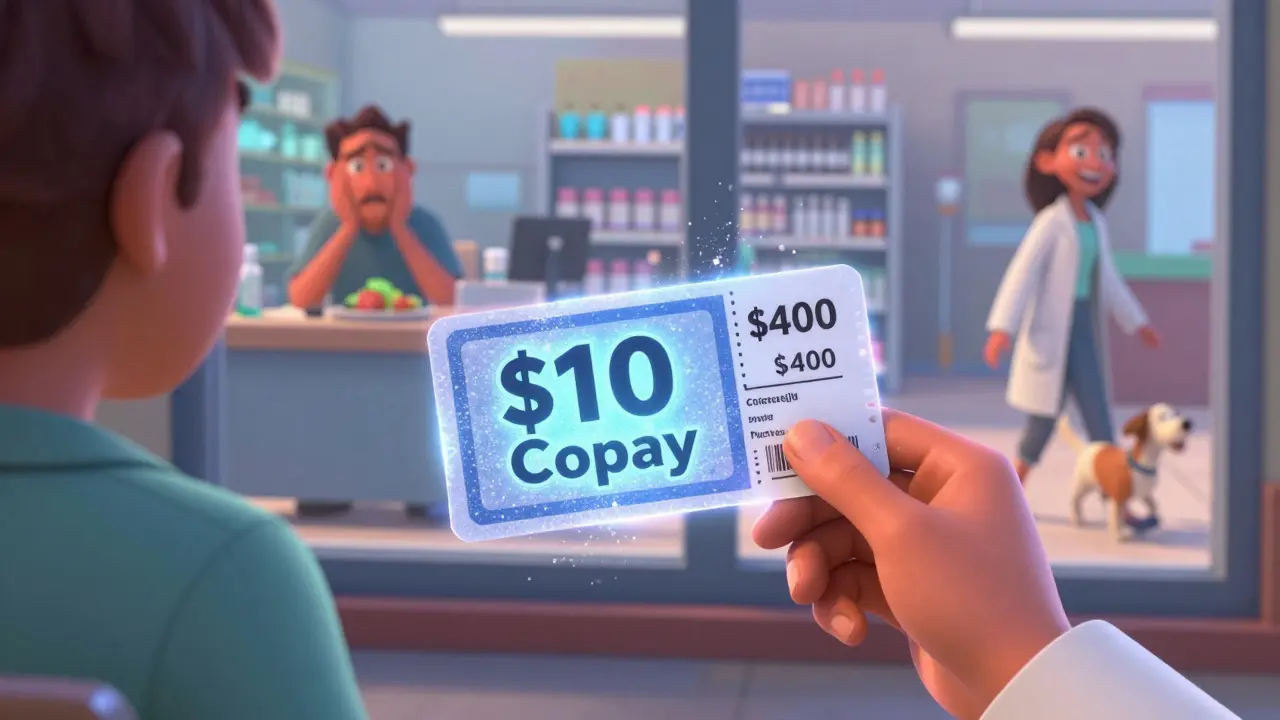
There are two main types of manufacturer-led assistance: copay assistance programs and Patient Assistance Programs (PAPs). They serve different people and operate in completely different ways.Copay assistance is for people who have private health insurance but still struggle with high out-of-pocket costs. These programs give you a card or coupon that cuts your copay dramatically-sometimes to just $10 or $15 per prescription. For example, if your asthma inhaler costs $400 and your insurance says you owe $120, the manufacturer's card might cover $110 of that, leaving you with just $10. These are common for specialty drugs like biologics for rheumatoid arthritis, multiple sclerosis, or cancer treatments. According to the Pharmaceutical Research and Manufacturers of America (PhRMA), 85% of specialty drugs now offer some form of copay help.
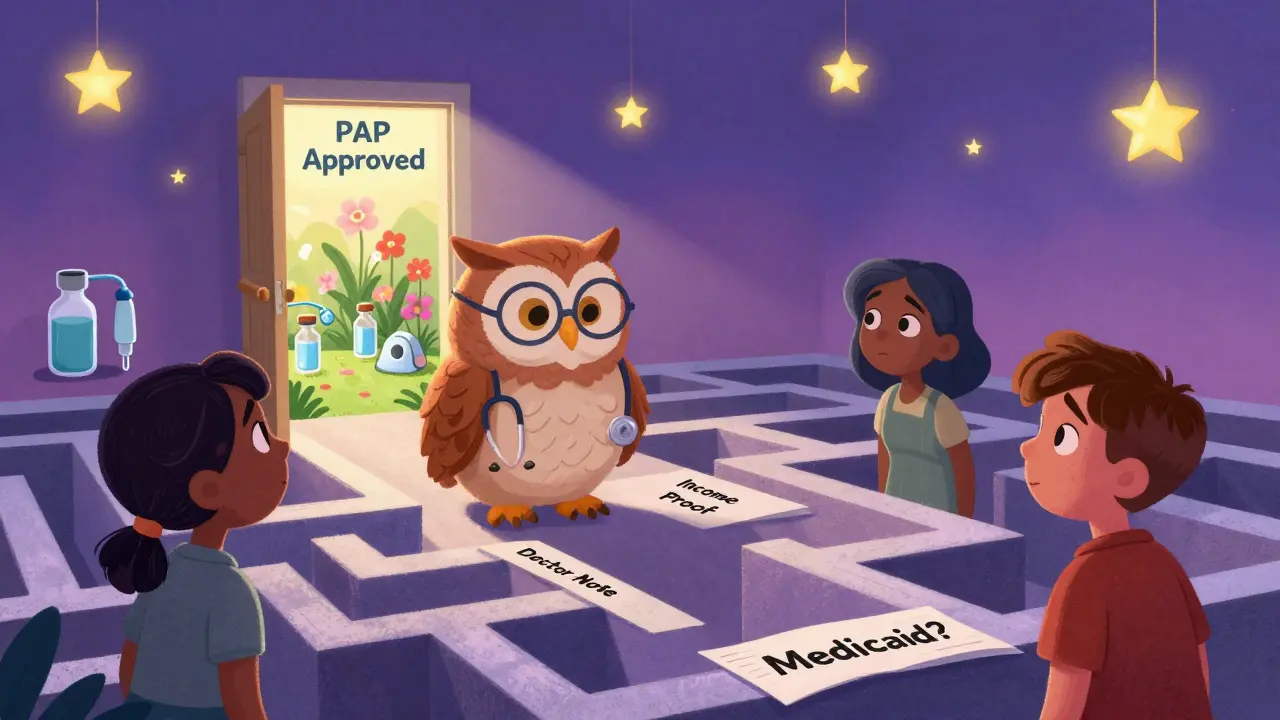
PAPs, on the other hand, are meant for people without insurance or with very limited coverage. If your income is below 400% of the Federal Poverty Level (about $60,000 a year for a family of four in 2023), you might qualify for free medication. Programs like Teva’s Cares Patient Assistance Program or Pfizer’s Patient Assistance Program provide full prescriptions at no cost. You don’t pay anything-not even a copay. You just submit proof of income, residency, and a doctor’s note confirming the prescription is medically necessary.
Who Gets Help and Who Doesn’t
Here’s the hard truth: not everyone qualifies. And the rules are messy.Copay assistance is great if you have private insurance. But if you’re on Medicare, Medicaid, or any other government program, you’re often locked out. Why? Because Medicare Part D doesn’t let manufacturer coupons count toward your deductible or out-of-pocket maximum. That means even if you use a $100 coupon to pay for your drug, it doesn’t help you get out of the coverage gap faster. In fact, it can make it worse-because you’re still spending more money over time without moving closer to catastrophic coverage.
And here’s another twist: 78% of state Medicaid programs ban copay assistance entirely. They argue it pushes patients toward more expensive brand-name drugs instead of cheaper generics. So even if you’re poor and on Medicaid, you might not be able to use a manufacturer coupon-even if it saves you hundreds.
PAPs have their own limits. While they help uninsured people, many programs won’t accept anyone with *any* prescription coverage-not even Medicaid or VA benefits. According to CMS guidelines, 62% of PAPs exclude patients with government insurance. That leaves a huge gap: people who are technically insured but still can’t afford their meds.
The Hidden Costs and Controversies
These programs aren’t perfect. In fact, they’re deeply controversial.Supporters say they save lives. PhRMA reports that in 2022, pharmaceutical companies gave out $24.5 billion in assistance to 12.7 million patients. Dr. Jane Smith from the Brookings Institution estimates that without these programs, over 2 million more Americans would stop taking their meds because of cost.
But critics point to a darker side. A 2022 study in JAMA Internal Medicine found that copay assistance programs push patients toward expensive brand-name drugs-even when cheaper, equally effective generics exist. The study estimated this behavior added $1.4 billion to total drug spending each year. It’s like giving someone a discount on a luxury car when a reliable sedan is right next to it.
There’s also a lack of oversight. The National Institutes of Health (NIH) noted in 2021 that no single agency tracks how many people use PAPs, how long they stay on them, or whether they’re actually improving health outcomes. There’s no accountability. And with 92% of major drugmakers running some kind of assistance program, the system is huge-but invisible.
How to Find and Apply for Help
You don’t need to be a expert to get help. Here’s how to start:- Identify your drug. Write down the exact name-brand and generic. If you’re on a brand-name drug, there’s a good chance help exists.
- Use the Medicine Assistance Tool (MAT). Run by PhRMA, this free, confidential site (medicationassistancetool.org) searches over 900 programs. Just enter your drug name, income, and insurance status. It will tell you exactly which programs you qualify for.
- For copay assistance: If you have private insurance, download the coupon or card. Bring it to the pharmacy when you fill your prescription. The pharmacist will apply it automatically.
- For PAPs: You’ll need to fill out a longer application. Most require: recent tax returns or pay stubs, proof of address, a signed form from your doctor, and sometimes a letter from your pharmacy. The process can take 45 to 60 minutes per application. Some programs take 2-4 weeks to approve.
- Ask your doctor or pharmacist. Many clinics have patient navigators who help with applications. Pharmacists often know which manufacturers offer help for specific drugs.
Don’t give up if you’re denied. Some programs allow appeals. Others have waiting lists. And if one drug’s program won’t help, another might.
What You Need to Know Before You Apply
There are common pitfalls most people don’t expect:- Annual limits. Many copay programs cap how much they’ll pay per year-$5,000, $10,000, sometimes $25,000. If your drug costs $1,200 a month, you might hit that limit by June.
- Monthly caps. Some limit you to $200 per month. That still leaves you paying hundreds.
- Income changes. If your income goes up next year-even a little-you might lose eligibility. Some programs require annual reapplication.
- Insurance changes. If you switch from private insurance to Medicare, your copay card might stop working overnight.
- Not all drugs are covered. Only brand-name drugs qualify. Generics rarely have assistance programs.
Also, awareness is low. A 2022 survey by the Patient Advocate Foundation found only 37% of eligible patients even knew these programs existed. That means two out of three people who could get help are paying full price.
The Bigger Picture
These programs exist because drug prices are broken. They’re not a solution-they’re a patch. A 2023 Congressional Budget Office report projected that by 2028, these programs will be helping over 15 million Americans, spending $34.8 billion a year. That’s money going directly from drug companies to patients, bypassing insurers, pharmacies, and even government programs.And while they’re helping millions, they’re also reinforcing a system where people rely on corporate charity just to stay alive. No one should have to fill out 10 forms just to get their insulin. But right now, that’s the reality.
For now, if you need help, use what’s available. Don’t wait until you’re choosing between your medication and your rent. The system isn’t fair, but the help is real-and it’s waiting for you.
Can I use manufacturer assistance if I have Medicare?
You can use copay assistance programs if you have Medicare, but the savings won’t count toward your Medicare Part D deductible or out-of-pocket maximum. This means you won’t move faster into catastrophic coverage. Some PAPs don’t accept Medicare patients at all. Always check the specific program rules.
Do I need to reapply every year?
Most PAPs require annual reapplication, especially if your income changes. Copay assistance cards usually renew automatically if you’re still eligible, but you should check with the program each year. Some programs send reminders; others don’t.
Can I use these programs if I’m on Medicaid?
In most cases, no. 78% of state Medicaid programs prohibit the use of manufacturer copay cards because they believe it encourages the use of expensive brand-name drugs over generics. PAPs also often exclude Medicaid recipients. However, a few programs may still help if you have no other prescription coverage-so it’s worth checking.
How do I know if a drug has assistance?
Use the Medicine Assistance Tool (MAT) at medicationassistancetool.org. Enter your drug’s name and your insurance status. It will show all available programs, including eligibility rules and links to apply. You can also ask your pharmacist-they often have brochures or digital access to these programs.
Are there any free services to help me apply?
Yes. Many nonprofit organizations like the Patient Advocate Foundation and the American Diabetes Association offer free case managers who help patients fill out applications, gather documents, and appeal denials. Your doctor’s office may also have a patient navigator on staff. Don’t try to do it alone-help is available.
What if I’m denied help?
Denials happen, but they’re not final. Call the program directly and ask why you were denied. Sometimes it’s a simple paperwork error. You can appeal with updated documents. If you’re still stuck, contact a patient advocacy group-they often have experience fighting these decisions.
Philip Blankenship
February 17, 2026 AT 21:01Man, I’ve been down this road before-my mom’s on a biologic for RA, and without the copay card, she’d be choosing between her meds and groceries every month. I didn’t even know these programs existed until her pharmacist pulled up the MAT site one day. It’s wild how little most people know about this stuff. The system’s a mess, sure, but if you take 20 minutes to fill out one form, you can save someone’s life. I wish more docs just handed out printed guides with prescriptions instead of assuming patients ‘know how to navigate.’
Liam Earney
February 19, 2026 AT 06:33...I just... I mean... it’s not even a question of whether these programs exist... it’s that they exist at all... and we’re supposed to be grateful?... for corporate charity?... while drug companies report record profits?... and Congress sits on its hands?... and we’re told to ‘just apply’?... as if paperwork is a cure?... as if bureaucracy is compassion?... I’m not angry... I’m heartbroken... and exhausted... and frankly... I’m done pretending this is a system... instead of a spectacle... of human suffering... masked as innovation...
Adam Short
February 20, 2026 AT 21:36This whole thing is a joke. America lets pharmaceutical giants charge $10,000 for a vial of insulin while people die on sidewalks-and then we pat ourselves on the back for letting them give out ‘assistance’? It’s not help, it’s PR. In the UK, we just put it on the NHS and call it healthcare. No forms. No coupons. No ‘eligibility.’ You get the drug because you need it. Not because your income is under 400% of poverty. Not because you have private insurance. Because you’re sick. That’s it. We don’t need charity-we need justice. And until we stop treating medicine like a luxury product, this ‘system’ is just a Band-Aid on a hemorrhage.
Linda Franchock
February 20, 2026 AT 22:57Okay, real talk: if you’re reading this and you’re on Medicare, don’t panic. I’ve helped three friends navigate this, and yes, the copay card doesn’t count toward your out-of-pocket max-but you can still use it to lower your monthly cost. And if you’re denied a PAP? Call them. Ask for the supervisor. They’re humans too. Also-your pharmacist? They’re your secret weapon. Most have a spreadsheet of which programs are currently accepting applications. Don’t be shy. And if you’re on Medicaid? Check the fine print. Some states have exceptions. I’ve seen it happen. It’s not fair. But it’s not hopeless. You’re not alone.
Kancharla Pavan
February 21, 2026 AT 08:01Let me be clear: this entire system is a moral failure disguised as a safety net. People are being told to beg for their own survival from the very corporations that price-gouged them into this position. And now we’re supposed to be impressed that they’re offering $10 coupons? That’s not compassion-that’s calculated PR. The fact that 62% of PAPs reject Medicaid patients is a direct result of policy designed to protect profits. This isn’t about access-it’s about control. The government lets drug companies set prices, then lets them ‘help’ the people they’re exploiting. It’s a pyramid scheme with syringes. And we’re the ones filling out the forms.
Dennis Santarinala
February 22, 2026 AT 13:21I just want to say-thank you for writing this. I’ve been scared to talk about this because I didn’t want to sound ungrateful, but honestly? I’ve been using a PAP for my diabetes meds for two years now. It’s the only reason I’m still here. I didn’t know about MAT until last year. I cried when I found out I qualified. It’s not perfect. It’s not fair. But it’s real. And if this post helps even one person find their insulin? That’s worth everything. Please don’t stop sharing this. We need more voices like yours.
Betty Kirby
February 23, 2026 AT 07:13Wow. Just wow. You really think giving someone a $10 coupon for a $1,200 drug is ‘help’? That’s not assistance-that’s a slap in the face with a tissue. And you call this ‘system’? It’s a carnival game where the prize is staying alive. People don’t need ‘tips’ on how to fill out forms-they need their drugs to cost less. This isn’t a story about access. It’s a story about exploitation. And you? You’re just the cheerleader for the people who made this mess.
Josiah Demara
February 24, 2026 AT 15:13Let’s cut through the noise. You want to know why these programs exist? Because drug companies know they can’t legally raise prices 100% year over year anymore-so they create these ‘charity’ programs to inflate the perceived value of their drugs. They pay out $24 billion in assistance? Great. That’s $24 billion in tax write-offs. That’s $24 billion in PR that lets them claim they ‘care.’ Meanwhile, they’re still charging $1,500 for a pill that costs $2 to make. And you’re praising them for giving you a discount? You’re not a beneficiary-you’re a pawn. The only thing that will fix this is price caps. Not coupons. Not applications. Not ‘patient navigators.’ A federal law that says: ‘This drug costs $50. Period.’ Everything else is theater.