
The FDA doesn’t stop checking on a drug the moment it hits the pharmacy shelf. In fact, that’s when the real work begins. Around 10,000 prescription and over-the-counter drugs are available in the U.S. after approval, but clinical trials-often involving just a few thousand people over months or a couple of years-can’t catch every possible side effect. Some reactions only show up in millions of users over years. That’s why the FDA runs one of the most complex drug safety systems in the world, tracking drugs long after they’re sold.
Spontaneous Reporting: The Foundation of Drug Safety
The backbone of the FDA’s system is the FDA Adverse Event Reporting System (FAERS). Since 1969, this database has collected over 30 million reports of side effects, medication errors, and product quality issues. These reports come from doctors, pharmacists, patients, and drug manufacturers. Healthcare providers are encouraged, but not required, to report serious reactions. Manufacturers, however, must report any serious or unexpected side effect within 15 days-under federal rules 21 CFR 310.305 and 21 CFR 600.80.
But here’s the catch: most reactions go unreported. Studies show FAERS captures only 1% to 10% of actual adverse events. Why? Many doctors don’t know how to report. Others feel it’s too time-consuming. Patients often don’t connect a new symptom to a drug they’ve been taking for months. A 2023 study found that patients submitted just 6% of FAERS reports. Doctors made up 63%. Manufacturers, 31%.
That’s why the FDA doesn’t rely on FAERS alone. It uses advanced tools to find patterns in the noise. Algorithms like Empirical Bayes Screening (EBS) and Proportional Reporting Ratio (PRR) scan millions of reports to flag unusual clusters. For example, if a rare blood disorder suddenly shows up in 50 reports for one drug but only 2 for all others, the system lights up. That’s a signal.
Active Surveillance: Watching Millions in Real Time
In 2008, the FDA launched the Sentinel Initiative-a game-changer. Instead of waiting for reports to come in, Sentinel actively pulls data from electronic health records, insurance claims, and pharmacy databases covering over 300 million people. That’s more than 90% of the U.S. population.
With Sentinel, the FDA can ask questions like: “Are people taking Drug X more likely to have a stroke within 30 days than those taking Drug Y?” It can track outcomes in real time. This isn’t guesswork-it’s science. In 2023, Sentinel had access to data from 190 million covered lives, far more than Europe’s EudraVigilance system, which covers about 100 million.
By 2024, Sentinel 2.0 added genomic data from 10 million patients through partnerships with major biobanks. This lets the FDA see if certain genetic profiles make people more prone to side effects. For example, a drug might be safe for most people but dangerous for those with a specific gene variant. Sentinel makes that discovery possible.
Technology That Sees What Humans Miss
Manually reviewing 30 million reports is impossible. That’s why the FDA built InfoViP, its Information Visualization Platform. Launched in 2019 and upgraded to InfoViP 3.0 in late 2023, this tool uses machine learning and natural language processing to scan reports, extract key details, and group similar events.
Before InfoViP, it took an average of 14 months to identify a serious safety signal. Now, it takes 6.2 months. False alarms dropped by 19%. The system can now detect subtle trends-like a small uptick in liver damage among elderly patients on a new diabetes drug-that would’ve slipped through the cracks before.
These tools don’t replace experts-they empower them. The FDA’s Office of Surveillance and Epidemiology has teams of epidemiologists, pharmacologists, and data scientists who dig into flagged signals. They don’t just look at numbers. They review medical records, talk to clinicians, and compare outcomes across populations.
When Risks Outweigh Benefits: What the FDA Does Next
Finding a signal is only step one. The FDA must decide: Is this a real risk? And if so, what should we do?
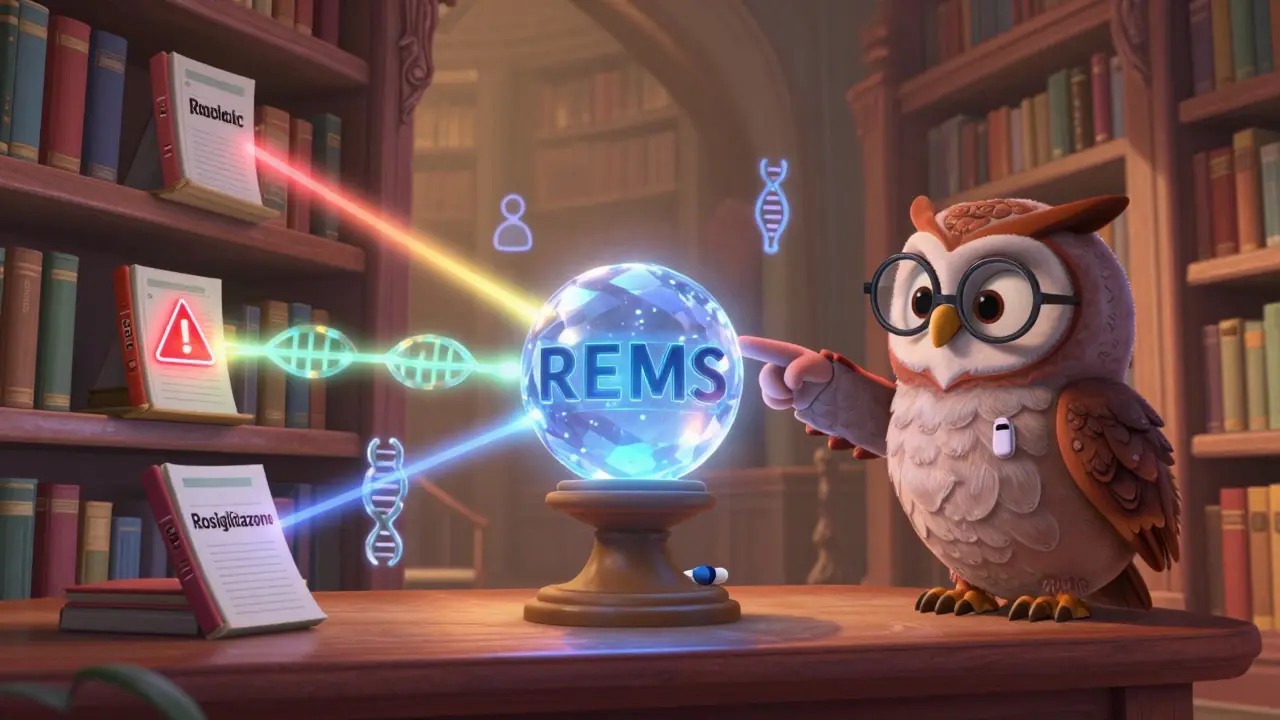
For high-risk drugs, the agency can require a Risk Evaluation and Mitigation Strategy (REMS). As of January 2024, 78 drugs had active REMS programs. These might include:
- Restricted distribution (only certain pharmacies can dispense)
- Prescriber certification (doctors must complete training)
- Patient education materials
- Regular blood tests to monitor for side effects
For example, the blood thinner warfarin has a REMS because it can cause dangerous bleeding. Patients must get frequent INR tests. The drug is still available-but only under strict controls.
In extreme cases, the FDA can issue a safety alert, require a label change, or even pull a drug off the market. In 2021, the FDA removed the diabetes drug rosiglitazone from the U.S. market after long-term data showed increased heart attack risk. The decision wasn’t made overnight. It took years of surveillance, multiple studies, and expert reviews.
Where the System Falls Short
Even the best system has gaps. One big problem: drugs with low usage. If only 50,000 people take a rare disease medication, it can take over four years to detect a safety signal. The FDA’s own data shows that for drugs with fewer than 100,000 users, the average detection time is 4.7 years.
Another issue: delayed studies. The Food and Drug Administration Amendments Act of 2007 required drugmakers to complete postmarket safety studies within agreed timelines. But a 2021 JAMA Internal Medicine study found only 58% were finished on time. The average delay? Over three years.
And then there’s the staffing problem. As of January 2024, the FDA’s Office of Surveillance and Epidemiology was operating at just 82% capacity. With new therapies like gene treatments and mRNA drugs exploding onto the market, the workload is growing faster than the team.
Patients also remain largely disconnected. A 2022 survey by the National Organization for Rare Disorders found that 72% of rare disease patients didn’t know how to report a side effect. Many think it’s the doctor’s job-and they’re right, in part. But patients are the first to notice changes in how they feel. If they don’t report, the system misses critical clues.
What’s Next for Drug Safety?
The FDA isn’t standing still. By 2025, it plans to integrate data from the National Institutes of Health’s All of Us Research Program, which includes 1 million participants from diverse backgrounds. This will help identify safety issues in underrepresented groups-something past trials often missed.
A blockchain-based reporting pilot is also in the works. The goal? To make reporting tamper-proof and faster. Imagine a patient logging a side effect directly from their phone app, and the data instantly reaches the FDA without delays or lost paperwork.
By 2030, experts predict 75% of safety signals will come from active surveillance like Sentinel-not passive reports. That’s a huge shift. It means the FDA will be predicting problems before they become crises.
But none of this works without funding. The global pharmacovigilance market is projected to hit $12.3 billion by 2028. In the U.S., companies spend an average of $2.8 million per drug annually on safety monitoring. The FDA’s budget, however, hasn’t kept pace. Without more resources, the system risks being overwhelmed by the complexity of modern medicines.
What You Can Do
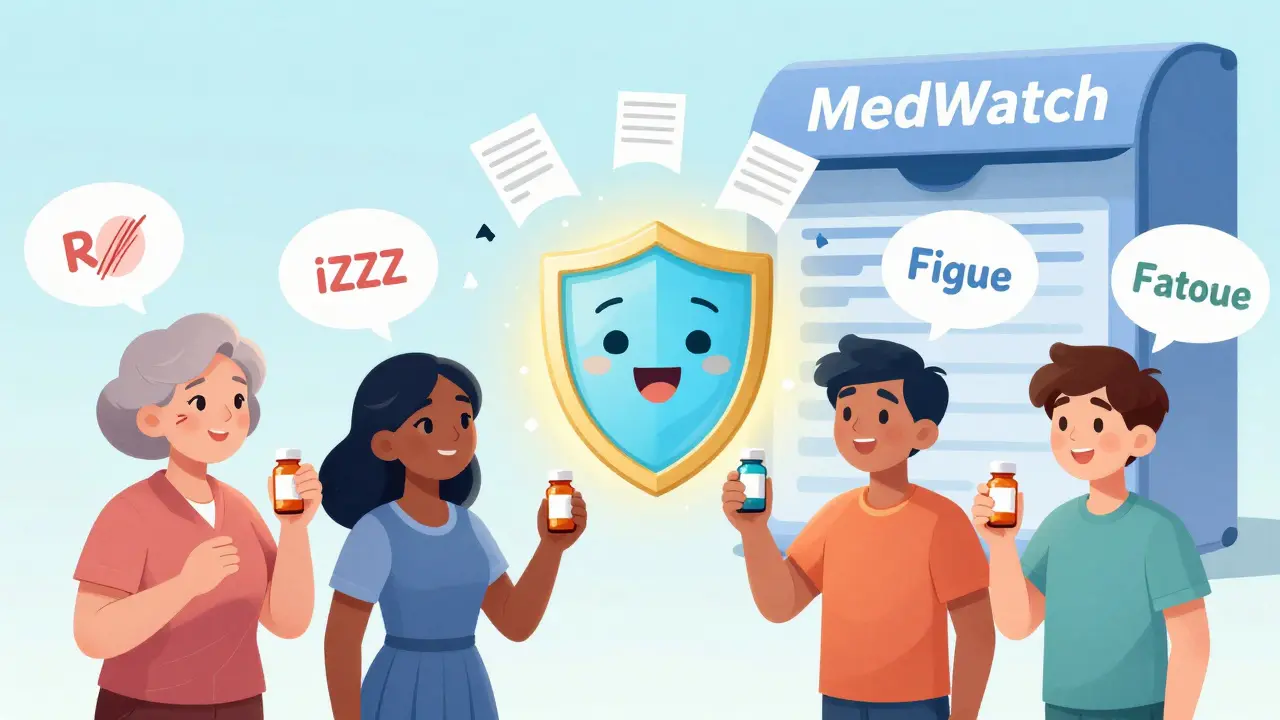
If you’re taking a medication and notice something unusual-dizziness, rash, fatigue, mood changes-don’t ignore it. Talk to your doctor. Ask if it could be related to your drug. Then, report it.
Reporting is simple. Go to the FDA’s MedWatch website. Fill out a form. It takes about 17 minutes, on average. Your report could help save someone else’s life.
And if you’re a patient with a rare disease, ask your provider about reporting tools. You’re not just a user-you’re part of the safety net.
How long does it take for the FDA to detect a dangerous side effect after a drug is approved?
It varies. For widely used drugs, signals can appear within months. For drugs taken by fewer than 100,000 people, detection can take up to 4.7 years on average. The FDA’s Sentinel system has cut detection time from 14 months to 6.2 months for many drugs by using real-time data from electronic health records.
Do drug companies have to report side effects?
Yes. Under federal regulations, manufacturers must report serious or unexpected adverse events to the FDA within 15 days. They must also submit periodic safety reports every 6 to 12 months. Failure to report can result in fines or legal action.
Can patients report adverse drug reactions themselves?
Absolutely. Patients can submit reports through the FDA’s MedWatch website or by calling 1-800-FDA-1088. While only 6% of reports come from patients, every report matters. Your experience helps the FDA spot patterns that doctors might miss.
What is a REMS program?
A Risk Evaluation and Mitigation Strategy (REMS) is a safety plan required by the FDA for certain high-risk drugs. It can include special training for doctors, restricted distribution, mandatory blood tests, or patient education. As of 2024, 78 drugs in the U.S. have active REMS programs.
Why doesn’t the FDA catch all dangerous drugs before approval?
Clinical trials involve thousands of people, but not millions. Rare side effects-like one in 50,000-can’t be seen in small studies. Also, trials are short. Long-term risks, like cancer or heart damage that appears after 10 years, only show up after the drug is used widely. That’s why postmarket surveillance is critical.
swati Thounaojam
January 7, 2026 AT 20:19Just reported my weird rash from that new blood pressure med-took 10 mins on MedWatch. Hope it helps.
Manish Kumar
January 8, 2026 AT 21:20Think about it-human bodies are like quantum systems, right? Every reaction is probabilistic, not deterministic. The FDA’s system is basically trying to map chaos with spreadsheets. We’re collecting data from millions of unpredictable biological machines, and we expect patterns? That’s like trying to predict which leaf will fall first in a hurricane. The real truth? We’re just guessing with better software. And don’t get me started on how we treat patients as data points instead of people with lived experience. We need to stop pretending this is science and start admitting it’s art with algorithms.
Dave Old-Wolf
January 10, 2026 AT 04:50I never realized how much goes into this. My aunt took that diabetes drug for years and never knew she could report side effects. Now she does. It’s wild how much we rely on patients noticing stuff doctors miss. Makes you wonder how many people are still suffering silently because they don’t know how to speak up.
Prakash Sharma
January 11, 2026 AT 17:05USA still leads the world in drug safety. No other country has Sentinel or InfoViP. India? They can’t even track fake medicines properly. Stop comparing. We’re building the future while others still use paper logs.
Kristina Felixita
January 12, 2026 AT 21:38OMG, I just found out I can report side effects myself?? I’ve been ignoring my headaches since I started the new pill… I’m going to do it right now!! Thank you for this!! 🙏
Joanna Brancewicz
January 14, 2026 AT 11:47FAERS sensitivity is low, but specificity is high. The PRR and EBS algorithms reduce false positives significantly. Still, confounding by indication remains a major limitation in passive surveillance.
Ken Porter
January 15, 2026 AT 14:33Why are we even doing this? If you take a drug, you accept the risk. Stop making it a government problem. Just let the market decide.
Annette Robinson
January 16, 2026 AT 15:28This is so important. Thank you for explaining how the system actually works. I used to think the FDA just approved drugs and walked away. Now I see how much effort goes into protecting us. I’ll make sure to report anything unusual from now on.
Luke Crump
January 18, 2026 AT 12:32Oh wow, so the FDA is just a glorified data miner with a fancy name? They're not curing anything-they're just collecting our pain like trading cards. And now they want blockchain? Next they'll be NFTing our side effects. This isn't safety. It's surveillance capitalism with a white coat.
Evan Smith
January 20, 2026 AT 02:56So… you’re telling me I could’ve saved someone’s life by reporting my weird sleepwalking after that anxiety med? Yeah, I didn’t think it was a big deal. Guess I’m a bad citizen now. 😅
Lois Li
January 21, 2026 AT 00:27It’s crazy how many people don’t know they can report. I’ve been telling my support group about MedWatch for years. If you’re reading this and you’ve felt something off-don’t wait. Don’t assume it’s ‘just you.’ It might be the key that unlocks a discovery for someone else.
christy lianto
January 22, 2026 AT 10:56My mom died from a reaction no one saw coming. This system saved my sister’s life when they pulled the drug after 3 reports. Don’t underestimate your voice. Even if it’s one line-it matters.
Aubrey Mallory
January 23, 2026 AT 02:24It’s not just about technology-it’s about trust. If patients don’t believe the system will act, they won’t report. And if regulators don’t communicate clearly, no amount of AI will fix that.
Donny Airlangga
January 24, 2026 AT 11:46Really appreciate the breakdown. I work in pharmacy and see how overwhelmed staff are. Reporting feels like an extra chore-but now I get why it’s worth it. I’ll start reminding patients more often.
Molly Silvernale
January 25, 2026 AT 05:56The FDA’s system is a cathedral built on whispers-each report a faint echo in a vast, echoing hall. And yet, from these murmurs, miracles emerge: a pattern, a pause, a warning. We are not just users-we are the quiet chorus that keeps the machine from sleeping. Let your voice be the ripple that becomes the wave.